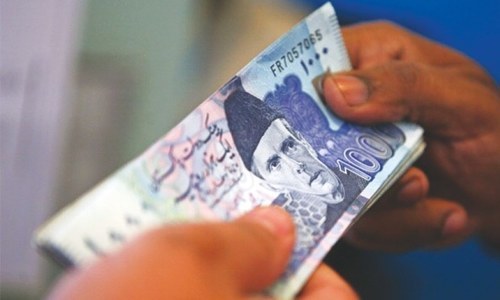
KARACHI: Overseas Pakistanis sent remittances amounting to $9.7 billion in the first half of 2017-18, up 2.5 per cent from the same period of the previous fiscal year, the State Bank of Pakistan (SBP) reported on Wednesday.
Despite a wide gap in the dollar rates in open and banking markets, overseas Pakistanis preferred to send money mostly through the banking channel. This reflects their confidence in the government as well as banks operating in Pakistan.
The open-market rate is Rs1.50 to Rs2 per dollar higher than the banking rate. This makes the illegal channel highly attractive for remitters. Yet few overseas workers used it to send money to Pakistan.
Another encouraging development was the year-on-year increase in remittances in July-December 2017 compared to the negative growth of 1.9pc in the similar period of the preceding year.
Remittances from all important destinations, except Saudi Arabia, showed a positive growth. Inflows from the kingdom declined 7.5pc during the period under review against a decline of 5.5pc a year ago. Pakistan received $2.53bn from Saudi Arabia in the last six months.
Due to the drive by the Saudi government to provide its own citizens with jobs, thousands of Pakistanis have lost their jobs in recent months — a fact that is reflected in the fall in remittances.
Pakistan still enjoys good relations with the kingdom, but the government has failed to address the issue of layoffs with its Saudi counterpart.
Despite tense relations with the United States, remittances from the country noted a growth of 9.2pc to $1.28bn during the six months.
Inflows from the United Kingdom recorded an increase of 23pc to $1.35bn. Remittances from these two countries posted a negative growth of 10pc and 12pc, respectively, in the same period of the previous fiscal year.
The second highest inflows were from the United Arab Emirates, which increased 1.13pc to $2.2bn. Pakistan received $1.13bn from the members of the Gulf Cooperation Council, excluding Saudi Arabia and UAE, during the six-month period.
In December 2017, remittances amounted to $1.72bn, up 9.3pc from the preceding month and 8.7pc from a year ago.
Remittances are an essential and vital part of the economy. The country has been facing a widening current account deficit mostly because of a trade imbalance that is almost equal to exports.
However, there is no effort by the government to improve the export of manpower to the Gulf region, which is dominated by Indian citizens.
Recent volatility in the exchange rate also indicates the increasing importance of remittances. The local currency depreciated by 5pc last month while the open market remained in the grip of wild fluctuations.
The government is trying to keep foreign exchange reserves at a reasonable level, which is mandatory for maintaining global credit ratings. It borrowed $2.5bn through bonds during the current fiscal year.
Published in Dawn, January 11th, 2018