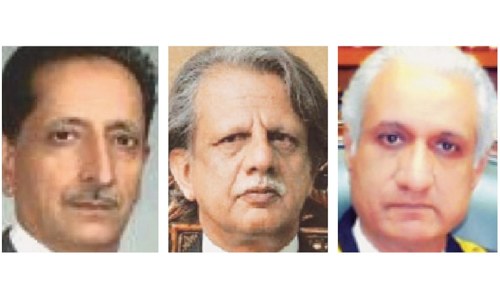
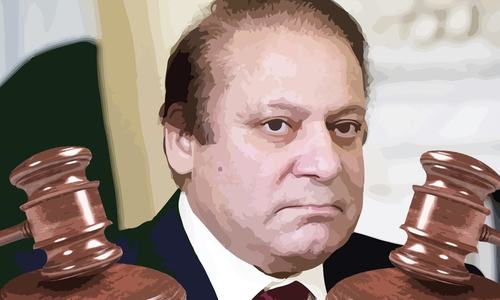
A special bench of the Supreme Court (SC), which will be overseeing the implementation of the Panama Papers case verdict, on Wednesday rejected the nominees from the Securities and Exchange Commission Pakistan (SECP) and the State Bank of Pakistan (SBP) for the joint investigation team (JIT) that will probe Prime Minister Nawaz Sharif and his sons' business dealings abroad.
The SC had, by a majority verdict of three to two, ordered the constitution of a JIT to probe the assets of the incumbent prime minister.
In an April 20 order, the five-judge bench hearing the Panama Papers case had requested Chief Justice of Pakistan Mian Saqib Nisar to constitute a special bench to ensure the implementation of the judgement.
The special bench includes the three judges who handed down the majority judgement in the Panama Papers case: Justice Ejaz Afzal Khan, Justice Sheikh Azmat Saeed and Justice Ijaz-ul-Ahsan.
Justice Khan, who heads the special bench, said it had rejected the names of officials nominated by the SBP and SECP because they did not meet the court's criteria.
The court wants a transparent investigation, Justice Khan asserted, adding: "We want honest and professional officials to be members of the JIT."
The court also directed the SECP chairman and SBP governor to appear in the next hearing with lists of all officers of Grade 18 and above working in the two organisations.
Justice Sheikh Azmat Saeed said the bench had asked for the lists so that they could pick the JIT members itself.
"No one will be allowed to play games with the court," he added.
The third member of the bench, Justice Ijaz-ul-Ahsan, said the court would also not stand any excuses or delays during the implementation of its orders.
The next hearing of the case has been scheduled for Friday, May 5, 2017.
Earlier today, the federal government had appointed Riaz Riazuddin as the acting SBP governor after Mahmood Ashraf Wathra's tenure ended April 28 and the central bank chose not to renew his contract.