2
2
KARACHI: Finance Minister Ishaq Dar announced on Monday a road map for the promotion of Islamic financing.
Addressing the World Islamic Finance Forum (WIFF), organised by the Institute of Business Administration-Centre for Excellence in Islamic Finance (IBA-CEIF), Mr Dar said the government was willing to promote the Islamic finance and economic system.
“We are ready. That is why I had formed a steering committee at the State Bank of Pakistan (SBP) to develop comprehensive reports and strategies soon after assuming the office,” he said.
It shared its research findings with the government, he said while announcing the formation of the implementation committee.
The implementation committee will consist of the SBP governor and deputy governor, Securities and Exchange Commission of Pakistan (SECP) chairman, secretary of the law ministry, and chairmen of the Institute of Chartered Accountants of Pakistan (ICAP) and Institute of Cost and Management Accountants (ICMA).
The objective of the two-day conference is to evolve a viable path for the promotion of Islamic financing and the identification of solutions for the challenges in Islamic finance. Scholars, bankers and Shariah experts from several Islamic countries attended the first global Islamic conference organised by IBA-CEIF.
“This is the road map. We will achieve the goal, but we must understand that we can’t get rid of the interest-based system overnight,” Dar said, adding that the process will be gradual.
“We have Rs19 trillion debt. How can we change it overnight?” he said, adding that he was ready to chair the implementation committee.
The minister said Islamic financing is in its evolutionary phase. “A lot needs to be done by using the latest technology to reach the target,” he said.
He suggested that industry players should come up with innovative products in view of energy and infrastructure projects under the China-Pakistan Economic Corridor (CPEC).
Earlier, Meezan Bank Shariah Board Chairman Taqi Usmani expressed concerns over the way Islamic banking has been growing. “The aim must not be to develop a financial system parallel to conventional banking. Rather, it should be to eliminate the interest-based system,” he said.
He demanded that a complete road map, with a time-frame for the phased elimination of interest-based system, should be furnished.
Speaking on the occasion, International Centre for Education in Islamic Finance First Holder Dr Abbas Mirakhor said all members of the Organisation of Islamic Cooperation (OIC) depend on the conventional interest-based system.
He said currently Islamic financing is based on risk-shifting, which is more dangerous than risk transfer. In the financial crisis of 2007-08, risks were shifted and the taxpayers had to bear the cost, he said.
“The essence of Islamic financing is risk sharing, which is not applied anywhere in the Islamic world,” he said.
SBP Governor Ashraf Mahmood Wathra explained the central bank’s role in the promotion of Islamic finance. He said Islamic finance will increase the financial inclusion among the poor and reduce inequality.
CEIF Chairman Dr Ishrat Husain and Islamic Research and Training Institute (IRTI) Director General Dr Azmi Omar also spoke on the occasion.
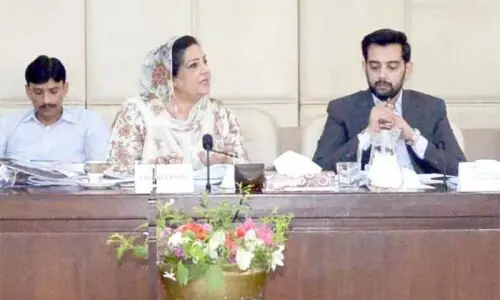
Our Equities Correspondent adds: Speaking at a seminar on the Draft Companies Bill 2016, Mr Dar said it is important for Pakistan to show its presence in the international bond and sukuk markets to attract foreign investment.
He expressed satisfaction over the bill, saying it will be beneficial for the Securities and Exchange Commission of Pakistan (SECP) and the stakeholders besides leaving a positive impact on the economy.
He appreciated the work done by the SECP and emphasised the need for a continued review of corporate laws and reforms in accordance with the best international practices.
He also stressed upon keeping the economy separate from politics. He said many reforms were introduced in the last three years by the SECP, State Bank of Pakistan (SBP) and Federal Board of Revenue (FBR).
He noted that Pakistan has enormous potential for growth and the key lies in dedication and will. He also highlighted the macroeconomic stability achieved in the last three years.
Leading corporate sector professionals attended the seminar. Institute of Chartered Accountants of Pakistan (ICAP) President Hafiz Mohammad Yousaf, ICAP former president Masood Naqvi and SBP Deputy Governor Saeed Ahmad also spoke on the occasion.
The seminar focused on creating awareness about the important features of the bill. The major focus of the bill is on the facilitation of the corporate sector and other stakeholders as well as strengthening of the regulatory framework, emphasis on the use of technology, abolition of unnecessary requirements and protection of the interest of shareholders.
Published in Dawn September 6th, 2016