1
1
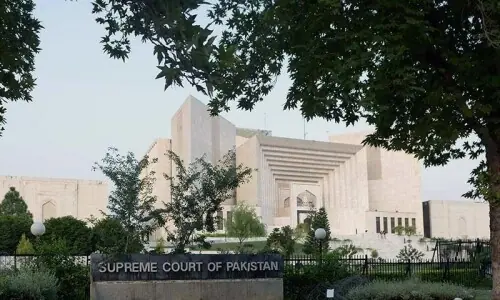
KARACHI: The Sindh police’s high rate of closing murder cases, including those pertaining to the targeted killings of lawyers, on Thursday irked the Supreme Court that ordered the authorities to submit details of all the cases declared ‘A-Class’ — or closed — for want of evidence since 2000 in Karachi.
Headed by Chief Justice of Pakistan Anwar Zaheer Jamali, a three-member bench was conducting the suo motu proceedings on the targeted killing of lawyers in the province, particularly in the city, at the SC’s Karachi registry.
The bench that also comprised Justice Amir Hani Muslim and Justice Maqbool Baqar expressed extreme annoyance over the inefficient investigation by police in murder cases and rejected a police report over slow progress made into investigation of cases of targeted killing of lawyers in Karachi.
The police report of cases in which progress was not made was presented to the judges by the city police chief, Additional Inspector General Police, Karachi, Mushtaq Mahar.
Expressing grave displeasure over the police report, CJP Jamali remarked that the court had sought details of all the A-Class cases and not only those related to lawyers’ killings.
Justice Muslim remarked that hundreds of cases had been declared A-Class three to four days after registration of the FIR and put into the ‘cold storage’.
The hearing of the case was adjourned to the next sitting of the bench at the Karachi registry.
Earlier, the police had submitted a report on lawyers’ killings stating that 42 different murder cases were registered and as many as 30 charge-sheets were filed in the trial courts.
It said that accused persons in two cases were convicted, while 10 other cases were declared A Class.
Thar drought case
The same bench put off the hearing of another suo motu proceedings on the drought-hit Thar after the additional health secretary submitted his report.
The report said that the total population of Thar was 1.299 million and it contained six taulkas and 48 union councils.
It said that several post of doctors were lying vacant in three major taulkas — Diplo, Nagarparkar and Chachro.
The report said that rural health centres were established in two hospitals in Mithi, while 31 basic health units and 18 dispensaries were also present in the famine-hit district of the province.
Quoting officials records, the health department report further said that pathological tests of as many as 24,594 patients were conducted, while a large number of patients were also given facility of ultrasound and X-ray.
It said that as many as 10,074 patients were hospitalised in different medical facilities in the district.
The bench would take up the matter in the next sitting at the Karachi registry.
Published in Dawn, October 23rd, 2015
On a mobile phone? Get the Dawn Mobile App: Apple Store | Google Play