0
0

KARACHI: “If you want to invest in gold, you’re at the wrong place. But if you want to buy jewellery, Sarafa Bazaar is the place to be,” says Haji Abbas of Arafat Jewellers, a small shop among the other small ones at the entrance to the biggest gold market in the city situated in Kharadar.
“The jewellery is made from 21 carat gold while the gold biscuits are pure 24 carat. Then for jewellery we will also add our making charges, around Rs600 to 800 according to skill, which won’t be counted if you are reselling it. So it’s always better to invest in biscuits,” he says.
 |
| All that glitters ... |
As you walk down the narrow winding roads of this market, you are treated to sights you wouldn’t normally see at or near other jewellery shops in the city’s posh areas.
There is Abdul Ghaffar heating up his chemicals over charcoal before polishing a locket and some bangles. “Karachi’s salty air robs gold and silver of its shine. This doesn’t happen so often in Punjab but here we are always polishing and re-polishing,” he says while first scrubbing the bangles with a detergent to get the dirt off. About the main chemicals used for polishing jewellery, he mentions “cyanide”, one’s cue to move away from his workshop.
You come across a workshop after every few jewellery shops. But the others are mostly goldsmiths’ workshops. What is it that they say about hundred blows of a goldsmith? “Melting gold is the first step to producing jewellery,” says Fahad Siddiq, the goldsmith working with his little pots of gold.
 |
| Bead-work by skilful hands. |
Mohammad Hanif busy in intricate bead-work nearby says that he has been working at Sarafa Bazaar for years. When asked what has he seen change over these years, he only laughs, “The colour of my hair and inflation. There was a time, beta ji, when gold was Rs500 per tola [11.66 grams], and now it is Rs49,000,” he says.
Nearby, Hunain Nadeem and his brothers run a shop of pretty, velvet and satin jewellery boxes. “We are the third generation selling boxes in this market. We also supply in bulk to other jewellers in other areas,” says Hunain.
 |
| Washing pieces of jewellery before polishing them. |
Most of the boxes in the shop are red and maroon. “Well, red and maroon contrast well against gold,” the young shopkeeper reasons.
Meanwhile, Ms Anusha is there selecting from the latest kundan designs. “I have come here from Clifton,” she says. “I know there are plenty of shops in Clifton, and Saddar and Tariq Road, too, for that matter, but we have been coming to Sarafa Bazaar since my great-grandmother’s time,” she says while sipping a cold drink offered to her by the jeweller.
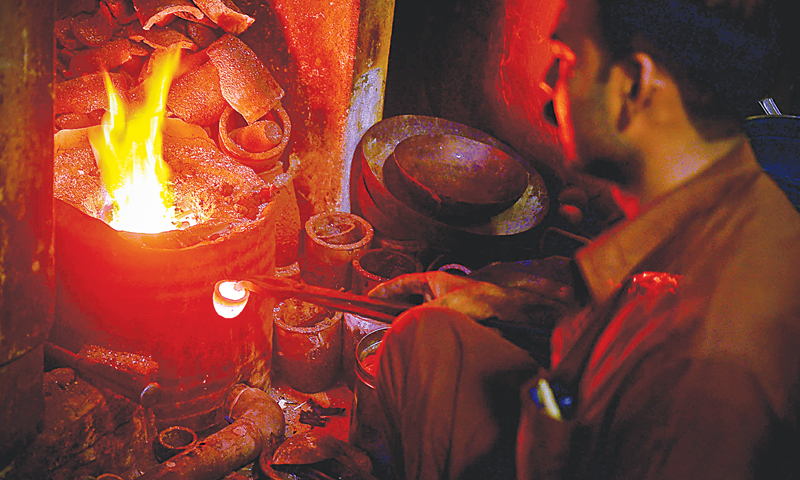 |
| Melting gold. |
Being served cold drinks, tea or coffee is another thing commonly seen at the jewellers. Ghaffar Chottani laughs. “We only offer beverages to our customers once we see them interested in a jewellery set,” he says.
“Earlier, before the creation of Pakistan, Sarafa Bazaar was a very different market than what it has come to be now. Then all the jewellery shops here were owned by Hindus. Only one shop, that of Juma Ibrahim, belonged to a Muslim and he was famous for making one tola gold guineas. The shops here also weren’t all selling jewellery. There were also cosmetic, cloth and sweetmeat shops here. But after partition, when most of the Hindus migrated to India, the Muslims who came here decided to open only jewellery shops in the market,” says Haji Haroon Chand, president of the All Sindh Jewellers Association.
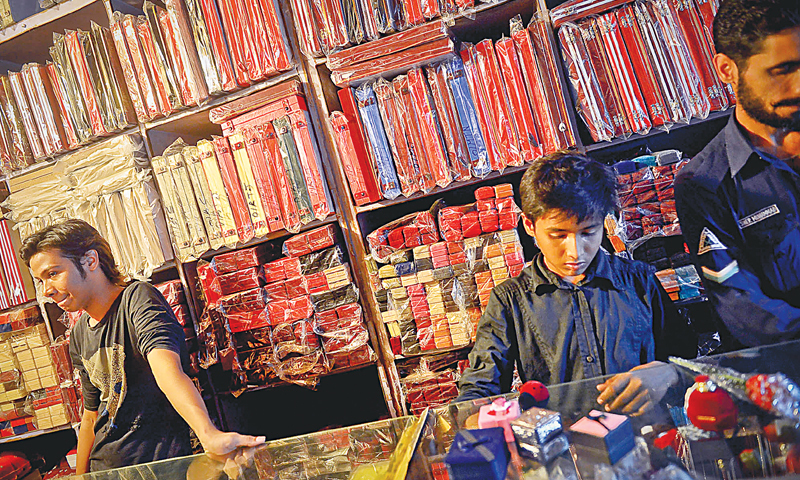 |
| Jewellery boxes sell better than the jewellery. |
“This market has seen very good days. People from all over Europe used to visit here and the old stone buildings here, reminiscent of the British Raj, added to the charm. But as time passed, new buildings and shops came up in place of the old ones. The customers also became fewer because of the gang warfare in the vicinity. But now business is once again picking up after the improving of the security situation here.”
 |
| The narrow winding lanes of Sarafa Bazaar. |
Published in Dawn, August 31st , 2014