0
0
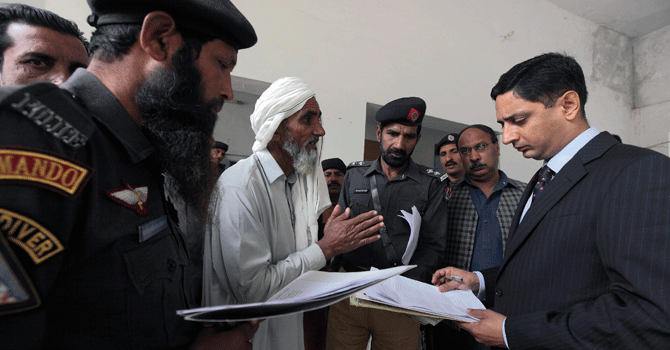
RAHIM YAR KHAN: Sohail Zafar Chattha set the tone for his tenure as police chief in Punjab’s Rahim Yar Khan town by launching Operation Clean Up, an audacious assault on river bandits featuring a home-made floating bunker he nicknamed "The Shark".
Eighteen months on, the no-nonsense officer faces a tougher test: keeping the peace in the home town of Malik Ishaq, who co-founded the sectarian militant outfit Lashkar-i-Jhangvi (LJ) In 1996.
"I'm not a Scotland Yard officer. This is hard-core policing," Chattha said at his official residence in Rahim Yar Khan, the main town in a district of sugar cane plantations and mango orchards along the Indus River.
"I'm a fair referee, and a referee who sometimes shows the red card. You break the law, then you will be taken to task."
Since the start of the year, militants have staged devastating bombings in Shia neighbourhoods in Quetta and Karachi, seeking to enflame tension in a country where a violent militant fringe has eroded once robust traditions of tolerance.
In the past month, Chattha has been forced to defuse an unusual spike in incidents of shootings and beatings involving Ishaq's followers and members of the Shia community in Rahim Yar Khan, a placid-looking district of more than four million people where different sects once lived in harmony.
While nobody has been killed in the fracas, and there is no appetite for bloodshed among the vast majority of residents, people here say tension is at its highest since a far worse bout of sectarian violence erupted in Punjab in the 1990s.
Punjab's administration ordered Chattha to put Ishaq in jail for a month under public order laws in February after LJ claimed responsibility for a series of blasts in Quetta that killed almost 200 people. Police say they have arrested more than 150 of his suspected sympathisers.
But with religious radicals campaigning openly in the province ahead of the polls, it has fallen to Chattha to ensure that a spark in the farming town of Rahim Yar Khan does not ignite a powder-keg in Punjab.
"It's a game of nerves: You have to be assertive, and non-partisan," said Chattha, an articulate man who enjoys discussing political philosophy as much as dissecting the finer points of policing Punjab. "It could spiral out of control."
"It’s already started"
Chattha's troubles can be traced to July 2011, when judges ruled there was insufficient evidence to continue to detain Ishaq who had spent 14 years in jail on 44 murder charges. Ishaq returned to Rahim Yar Khan to a rapturous welcome from followers brandishing assault rifles.
Since his release, Ishaq has sought to leverage his position as vice-president of Ahle Sunnat Wal Jamaat (ASWJ), an increasingly strident but faction-ridden party, to carve out a niche in national politics.
Ishaq's son Usman, who is also an ASWJ activist, said his father was not involved in militancy.
"Malik Ishaq and his organisation have nothing to do with killing, murder and terrorist activities," Usman Ishaq said, speaking by telephone after going into hiding following his father's most recent arrest. "We believe in harmony and peace."
Tension flared in Rahim Yar Khan on February 10 when Ishaq sent his followers to hold a rally near the village of Rukan Pur, Chattha said. Armed Shia residents set up firing positions with sandbags on rooftops in anticipation of Ishaq's arrival, while dozens of his supporters gathered in a nearby field.
Chattha said he deployed two armoured vehicles and scores of police to act as a buffer, but Shias fired shots from the village, wounding two of Ishaq's men. A series of beatings by both sides followed, and then about 30 of Ishaq's supporters roared into Rahim Yar Khan on motorbikes.
Members of the Shia community, on the other hand, said the mob beat six members of their sect in the street.
"One of them shouted: 'He's also a Shia! Kill him!'," said Syed Abbas Raza Naqvi, a travel agent, who was attacked while driving his motorbike with his three children riding pillion.
"I would have been killed if my kids hadn't begged them for mercy," he said, displaying welts on his back.
Naseem Abbas, a barber, said the gang burst into his shop several hours later and pistol-whipped him around the head, while chanting insults.
Scenes of the charred aftermath of the Quetta and Karachi blasts have revived memories of a bombing that killed almost 20 people in a Shia procession at a nearby village in early 2012, leaving the community even warier of Ishaq's followers.
"He (Ishaq) has no popular support, but as an organisation they are becoming more influential," said Shiekh Manzoor Hussain, a prominent Shia leader, speaking at a mosque complex in Rahim Yar Khan fronted by a towering gold-tinted archway.
"Clean up"
Even as the state has fumbled for a response to Ishaq, Chattha has proved he can take an unflinching approach to crime when given a free hand by Punjab's provincial government.
In Operation Clean Up, Chattha ordered his men to fortify a barge and affix four 75-horsepower Yamaha engines and a pair of anti-aircraft guns - creating the "Rahim Yar Khan Shark". Awed brigands capitulated and his men became the first police to set foot on their island hideout in 37 years.
"It was very strong, it could conquer anything," Chattha said, flicking through photos of the squat-looking craft and himself leading the mission on horseback. "It was a military operation, we camped for two months on the river."
As a result, Chattha said the number of reported kidnappings in the district fell from 456 in 2010 to zero last year.
Human rights groups, however, suspect Punjab police routinely commit extra-judicial killings of suspects – partly out of frustration at judges' frequent failure to convict.
In 2011, up to 337 people were killed across the country in what are termed "encounters" between police and criminals, according to the Human Rights Commission of Pakistan, which questions whether officers often use excessive force.
Chattha says such allegations are baseless and that the deaths of five of his men in clashes with gangsters since he took over in Rahim Yar Khan in September 2011 underscore the danger they face.
Chattha's combative approach to conventional outlaws throws the Punjab government's failure to control sectarian hate-mongering into sharper relief. He estimates Ishaq's inner circle in Rahim Yar Khan numbers fewer than 20 hardened members, only a handful of whom have received serious weapons training.
Any officer or judge who dares to confront militants can expect swift retaliation against themselves or their family.
Interior Minister Rehman Malik last week questioned why the provincial government had allowed Punjab to become a "safe haven" for LJ.
Rana Sanaullah, Punjab's law minister, who appeared alongside ASWJ leaders at a by-election rally in 2010, said the PML-N had no need to turn to religious groups for support in Punjab.
Sanaullah said authorities had found no link to connect Ishaq to blasts in Quetta or Karachi and that Malik's remarks were politically motivated.
"It's a conspiracy to trigger hatred of Punjab amongst other provinces," Sanaullah told Reuters.