0
0

LONDON: The Arab world has recently gone through its most anxious period since the start of the Arab spring 19 months ago. People held their breath before their television screens, awaiting the outcome of the Egyptian presidential election. Only when the success of the Muslim Brotherhood and revolutionary forces candidate, Muhammad Morsi, over Hosni Mubarak's prime minister, Ahmad Shafiq, was announced did people start to breathe freely again. The weeks that preceded Morsi's victory were laden with despair. Far from being a symbol of hope, the Arab spring suddenly felt like a bad omen.
There were media campaigns targeting revolutionary forces, especially the Muslim Brotherhood, splits in revolutionary ranks, and public infighting — all conspiring to paint a forlorn picture. Everything changed when the Supreme Council of the Armed Forces (Scaf) thought that the revolution had ended and that the time was ripe for a coup. It issued five decrees, including the dissolution of parliament and the creation of a constitution transferring legislative power to the military council. An enforcement law allowed members of the armed forces to arrest civilians.
Shortly before the second run-off, when it became clear to Scaf that Morsi was about to win, it hastened to issue two further decrees: the first forming a secretariat that curtailed the powers of the president, and the second creating a higher council for defence, to be staffed mainly by military personnel.
The military's decisions infuriated the Egyptian public, and the wider Arab world. In a strange way, however, they also benefited the Brotherhood and the revolutionary forces, rescuing them from their growing disarray. They helped them overcome internal divisions and form an understanding.
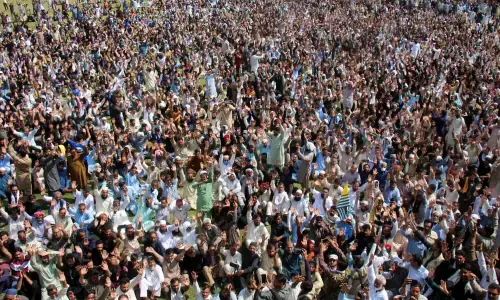
This change in mentality became apparent when Morsi announced that the office of the prime minister would not be given to a member of the Muslim Brotherhood. Vice-presidents would also be appointed from a range of political forces. This has reassured the revolutionaries and driven people back to the place where it all started — Tahrir Square.
Morsi being declared president means that the revolution now has three institutions: the presidency, the parliament and the square. Two of them, the parliament and the presidency, are consistent with the legitimacy of the democratic elections. As for the square, it has its own revolutionary legitimacy. The destiny of the three is intertwined.
This is what prompted the revolutionaries to continue with their sit-in, even after Morsi's presidency was announced. The confrontation with Scaf is not over: it has merely entered a new phase, in which the people appear to be armed for the first time with both determination and legitimacy. The Arab spring is stronger today than at any time in its history; in not only Egypt, but also the entire Arab world.
It needs to be pointed out that the reaction of the international community towards these developments has been pathetic. In general, western governments remained silent over Scaf's attempts to sabotage the democratic process. The only exceptions were a few timid signals from the American administration and the European Union.
To the people in the street, the rest of the world's reaction has merely confirmed their suspicions, namely that western governments still indulge in double standards in their approach to the democratic changes in the Arab world. The region's people still recall the staunch support those countries lent to tyrannical regimes for decades. And it will not have gone unnoticed how western governments remained silent for several hours after Morsi's victory. Only when Paris took the initiative to congratulate the first democratically elected president in the history of Egypt did Washington follow.
Let's hope that the Egyptian people's determination to finish their revolution will one day remind western powers where their true interest should lie: not with military-backed fantasies of supposed stability, but with legitimitely elected governments.
By arrangement with the Guardian