0
0
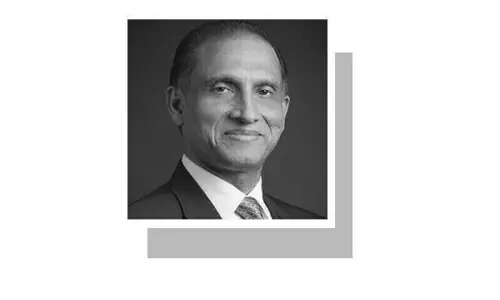
NEW YORK Saying that `war is not an option` former Pakistan`s United Nations Ambassador Munir Akram called on India and Pakistan to restart composite dialogue to resolve the festering Kashmir dispute and tackle the terrorism issue.
Speaking to a large audience of India and Pakistani Diaspora at the Asia Society, after he was forced to withdraw last month from a discussion on the impact on India-Pakistan relations by the Mumbai terrorist attacks, Akram observed any war between India and Pakistan would be devastating for the region.
Rejecting the doomsday scenario for Pakistan in which Pakistan could be divided in four parts —Baluchistan, Sindh, Punjab and NWFP—Akram expressed belief that both countries should try and deal with terrorism through the mechanism they have established, with sincere efforts, not posturing.
Conceding that Pakistan had consistently supported the Kashmiri peoples struggle for the right to self-determination, Akram expounded at length about how their liberation struggle took shape and referred to several occasions when India backed away as the two countries came close to a settlement.
Unless there was an amicable resolution of Kashmir dispute, Mr Akram felt that some groups would continue to act in support of the Kashmiri people suffering at the hands of India occupation forces.
In the absence of any significant progress towards a final settlement, Pakistan would not be in a position to decisively act against such groups because the cause was too popular. Only a Kashmir settlement could empower Pakistan to finish them off, said Akram.
Earlier, Ashutosh Varshaney, professor of Political Science at Brown University suggested that Islamabads anti-India stance was keeping the country united, not Islam, which, he claimed, was dividing Pakistan.
However, he quickly added he does not agree with the right-wing view that Pakistan should be disintegrated to bring about stability in the region.
Reacting to Prof Varshaney`s suggestion that Pakistan was sponsoring terror groups Akram told him that Indias record on this count was tainted. Terrorism was not a new phenomenon in South Asia, it has existed for decades.
Akram refreshed the memory of the audience referring to the Bhinderwales Sikh terrorist group which was created by the Indian intelligence as also the LTTE terrorists who were now biting back India.
Now, he said, India was involved in destabilising Balochistan. The Baluchistan Liberation Army was trained and financed by the Indian intelligence and Pakistan had proof of its complicity. The BLA has been engaged in sabotage activities in the province causing death and destruction.
Munir Akram said that most jihadi groups were the off-shoots of Afghan Mujahideen who were backed by the United States and Pakistan to fight the Soviet invasion of Afghanistan.
The US abandoned the battle hardened and heavily armed Mujahideen after the objective was achieved, with some of them linking up with groups devoted to the Kashmiris` struggle.
Following US invasion of Afghanistan, the Pushtuns, some of whom had taken refuge on the Pakistan side of the border, organised resistance. Under US pressure, Pakistan sent troops to its tribal areas and now they have turned their guns on Pakistan.
Nicolas Platt, a former US ambassador to Pakistan and a former President of Asia Society, in his remarks rejected that disintegration of Pakistan theory which many Indian writers maintain could resolve the terrorism problem .
He asserted that the disintegration of Pakistan was not on the cards, nor was it in any bodys interest.
He said the US was not going to act as a mediator but would encourage India and Pakistan to settle their disputes through negotiations.
He said he believed that the aim of the group that carried out deadly attacks in Mumbai was to set India against Pakistan when their relations were improving.
He urged both sides to remain calm and keep the doors of communications open.