0
0
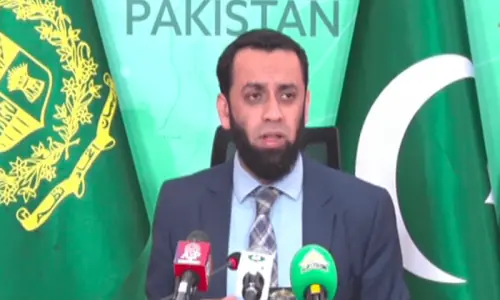
ISLAMABAD: The Foreign Office on Friday expressed the hope that India’s new government would promote peace and address the Kashmir dispute, underscoring Pakistan’s commitment to regional stability.
FO Spokesperson Mumtaz Zahra Baloch, while speaking at a media briefing, said, “We hope that India will take steps to create a conducive environment for advancement of peace and dialogue and resolution of long-standing dispute for the mutual benefit of the peoples of Pakistan and India.”
Despite cobbling together the required numbers in Lok Sabha to form the government, BJP’s subdued performance in the polls means it will have to heavily rely on regional parties’ support. This shift, coupled with a strong opposition, signals a more complex political environment for the ruling alliance. Pakistan has so far not congratulated PM-designate Modi on his party’s success in polls awaiting, what the spokesperson said, the completion of “the process of formation of government”.
Ms Baloch refused to comment on India’s electoral process, saying “it is the right of the people of India to decide about their own leadership”.
Though there has been a steady deterioration in ties between the two countries since Mr Modi first assumed office in 2014, the spokesperson noted that his action of stripping Occupied Jammu and Kashmir of its autonomous status and annexing it with India in 2019 “vitiated the bilateral environment”. She highlighted that “vitriolic rhetoric” against Pakistan was prominently used during the recent elections.
The spokesperson emphasised that despite ongoing challenges in relations with India and the hostile rhetoric emanating from there, Pakistan has consistently chosen to respond responsibly.
“Pakistan has always desired cooperative relations with all its neighbours including India. We have consistently advocated constructive dialogue and engagement to resolve all outstanding issues, including the core dispute of Jammu and Kashmir,” Ms Baloch said.
“Pakistan believes in peaceful coexistence. We want peace and stability in the region,” she added.
She reiterated that superficial electoral exercises in India-held Jammu and Kashmir cannot alter the reality prescribed by international law, which mandates that the future of Kashmir is to be determined by its people in accordance with the UN Security Council resolutions.
Published in Dawn, June 8th, 2024