2
2

KARACHI: Russia is the largest country in the world by area and the 10th largest in terms of gross domestic product. But Pakistan’s bilateral trade with such a major regional economy has been minimal of late, averaging out at $420 million a year since 2004.
But the problem is more acute — the trade between the two countries in 2015 failed to meet even the modest standards, languishing at a mere $381m compared to $454m in 2014, according to a recent research report prepared by the Pakistan Business Council (PBC).
For Pakistan, the only bright spot is that the trade balance has been in its favour since 2010.
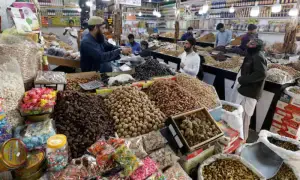
Russia imported goods worth $285m from Pakistan last year; the bulk of these imports comprised fruits, vegetables, cereals and apparel.
However, indicative potential for Pakistan’s exports to Russia stands at $24.5 billion, indicating the huge market that exists in Russia for commodities exported by Pakistan, the report said.
The commodities Pakistan can potentially export to Russia include women’s and men’s trousers and shorts (of cotton, not knitted), petroleum oils and preparations, instruments and appliances used in medical or veterinary sciences, and Portland cement with a potential of $758m, $422m, $315m and $311m, respectively.
In contrast, Pakistan’s imports from Russia were $95.7m in the preceding year, consisting mainly of paper and paperboard, vegetables, iron and steel, inorganic chemicals and machinery.
The top items that Pakistan can potentially import from Russia include ‘other’ petroleum oils and preparations ($6.2bn), petroleum oils and crude ($5.6bn), and light petroleum oils and preparations ($2.2bn). Some of the other products include iron and steel ($561m), residues and waste from the food industries ($316m), fertilisers ($287m) and pharmaceutical products ($280m). The overall import potential stands at $47.3bn, the PBC report said.
Islamabad’s trade with Moscow has shrunk despite Russian President Vladimir Putin’s “pivot-to-Asia” policy which, though dates back to 2011, has been bolstered by Western economic sanctions in the aftermath of Ukrainian crisis, and plunging oil prices.
Published in Dawn, May 22nd, 2016