14
14

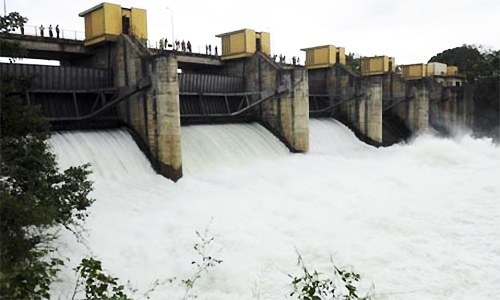
GARHI DUPATTA (Muzaffarabad): With a Rs404 billion funding for a strategic 969-megawatt Neelum-Jhelum Hydropower Project (NJHP) in sight and physical progress in advance stages, the Water and Power Development Authority (Wapda) wants the federal government to charge mark-up on foreign loans at par with provinces to ensure economic and commercial viability of cheaper sources of power generation.
“Financial constraints of the project are over now. Financing is no more an issue. All arrangements are now in place,” said Chairman Wapda Zafar Mahmood at the completion ceremony of two headrace tunnels. The ceremony was held 200 feet under the Jhelum riverbed where the tunnel was connected from two sides with amazing engineering precision.
He said it was perhaps the first project in the world which was close to 80 per cent off physical progress without a financial close.
Wapda wants government to charge mark-up on foreign loans on a par with provinces
Under the existing arrangements, foreign loans secured for Wapda projects at 2-5pc interest rate were generally re-lent to Wapda at 15pc as compared to provinces which get them re-lent at actual rate charged by the foreign lenders, he said.
Wapda has requested the government to re-lend foreign loans on mark-ups like those of the provinces because all costs have ultimately become part of the tariff.
Member finance of Wapda, Anwarul Haq, explained that the National Bank of Pakistan (NBP) was mandated only a week ago to arrange Rs100bn through financial institutions and 40pc of commitments from banks had already been achieved. “We need around Rs30bn until March for necessary payments and these funds are already available,” he said.
Mr Mahmood said the project had achieved 78pc progress as of Feb 17, with an expenditure of Rs250bn. Besides the NBP financing, China Exim Bank, Islamic Development Bank and Kuwait Fund loans were also lined up. It is expected to start power generation tests in December 2017 and contribute its energy to the national grid by the following high-flow season, he said.
An engineering marvel, the project involves 68 kilometres of underground tunnels to divert Neelum river waters underneath the Jhelum riverbed. Project CEO Muhammad Zubair said 90pc of the project would be underground, hence any “indecent haste can cause an irreparable loss”.
The project involved three river diversions at different times and maximum overburden of the project was around 1.7km, meaning that the highest mountain peak over the project was 1.7km. Apart from over 200 local staff, around 1,443 Chinese workers were currently working on the site and a few other experts from the UK, US and other nationalities.
A total of 22 people have lost their lives and 178 injured during the project implementation so far because of repeated rock bursts and sandstone falls.
The project will produce 5.15bn units of electricity. The 68km tunnel system involved 19.6km stretch of headrace twin tunnels and ten access tunnels. The intake of the project is Nauseri, 41km east of Muzaffarabad and power house located near Chattar Kalas, around 22km south of downstream Muzaffarabad.
Responding to a question, the Wapda chairman explained that the verdict of international arbitrators on Kishenganga Hydropower allowing India to divert Neelum waters to Wullar Barrage would impact only 5pc of project output.
He explained that about 77pc of water to Neelum at Nauseri (the dam site) was contributed by local tributaries and only 23pc came from across the line of control. India would have to release at least 9 cumecs downstream under the arbitration award.
Praising the commitment and professional expertise of the project authorities, the contractor and the consultants, the Wapda chief expressed satisfaction over the pace of construction work. He said the authority was confident to complete first generating unit of the project in mid-2017 and the rest of the three units in a phased manner by December 2017.
Mr Zubair, the project CEO, said the redesigned composite dam and the spillway were 74pc and 100pc complete, respectively. About 60.5km of the 68km-long tunnels (88pc) had been excavated. The power house and the switchyard were expected to be completed in November this year, he added.
Published in Dawn, February 19th, 2016