1
1
WEDNESDAY’S devastating suicide bombing in Quetta serves as a painful reminder that despite advances, religious militancy remains a major security threat to Balochistan.
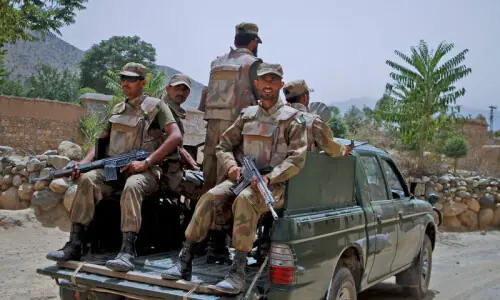
Most of the victims of the attack were police personnel deputed to guard polio vaccination teams. An anti-polio vaccination drive was under way in Balochistan on the day of the bombing. To their credit, the authorities resumed the anti-polio campaign soon after the tragedy.
The banned TTP has claimed responsibility for the atrocity. It seems that with the bombing, terrorists have struck two of their ‘favourite’ targets: members of law-enforcement agencies, as well as the anti-polio campaign.
The bombing occurred the day after the new Balochistan cabinet took oath; indeed, the Sanaullah Zehri-led provincial set-up has its work cut out for it on the law and order and counterterrorism fronts.
Over the past several years, the province has suffered from a low-level separatist insurgency along with sectarian terrorism. However, last year, after the formulation of the National Action Plan, like elsewhere in Pakistan there seemed to be perceptible movement on the anti-militancy front. Provincial officials claimed “thousands” of militants had been arrested.
While some observers point out that most of these were quite likely Baloch separatists, it is a fact that religiously motivated and sectarian militants were also apprehended. Moreover, some high-profile sectarian militants were eliminated in Balochistan in 2015; their numbers included Usman Saifullah Kurd, a provincial ‘commander’ of Lashkar-i-Jhangvi.
But while sectarian killings may indeed have come down, especially compared to the situation in 2013 when massive bombings targeting the Hazara Shia community resulted in hundreds of deaths, the infrastructure of religiously motivated militancy very much appears to be intact in Balochistan, as Wednesday’s bombing shows.
The significance of militants targeting security officials guarding polio teams also cannot be overlooked. Last year, significant gains were made in the fight against polio, with far fewer cases reported as compared to 2014.
Hence, the momentum of the anti-polio drive should be maintained and security for the vaccinators beefed up. The civil and military leadership must reassess the threat posed by religiously motivated militants to Balochistan. Intelligence-based operations need to be stepped up to dismantle what remains of the terrorist infrastructure in the province. Balochistan is far from pacified.
The gains made in the realm of security in the recent past should not be squandered, and terrorism and militancy of all shades must be eliminated in the province.
Published in Dawn, January 14th, 2016