THE more things change, the more they remain the same — unless some brave individuals challenge the status quo, and unless political ambitions are in danger of being thwarted.
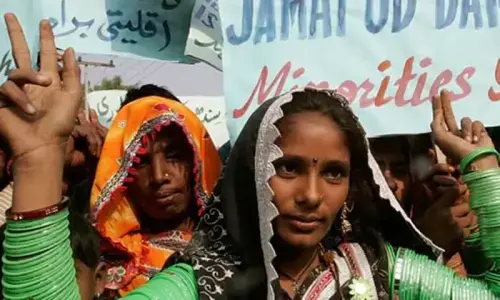
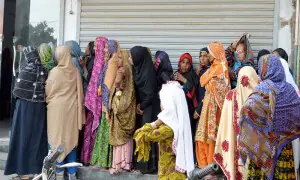
The local government elections in Punjab on Thursday were edifying in several respects where female franchise is concerned.
In village Laliani, Sargodha district, residents maintained their execrable, decades-old practice of disallowing their women to vote. Mauza Mohripur in Khanewal district would have also witnessed complete female disenfranchisement, had it not been for one woman, Fauzia Talib, who defied tradition and voted.
Meanwhile, a rather different scenario was observed in the Paikhel union council of Mianwali where women are also prevented from exercising their right of franchise as a matter of course.
Here, a rumour that the ECP would hold re-election in any UC where 20pc of women voters did not cast their ballot, prompted candidates to hurriedly set aside what they earlier considered a venerable tradition, and allow women to vote.
A patriarchal society does not easily let go of customs based on antediluvian notions of honour; it fears that any expression of personal opinion on the part of its women will spill over into other aspects of life and undermine the very bedrock of its existence.
However, the Mianwali incident illustrated how swiftly ‘tradition’ can be cast aside when it is politically expedient to do so, which only serves to highlight the rank hypocrisy that underlies this smokescreen.
Meanwhile, the example of Ms Talib shows there are courageous individuals who are willing to stand up to misogyny and unjust customs: the ECP must reinforce their stand by imposing such sanctions as allowed by law against those who violate the electoral code.
In the run-up to the general elections in 2013, the body had made it abundantly clear it would not tolerate any attempt to disenfranchise women, often achieved through agreements among local candidates and right-wing pressure groups.
To its credit, it has followed through in some instances — with salutary effect. Most recently, it ordered re-polling in Lower Dir’s PK-95 constituency when no women turned up to vote in the by-election on May 7 — a step, it is believed, that led to women being allowed to participate in the Upper Dir by-election a few months later.
For its part, parliament should enact legislation that re-polling must be mandatory at polling stations where results show a less than 10pc turnout of registered women voters.
Published in Dawn, November 23rd, 2015