4
4
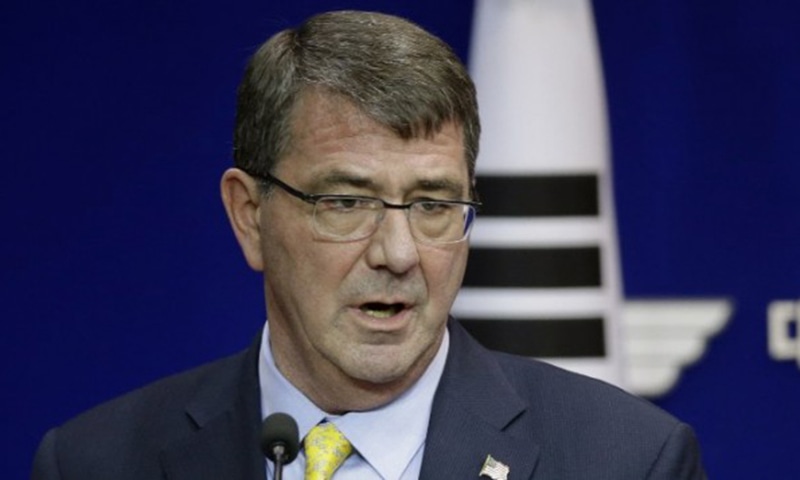
WASHINGTON: The United States is training moderate Syrian forces to fight the self-styled Islamic State (IS) as part of an “ever-expanding programme”, according to Defence Secretary Ashton Carter.
Secretary Carter, who spoke alongside Chairman of the Joint Chiefs of Staff Gen Martin E. Dempsey, told a briefing on Thursday that about 90 Syrian fighters were receiving combat training from US instructors.
A second group would begin training in the next few weeks, he added, calling it “critical and a complex part” of US efforts to fight IS.
Mr Carter, however, declined to name the place where US instructors were training the Syrian rebels.
He insisted that the fighters were being trained to fight only the IS and not the forces of President Bashar al-Assad in the Syrian civil war.
“That is the purpose, and that is the basis upon which they’re being vetted and trained,” he said. “That will be their principal mission and that’s one of the bases on which they would join our programme in the first place.”
Explaining why he was certain that US-trained fighters would only fight religious extremists. Mr Carter said: “These trainees are recruited, they’re vetted, and only then are they put into training. So they’ve been in the programme for quite a while.”
After the training, “they would be inserted into operations, and the trainees [coming in] behind them. … We hope this to be an ever-expanding programme once it proves itself, which I think it will,” he said.
President Barack Obama said in September that strengthening the Syrian rebels, rather than relying on Syrian government forces, represented “the best counterweight” to IS militants.
The defence secretary also said that if the Syrian government forces undertook to engage the US-trained fighters, the defence department “would have some responsibility towards them”.
He said the extent of such responsibility and the rules of engagement had yet to be decided.
Mr Carter said that along with the training, those who participated would receive compensation and small arms. “We’re figuring out what the best training is [and] what the best initial deployment is,” he added.
Gen Dempsey noted that the programme would be expanded in a measured way. “It won’t be easy, but I’d emphasise that it’s one part, one component, of a much broader approach.”
The US Department of Defence News Service reported that “the stability of the Assad regime could be a consideration” as the training programme proceeds, noting that Gen Dempsey agreed that a destabilised regime would pose new challenges.
Published in Dawn, May 9th, 2015
On a mobile phone? Get the Dawn Mobile App: Apple Store | Google Play