0
0

JEDDAH Larita Delacruz sits on the concrete base of a bridge pylon, rubs her swollen belly and explains her predicament she is five months pregnant with twins, and wants to go home to give birth.
But after four years of working as a maid in Saudi Arabia, she lacks both her passport and the crucial exit permit that would allow her to return to the Philippines.
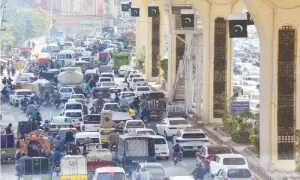
So for three months Delacruz has lived on the pavement under a massive elevated eight-lane highway in central Jeddah, hoping to be rounded up by immigration police, then given documents and a ticket home.
Around her maybe 1,000 other Asian men and women sit in darkness under the flyover in the bustling Red Sea port. All have been trying for months to get deported.
In another area huddle hundreds of Africans, also seeking to leave.
Some fled abusive or non-paying employers, others were abandoned by sponsors, and still more came on pilgrimage to nearby Mecca but then stayed on to work illegally.
In each case, under Saudi rules for the millions of foreigners working in the kingdom, their documents were taken away on arrival. Without travel papers or an official exit permit, they cannot leave.
'If you are working here, automatically your passport is taken by the employer,' said Andrew Occiones, a Jeddah coordinator for Migrante, which helps overseas workers from the Philippines.
He said the numbers under the bridge seem to be rising, possibly because it has become more difficult recently for those without proper papers to get jobs.
Everyone under the Jeddah bridge has a similar story.
Sri Lankan Trina Chandrakarya came to work as a maid two years ago. For five months she was not paid, so she fled the sponsor for another job — easy to do in a huge black market for workers.
Now, with two children back home, she wants to return, but does not have her papers. So she is living under the bridge waiting to be arrested.
'All the people are coming here because they want to go home,' she said.
Such cases are a growing headache for the Saudis and foreign embassies.
Officially about six million of the countrys 25-million population are foreigners.
But according to government and private sector estimates, there are as many as four million more who are undocumented.
They include people who stayed after their work permits expired, pilgrims who stayed on to work, and people who entered the country illegally.
Leaving is harder than getting in
For most, leaving is much harder than getting in. The problem is most acute in Jeddah, gateway to the Muslim holy cities of Mecca and Medina.
In Riyadh there is nowhere for paperless immigrants to go, and under Islamic Sharia law, a pregnant woman like Delacruz is more likely to be jailed for having illicit sex and then expelled after giving birth, diplomats say.
In the small courtyard of Nepals Riyadh embassy, about 15 women sit listlessly, hoping to be accepted into a half-way house run by a Saudi charity where police will process their cases.
Ambassador Hamid Ansari said most had run away from Saudi families who did not pay them at all or beat them. None has documents.
Dealing with the estimated 500,000 Nepalis in the country is especially difficult, Ansari said.
Because Riyadh has no embassy in Kathmandu, Nepalis go through Indian brokers in Mumbai to secure jobs in Saudi Arabia, and the Nepal government has no records on them.
'Before they came to our embassy, we did not know that any of these girls were in Saudi Arabia,' he said.
In Jeddah, under the flyover, the migrants are separated into sections Sri Lankans, then Indonesian men, then Indonesian women next to them; Pakistanis further down and then Filipinos.
The space is grimy, but most people look fairly healthy and clean. Some are still working, there are charity food donations, and showers are also available at a nearby mosque.
One Wednesday evening they all jump up as two huge buses arrive. But they have come for about 100 Indonesian women, who are being taken to an immigration processing centre.
Tarina, a woman in her 30s from Banjarmasin in Java, is one of more than one million Indonesian workers in Saudi Arabia, mostly women working as household maids and cooks.
She said she and her three-year-old daughter had been under the flyover for 10 days.
She came on a pilgrimage pass, then had several jobs over five years, and was now simply ready to go home.
The immigration police do not relish the endless job of processing over-stayers which means establishing their identities — which sometimes even embassies cannot do.
'I am trying to get arrested, but the police dont want to catch us,' said Indian Nair Rameshen, a native of Vayanadu in Kerala, who has lived under the highway for two months.
Rameshen said he has worked for four years as a driver. He left his first job because they paid him less than promised, then found other jobs without having either passport or residency permit.
'I would like to see my parents, my two kids,' he said.
Rameshen said his embassy pushes the problem back to the police. 'They tell us to stay under the bridge. They have to see us in jail' before they can help.