0
0

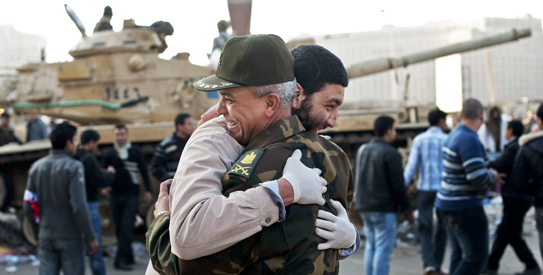
CAIRO: Egypt’s new military leadership vowed Saturday to pave the way for democracy and abide by its peace treaty with Israel, as Egyptians basked in their victory a day after Hosni Mubarak’s overthrow.
The Supreme Council of the Armed Forces said the current government would remain in place for a peaceful transition to “an elected civil authority to build a free democratic state,” although it set no timetable.
In Washington, US President Barack Obama welcomed the Egyptian military's pledge. Obama spoke with leaders in Britain, Saudi Arabia and Turkey, and “welcomed the historic change that has been made by the Egyptian people, and reaffirmed his admiration for their efforts,” the White House said in a statement.
“He also welcomed the Supreme Council of the Armed Forces’ announcement today that it is committed to a democratic civilian transition, and will stand by Egypt's international obligations.”
The official MENA news agency said the government would on Sunday hold its first meeting since Mubarak’s ouster.
The streets and squares of downtown Cairo remained in the hands of the mostly young demonstrators whose determined 18-day revolt overturned 30 years of autocratic rule and triggered an outpouring of national solidarity.
But political power now rests with the military commanders who stepped into the vacuum left by Mubarak’s departure, and many people are anxiously waiting to see if they will make good on their promise to respect the popular will.
In Tahrir Square, the epicentre of the revolt, many of the anti-regime protesters who have occupied the city’s vast central plaza since January 28 launched a massive cleanup effort.
But late on Saturday, tens of thousands of people were continuing to celebrate in the square to the accompaniment of popular Arab music and patriotic songs from a live band, an AFP correspondent reported.
In a sign that normal life was returning, state television announced that a curfew in effect since January 28 would be shortened by four hours and the stock exchange was expected to reopen on Wednesday.
But insecurity lingered, as 600 prisoners escaped from a Cairo jail on Saturday after rioting and gunmen fired at guards from outside the facility, security officials said. At least one prisoner was killed and 20 people were wounded on both sides, they said.
Cairo's press reflected the general sense of elation. Even state-run titles that had initially dismissed the uprising or alleged it was being fomented by foreigners hailed the “revolution of the youth.”
Saudi Arabia, a close ally of Hosni Mubarak, broke its silence on Saturday and welcomed the “peaceful transition of power” in Egypt.
Saudi King Abdullah last month expressed support for Mubarak, criticising those “tampering” with Egypt's security and stability.
In the Suez canal city of Ismailiya, hundreds of members of the widely hated police force marched in solidarity with the uprising, insisting they had been ordered against their will to shoot at protesters.
Much will depend on the stance of the junta now in control of the Arab world’s most populous nation.
Headed by a longtime Mubarak loyalist, 75-year-old Field Marshal Mohammed Hussein Tantawi, the Supreme Council of the Armed Forces clarified its plans with “Communique Number 4,” read by a spokesman on state TV.
It said Egypt would “remain committed to all its regional and international treaties,” implicitly confirming its landmark 1979 peace treaty with Israel would remain intact, soothing fears in the Jewish state and Washington.
Israeli Prime Minister Benjamin Netanyahu, who had expressed concern the unrest could lead to an Islamist takeover, welcomed the statement.
“The longstanding peace treaty between Israel and Egypt has greatly contributed to both countries and is the cornerstone for peace and stability in the entire Middle East,” said a statement from his office.
The army was widely praised for allowing the massive demonstrations to unfold peacefully, but the protesters have demanded civilian government and said they will return to the streets in the absence of a swift transition.
Egypt’s chief prosecutor on Saturday slapped a travel ban on former premier Ahmed Nazif, whom Mubarak sacked along with the rest of his cabinet in a bid to placate demonstrators in the early days of the revolt.
The prosecutor also froze the assets of Habib al-Adly, who as interior minister oversaw a secret police force widely accused of torture and extortion.
And state television reported the departure of information minister Anas Ahmad Nabih, saying he had resigned on Friday after Mubarak’s overthrow.