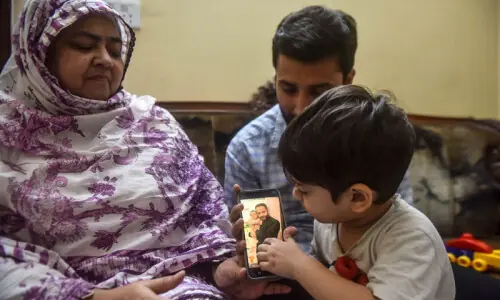
For the middle class, one salary is no longer enough. The latest Household Integrated Economic Survey shows an average monthly household income of Rs82,179 against consumption of Rs79,150, leaving only Rs3,029 for savings or unplanned expenses.
The Labour Force Survey reports an average monthly wage Rs39,042, with 80.8 per cent of workers in informal employment. Households spend 63pc of income on food and housing, while food insecurity has risen from 15.9pc to 24.4pc.
As a result, 2.39m Pakistanis have entered gig work: tutoring (425,000), selling goods (402,000), transport (402,000), freelancing (342,000) and delivery services (292,000). The income gap explains why households increasingly seek flexible, low-capital side work.
Terrorism has gripped parts of Balochistan and Khyber Pakhtunkhwa, narrowing the scope for new small physical businesses. Insecurity disrupts the movement of people and goods, weakens customer confidence, raises operating costs and discourages investment.
Pakistan’s expanding digital ecosystem is creating routes for entrepreneurship, particularly in Karachi, Lahore and Islamabad
But in urban and semi-urban areas of Sindh and Punjab, the continuing emergence of small shops, food outlets, workshops, service businesses, home-based enterprises and neighbourhood retail outlets points to the resilience of micro and small entrepreneurship. These ventures generally require modest capital and depend primarily on local demand.
Expanding formal small and medium enterprise (SME) financing also has a hand in it. According to the State Bank of Pakistan (SBP), outstanding SME finance increased from Rs691 billion in June 2025 to Rs1.11 trillion in June 2026 and over Rs1.14tr by September 2026. The number of SME borrowers rose from about 276,000 in June 2025 to 350,862 in September 2026. In July, SBP revised its SME classification, defining enterprises with annual sales of up to Rs30m as micro enterprises and businesses up to five years old as start-ups, thus enabling more entrepreneurs to seek formal financing.
Such micro enterprises and start-ups cannot be dismissed as informal activity. They represent an important entrepreneurial layer capable of absorbing labour, meeting neighbourhood demand and generating household incomes.
Pakistan’s expanding digital ecosystem is creating another route into entrepreneurship, particularly in Karachi, Lahore and Islamabad, where purchasing power, technology workers, freelancers, financial services, logistics networks and digitally connected consumers are concentrated.
By the second quarter of FY26, SBP reported 126m accounts registered with mobile apps, while 92pc of retail-payment transactions by volume were conducted through digital channels. E-commerce platforms processed 305.1m transactions worth Rs422bn during the quarter, while QR-enabled stores reached 1.9m.
Internet access is also expanding the potential customer base. The Household Integrated Economic Survey 2024-25 found that 57pc of the population used the internet, rising to 69pc in urban areas. Mobile-phone ownership stood at 58pc in urban areas.
A home-based seller can now easily display products through social media, receive orders electronically, accept digital payments, outsource delivery and reach customers beyond the immediate neighbourhood without renting a shop. Graphic design, software development, digital marketing, tutoring, consultancy and content production can similarly be offered from a small physical base while targeting customers across Pakistan and abroad.
But digitalisation does not mean effortless entrepreneurship. Online businesses still face weak consumer trust, intense competition, inconsistent logistics, taxation and documentation issues, limited access to formal finance and the challenge of converting visibility into repeat purchases. Digital platforms lower some barriers; they do not eliminate the need for quality, customer service, working capital and disciplined management.
For Karachi, Lahore and Islamabad, this creates an entrepreneurial pathway alongside the traditional shop, office or workshop. As digital payments and merchant acceptance expand, the online economy is becoming not merely a technology sector but a broader platform for self-employment and small-business formation.
The National Artificial Intelligence Policy 2025 seeks to develop an ecosystem for adoption of AI, skills, innovation and investment. The Pakistan Startup Fund has introduced non-equity financing for eligible early-stage startups, while the Prime Minister’s Cloud Programme seeks to reduce cloud-related costs for qualifying technology ventures.
But the difficulty arises if we begin to regard AI financing as synonymous with entrepreneurship policy. AI startups are potentially high-growth enterprises, but they constitute only one part of the business landscape. Pakistan also needs thousands of small ventures in retail, food, repair and maintenance, transport, logistics, manufacturing and personal services. Individually modest, these businesses collectively generate employment, widen household incomes and create local supply chains.
Entrepreneurship policy must therefore address the constraints faced by ordinary entrepreneurs as seriously as those facing technology startups. Small loans, simpler taxation, predictable licensing, affordable electricity, reliable internet, better logistics and less costly compliance can determine whether an enterprise survives its first few years.
The objective should be an entrepreneurial ecosystem with two complementary tracks. One should support high-growth technology and AI ventures capable of attracting investment, creating skilled employment and generating export revenues.
The other should make it easier for ordinary Pakistanis to establish and expand businesses with modest capital. The first can produce technology-led growth; the second can broaden participation in economic activity.
Published in Dawn, The Business and Finance Weekly, October 12th, 2026