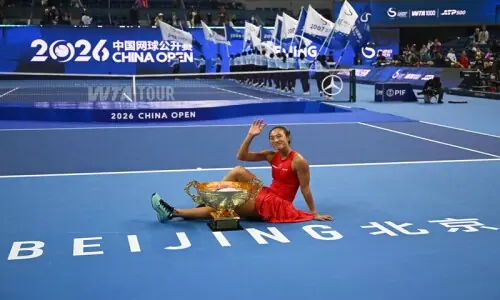
AT a time when good news is scarce, it was gratifying to see Navanethem ‘Navi’ Pillay receive the 2026 Nobel Peace Prize. Pillay is a South African judge at the International Court of Justice and former UN high commissioner for human rights. She chaired the UN Commission of Inquiry that concluded last year that Israel has committed genocide in Gaza. Such symbolic support for justice, human rights, and international law has been much wanting in recent years.
Sadly, Pillay’s prize can also be perceived as a eulogy for international rule of law, which has been flagrantly disregarded, particularly in conflict contexts — from the targeting of civilian infrastructure to the use of chemical weapons and genocidal acts. As if to ring the death knell of the rules-based order, hours after Pillay received the honour, the US sanctioned the International Criminal Court (ICC), a punitive measure that would make it impossible for the court to function.
That we now inhabit a multipolar, post-liberal democratic world order is evident. But moments like these highlight the extent to which the world we’ve known has been torn asunder. The collapse of liberal democratic norms leaves a vacuum which countries must now consider how to fill. This is not all bad — liberal democratic frameworks had imperial overtones, prioritised unfettered economic growth at the expense of social welfare and the planet, and engendered hypocrisy because those touting them were often unlikely to abide by them. But what has come in their wake is authoritarianism and a hyper-privileging of national sovereignty of the kind that enables the US — never a member state of the ICC — to declare the court a “rogue” institution. With World Values Day looming this Thursday, the question to ask is whether countries will use the world order vacuum to refresh national values in this era of national sovereignty.
The speed of developments in these uncertain times means that nations rarely get time to reflect or publicly debate before taking decisions in a way that allows for alignment with national values or sovereign principles. With each destabilising development, whether invasions, pandemics or natural disasters, realpolitik reigns.
National values that work for all must emerge organically.
Today’s conflict and energy dynamics lead to expedient defence pacts, the pervasiveness of AI forces countries to sign up to global technology governance frameworks, and the stop-start flow of climate finance leads nations to make ambitious climate commitments. Little heed is paid to whether these policy decisions cohere and complement or contradict and undermine each other.
In recent decades, the onus to cohere was less; the liberal democratic framework, with all its flaws and flows of money, offered some coherence — rule of law, rights, justice, but also individualism and rampant capitalist growth. But in its absence, the centre will not hold. This is why an intentional revisiting of national values may be welcome. The idea may cause shudders. National values in recent memory have been the bogeymen of authoritarians and dictators, imposed from the top down. Think of nations that have doubled down on alternative value systems, and places like Afghanistan and North Korea come to mind.
National values that work for all must emerge organically from tradition, practice, a nuanced understanding of history and a desire to progressively engage with national documents such as constitutions. They must be inclusive, dynamic and open to challenge, and reflected across policy, law, and curricula. The best values are the products of difficult reckonings — truth and reconciliation proceedings, high-profile trials. This is a tall order for states like Pakistan that are ‘takers’ of political stances, standards, and policies.
Ironically, it seems as if the thing that will replace the coherence of the liberal democratic world order will be AI’s rampaging monoculture. As all knowledge production, financial systems, and policymaking draw from the same well of AI slop, a consistency will emerge from the omnipresence of Big Tech and LLMs. Don’t ask me what that will look like.
Instead, let’s look at an example of what values emerge when all state structures, humanitarian norms and justice are stripped away. The horrific and hugely underreported conflict in Sudan has led to the emergence of the country’s Emergency Response Rooms, strong Nobel Peace Prize contenders alongside Pillay. These are among the few sources of relief in Sudan, offering food, healthcare, schooling, counselling, and protection. These organisations are staffed by 26,000 volunteers and have grown from community kitchens and pandemic-era clinics into the primary solace from the world’s worst humanitarian crisis. Perhaps a return to the most basic values is the best way forward.
The writer is a political and integrity risk analyst.
X: @humayusuf
Published in Dawn, October 12th, 2026