A few hours before Pakistan’s Pavilion at the Venice Biennale 2026 opened to the public, I found myself at a lunch organised by Pakistan’s Ambassador to the European Union (EU), H.E. Rahim Hayat Qureshi, and Dr Yaqoob Bangash, Commissioner of Pakistan’s Pavilion at La Biennale di Venezia.
Among those gathered were many of the people responsible for making the pavilion a reality, alongside well-wishers, such as myself. Sitting amongst this company, I thought about the pressure of representing a country through art, but also about the extraordinary effort it must have taken to get here.
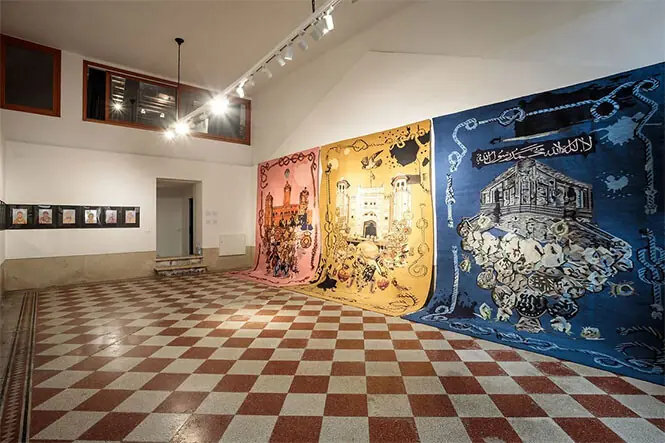
The exhibition itself, ‘Punj•AB — A Sublime Terrain’, featured the work of artist Faiza Butt, curated by Beatriz Cifuentes Feliciano. Pakistan’s participation at the historic biennale was greenlit by Islamabad a mere six months before the opening at Venice, which made this milestone even more impressive.
In 2021, I was part of the team curating Pakistan’s Pavilion at the World Expo in Dubai, and that experience has since profoundly influenced how I see public exhibitions, their role in society and the huge personal effort it takes from each person involved in making these public-private partnerships happen.
Pakistan has made its second-ever official appearance at the Venice Biennale with a pavilion featuring the work of artist Faiza Butt. The story behind how the Pakistan Pavilion came to be is as compelling as the art itself
This is Pakistan’s second participation at Venice, following the inaugural pavilion in 2019, which featured Naiza Khan’s work and was curated by Zahra Khan. In Pakistan, building a national pavilion remains a labour of love. Unlike countries with permanent structures for such diplomacy, each participation requires assembling an entirely new coalition of artists, curators, commissioners, government officials, diplomats, funders and patrons who believe in the transformative power of such an endeavour.
Hence, I hope this write-up also serves as a small record of what it takes to pull off something like this.
HOW IT HAPPENED
Butt, who initiated the idea that culminated in Pakistan’s return to Venice, approached the project with an urgency. A graduate of the National College of Arts (NCA), Lahore, her work is part of several notable collections in the United Kingdom (UK), where she met curator Feliciano. Their partnership is one of the strengths of the pavilion.
Weeks after Venice, I spoke to both over Zoom. What struck me was the ease with which they completed each other’s thoughts. Feliciano described the exhibition as a continuous process of “editing intensity”, while Butt spoke of resisting any attempt to smooth Punjab’s histories into a single narrative. Between them was a shared discipline that the pavilion would hold multiplicity as its approach.
Despite individual conviction, participation for all countries at La Biennale di Venezia has always been through the cultural ministries of countries and is a form of track-two diplomacy — a point we often seem to gloss over, in favour of in-vogue themes of criticality and independence in contemporary art.
Also integral to contemporary art is both community and patronage.
Speaking to both Bangash and Jugnu Mohsin, I came to appreciate the coalition that made this pavilion possible. Mohsin helped build support in Pakistan, after which the federal government formally backed the project in October 2025. Prime Minister Shehbaz Sharif approved Pakistan’s participation on the condition that funding be assembled through a public-private partnership.
Bangash was subsequently appointed Commissioner. A historian of Modern South Asia with a focus on decolonisation, modern state formation and identity-based conflicts, Bangash is also the founder of ThinkFest. His key role, as I observed, was holding together institutions and expectations that would otherwise drift apart.
I also particularly appreciated his effort of bringing together most Pakistanis who were in Venice at the time and using his position to celebrate them all, including noting how meaningful it was to have curators from both the upcoming Karachi Biennale 2027 (KB27) and Lahore Biennale (LB04) present together in Venice celebrating a rare moment of convergence within Pakistan’s cultural landscape. I was grateful to have met Nav Haq (curator of LB04) and to wish him the very best from myself and everyone at KB27.
That gathering also prompted a larger question. National pavilions inevitably claim, in some way, to represent entire countries. Yet ‘Punj•AB — A Sublime Terrain’ is framed as unapologetically centralist, despite its themes and impact being wider. Rather than seeing this as a contradiction, perhaps it should be seen as an invitation. As Pakistan develops a longer presence at Venice, future pavilions have the opportunity to explore the country’s linguistic, regional and cultural diversity through equally compelling lenses.
THE ART
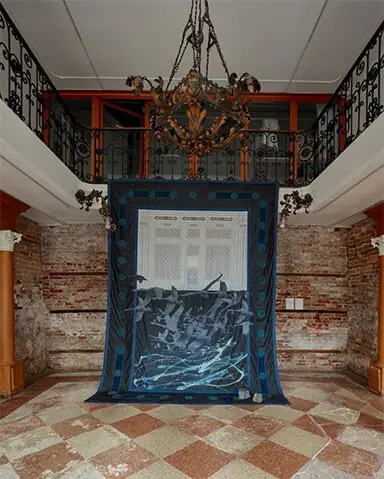
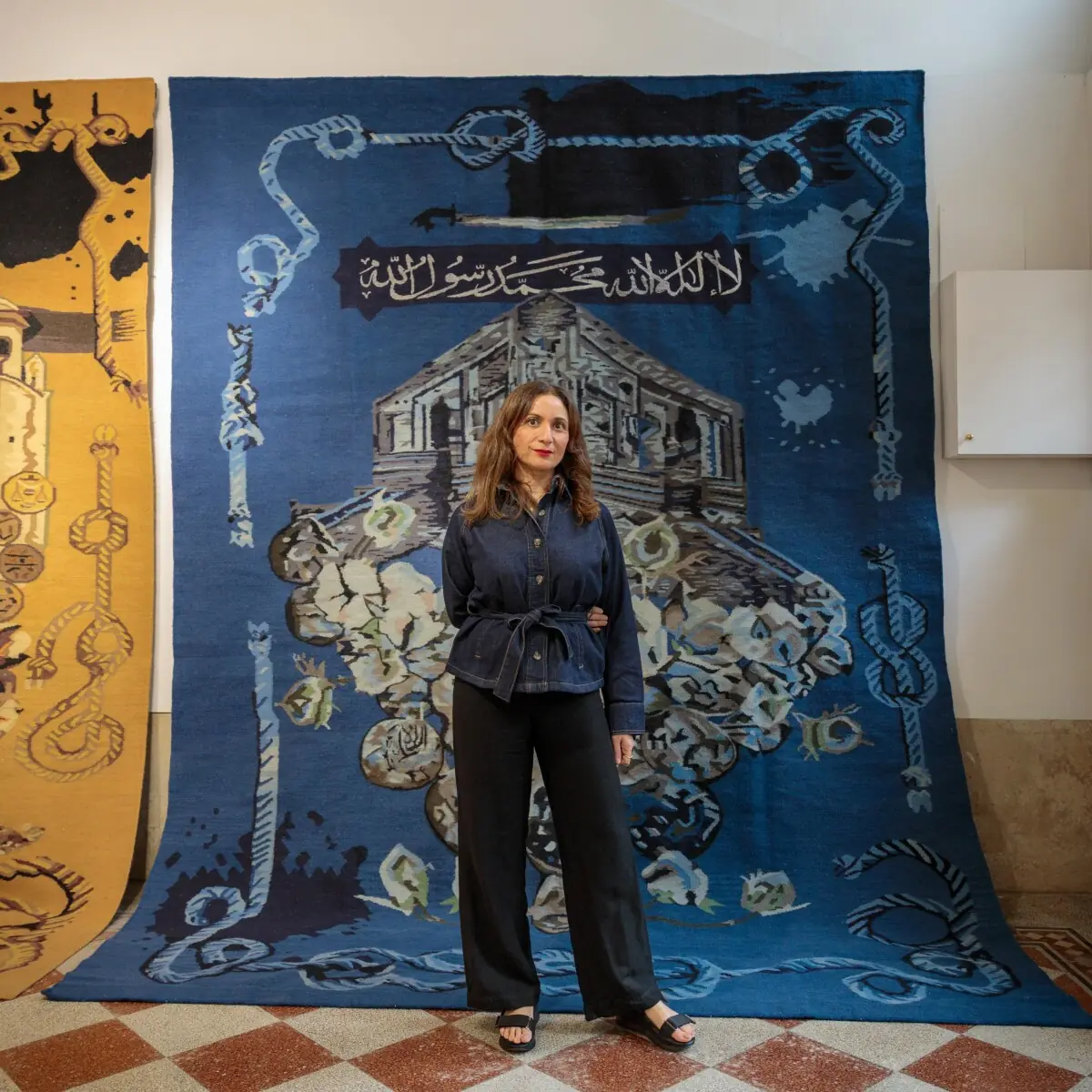
At the centre of ‘Punj•AB — A Sublime Terrain’ is Faiza Butt’s reimagining of Punjab not as a static province but as a layered historical terrain shaped by the movement of rivers, crops, empires and memory.
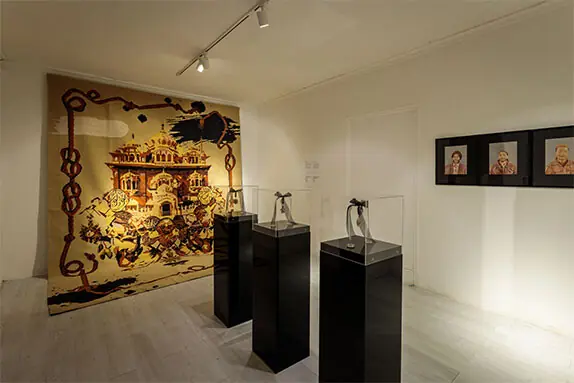
Her visual language, rooted in miniature painting but expanded into contemporary textile practice, layers Buddhist, Sikh, Mughal, colonial and contemporary imagery into dense compositions.
The large-scale tapestries and embroideries, installed in the site of a converted pharmacy, were produced with collaborators. Chief amongst these is Havelicrafts, a not-for-profit founded by Jugnu Mohsin in her village of Shergarh, in District Okara. Many of the artisans involved had never worked at this scale before, and the collaboration brought cotton, its production and the politics of Pakistan’s agrarian economy into focus.
Speaking to Mohsin, I realised that Havelicrafts is only one part of a much larger story. For years, she has argued that the disappearance of traditional crafts is inseparable from rural unemployment and ecological change. Her efforts to revive gossypium arboreum, the ancient Indus Valley cotton that has largely disappeared from cultivation, are part of a wider attempt to reconnect agriculture, craftsmanship and rural livelihoods.
Venice brings that conversation on to an international stage and becomes a way of thinking about labour, ecology and memory. As Feliciano explained, one of the curatorial challenges was transforming forms of labour often confined to the domestic sphere into works capable of occupying institutional space with authority.
In doing so, the pavilion asks us to reconsider where contemporary art begins and where craft ends.
CONTINUING SUCH INITIATIVES
Standing in Venice, I kept returning to Dubai. To the memory of how many moving parts had to align for a pavilion to exist at all, and how quickly those alignments dissolve once the event is over.
Pakistan has now participated in Venice twice. The real challenge is no longer whether we can produce a pavilion worthy of the international stage. It is whether we can build the institutional continuity that ensures that the next attempt does not have to begin from zero.
‘Punj•AB — A Sublime Terrain’ is on display at the Venice Biennale 2026 in Venice, Italy from May 9-November 22, 2026
The writer is the curator of the Karachi Biennale 2027. She can be reached at
Published in Dawn, EOS, July 12th, 2026