
The round bottle gourd — known locally as lauki — is a kitchen garden favourite across the Subcontinent, prized for its versatility in the pot and its ease of growth even in modest spaces.
After sprouting and spending their first days settling into direct sunlight, the seedlings of the round bottle gourd enter their most active phase: this is when the vine truly takes off, climbing, flowering and, eventually, setting fruit. But certain guidelines need to be followed to ensure the plant’s growth from a fragile sprout to a fully fledged, fruit-bearing vine.
The seeds germinate within one week to 10 days of sowing. Once they produce two to three true leaves, the plant is mature enough to be transplanted. If the seeds were sown in a seedling tray or a cup, shift the seedlings to a permanent grow-bag or a container of at least 14 inches, which offers better room for root growth. If three to four seeds were sown to germinate within the same pot, then the seedlings must be separated. The plant grows best in the ground, but it can also be shifted to a 14-inch container.
Once established, the round bottle gourd vine begins to grow rapidly. As it starts to grow and spread, the size of its leaves also increases. The leaves are large, soft and hairy. The leaves have a three-lobed, heart-shaped appearance. Even the young leaves are used in various South Asian cuisines.
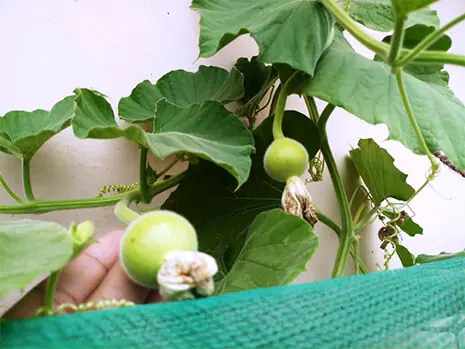
The creeping vine of the round bottle gourd can spread in all directions, especially in search of sunlight. The coiling tendrils aid the vine in clinging to any surface it encounters and the plant continues to grow in that direction. Kitchen gardeners usually hang ropes from an overhead support, tying them loosely at the base near the plant so the vine can climb, resulting in vertical farming that makes the most of the limited growth space. Vertical farming also helps to reduce the incidence of diseases, by reducing the chances of leaves overlapping. It also results in better aeration and sunlight for the leaves.
Alternatively, one can also install a trellis to support the vine in growing vertically. During this growth phase, the plant should be provided with a nitrogen-rich fertiliser to ensure better and stronger foliage. At this stage, pruning the growing tips of the round bottle gourd vine will result in more branches sprouting from the main stem, which later produce more flowers and fruit.
Once the vine is well established, it begins to shift its energy from producing leaves to producing flowers. Around four to eight weeks after germination, buds start to appear. The appearance of buds is a sign that growing conditions are on track. At this stage, the soil should be given enough water to ensure the soil is moist — neither dry nor wet — with the vine getting at least six hours of early morning to noon sunlight.
In case of scorching sunlight or a heat wave, provide shade or green netting and increase watering frequency. It is equally important that there are no water pockets or signs of water retention on the soil surface, and to ensure that excess water is drained quickly.
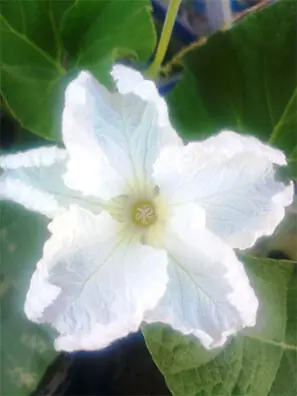
Within no time, the white male and, later, female flowers of the round bottle gourd start to bloom. This blooming especially occurs during late evening and night, which can be a hindrance to pollination. Most pollinators that would help fertilise the flowers and result in fruit tend to appear during early morning through afternoon. In cities, there is usually a dearth of natural pollinators, such as small birds, bees and butterflies.
In both scenarios, hand pollination significantly improves the chances of a successful pollination. The technique is useful for kitchen gardeners, as they pluck off the male flower and carefully remove the petals. The central part of this male flower is gently brushed against the already identified female flower’s centre. This transfers pollen from the male flower on to the female flower.
Identifying and distinguishing between the male and female flowers on the same vine is relatively easy. The male flowers appear comparatively early on the vine. It is also believed that male flowers appear on long stems, while female flowers bloom on shorter ones.
Sometimes, pollen is also visible in the male flowers to the naked eye. Finally, and more importantly, there is a small, immature gourd growing on the female flower’s stalk, just beneath the petals. All that the female flower requires here is a successful pollination to ensue.
Once pollinated, this tiny swelling begins to develop into the familiar round bottle gourd, marking the beginning of the harvest to come.
Please send your queries and emails to doctree101@hotmail.com. The writer is a physician and a host for the YouTube channel ‘DocTree Gardening’ promoting organic kitchen gardening
Published in Dawn, EOS, July 12th, 2026