Diplomacy, new war technology vital to deter India, say experts
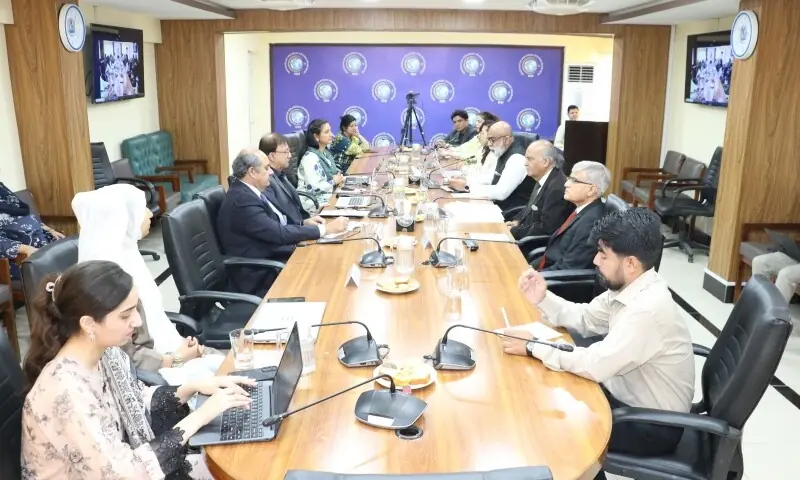
ISLAMABAD: Academicians, diplomats, military and war experts at a gathering emphasised importance of diplomacy and adoption of new war technologies to deter security threats posed by increasingly belligerent and aggressive India.
The conference ‘Strategic Stability, Emerging Threats and Role of Diplomacy’ was organised by the Institute of Strategic Studies Islamabad (ISSI) in connection with Youm-i-Takbeer falling on May 28.
The meeting was attended by Quaid-e-Azam University Vice Chancellor Professor Dr Zafar Nawaz Jaspal, Numl professor Dr Rizwana Abbasi.
While discussing the role of diplomacy, Dr Zafar Nawaz Jaspal highlighted that diplomatic engagement remains essential for maintaining strategic stability in South Asia.
He noted that Pakistan has played a significant diplomatic role in managing regional crises, including efforts linked to the Iran-US ceasefire, but stressed that sustained dialogue between India and Pakistan is even more important for regional peace.
He observed that the deadlock in bilateral engagement has prevented confidence-building measures from maturing and has created a serious gap in arms control and strategic stability.
He further noted that we are witnessing a transformation in India’s military doctrine, with a growing focus on escalation dominance. Chairman Board of Governors, ISSI Khalid Mahmood, in his welcome remarks, stated that Pakistan’s nuclear capability was shaped by its security imperatives and the need to restore strategic balance in South Asia.
He emphasised that Pakistan had adopted the nuclear course reluctantly, only after India’s nuclear tests created an existential challenge and pushed the region toward overt nuclearisation. Pakistan’s response, he noted, was guided by legitimate security concerns in the face of an increasingly belligerent and aggressive India.
Dr Rizwana Abbasi, Professor at the Department of International Relations, NUML highlighted that strategic stability in South Asia is becoming increasingly fragile due to India’s evolving military posture and the introduction of new technologies.
She stated that since the Cold Start Doctrine of 2004, India has focused on developing offensive war-fighting capabilities against Pakistan, including the option of limited conflict and so-called surgical strikes. This has been supported by major military modernisation efforts, not only to strengthen India’s position against Pakistan but also to expand its role in the wider Asia-Pacific region.
She further observed that India’s unilateral actions in Jammu and Kashmir and illegal holding of the Indus Water Treaty (IWT) in abeyance have added to regional instability, while precision weapons, drones, advanced surveillance, AI, and automated decision-making are making the battlefield more complex and increasing the risk of escalation.
While discussing the role of Emerging and Disruptive Technologies (EDTs), Air Commodore (Retd.) Khalid Banuri stated that the character of war is changing rapidly, with serious implications for strategic stability in South Asia. He noted that Artificial Intelligence, hypersonic missiles, and space-based systems are transforming the military domain by reducing decision-making time during crises.
Describing the convergence of AI, hypersonic weapons, and space capabilities as a dangerous “triangle of escalation,” he stressed the need to keep humans in the decision-making loop, extend arms control frameworks to emerging domains, and invest in reliable crisis communication networks.
Adding to the discussion, Maj. Gen. Ausaf Ali (Retd.) stated that nuclear capability is only one element of national power, and other dimensions of the state’s power must also be strengthened. He explained that escalation today can take multiple forms, including cyber operations, Artificial Intelligence, space-based capabilities, the electromagnetic spectrum, quantum technologies, and hypersonic missiles.
Published in Dawn, May 26th, 2026