COMMENT: Trust the signals, but verify the policy
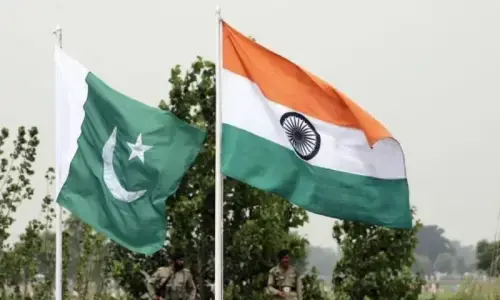
INDIAN army chief Gen Upendra Dwivedi’s recent provocation, asking Pakistan to choose whether to remain part of “geography or history”, has once again exposed the contradictions that continue to define India’s policy towards its western neighbour.
The statement came barely days after an unusual chorus seemed to be emerging within sections of India’s strategic and ideological establishment, one that seemed to be creating space for engagement with Islamabad. This led many to believe that New Delhi’s political ecosystem was quietly preparing domestic opinion for a limited thaw with Islamabad.
The signal came not from the government directly, rather from its ideological forebears, the Rashtriya Swayamsevak Sangh (RSS), with its General Secretary Dattatreya Hosabale arguing that doors for dialogue with Pakistan should not be permanently shut.
The remarks were striking because they came from the ideological nerve centre of the broader ‘Sangh Parivar’, at a time when official Indian discourse has become increasingly securitised after the 2025 conflict with Pakistan.
From the pro-dialogue chorus to Gen Dwivedi’s provocation, India seems to be testing domestic waters about the possibility of a ‘limited thaw’ with Pakistan
Mr Hosabale’s intervention was not an isolated incident, and was followed up by an article on similar lines in Organizer, an RSS publication. Former Indian army chief Gen Manoj Naravane and some other Indian figures also publicly backed the idea of preserving communication channels and people-to-people engagement.
All of this came against the backdrop of a constant trickle of reports in Indian media that Track-II and Track-1.5 contacts involving retired officials, diplomats and strategic figures from both sides had taken place.
None of this necessarily means that Narendra Modi’s government has decided to alter its policy of not engaging Pakistan, but what was striking was that none of the usual suspects — Mr Modi, National Security Adviser Ajit Doval or Foreign Minister S. Jaishankar — contradicted the RSS leader’s remarks.
India’s Ministry of External Affairs also did not dismiss media reporting regarding ‘quiet contacts’.
The silence was meaningful, because in India, silence from the top on Pakistan is often used to preserve deliberate ambiguity, rather than the absence of a position.
The RSS statement was, therefore, interpreted in some quarters less as a policy declaration and more as a trial balloon. It may have been intended to test domestic reaction, gauge international response and slowly prepare political ground should New Delhi eventually decide that some form of controlled engagement with Pakistan had again become strategically necessary.
Pakistan’s Foreign Office also showed similar scepticism, with Spokesman Tahir Andrabi telling his weekly media briefing that while the emergence of pro-dialogue voices was a welcome development, it was New Delhi’s official policy that actually mattered.
Tactical flexibility?
There are multiple reasons why such signalling by India may have emerged now. The geopolitical environment after the 2025 conflict did not evolve in India’s favour.
Pakistan, instead, gained far more relevance because of the conflict in the Gulf. The strains in the Modi-Trump personal equation also helped.
In this situation, some think the Modi government may be quietly encouraging such signals to buy some time. One view is that India may be seeking tactical flexibility, rather than strategic reconciliation, through such signals.
The RSS also has an interest in adopting a pro-dialogue posture, as projecting moderation internationally serves its goals. In recent years, it has attempted to present itself abroad as a culturally-rooted organisation, rather than the hardline Hindu movement it is largely viewed as.
Therefore, calling for dialogue with Pakistan costs little domestically, while helping soften external perceptions.
None of this should be mistaken for a policy shift in Delhi, though. One must not forget that the Pakistan file in India remains tightly controlled by the Prime Minister’s Office and the national security establishment. On core security issues, particularly Pakistan, authority rests far less with ideological organisations or retired officials, and more with the small circle around Mr Modi, Doval and Co.
This is what makes Gen Dwivedi’s intervention interesting. His remarks were delivered at a public interaction event, held around the first anniversary of ‘Operation Sindoor’, and were aimed at reinforcing deterrent messaging toward Pakistan.
Yet, the real question is whether the statement reflects an institutional veto by the Indian military against dialogue, or is tactical signalling aligned with domestic nationalist sentiment.
There is little evidence that the Indian army chief independently shapes New Delhi’s Pakistan policy.
India’s armed forces operate within a centralised civilian decision-making structure and while the Indian army chief may be an important voice, it is definitely not the principal architect of strategic policy toward Pakistan.
If the political leadership in New Delhi decides that engagement with Pakistan would serve India’s interests, the military establishment will almost certainly fall in line. Historically, Indian army chiefs have reflected prevailing political direction rather than independently determining it.
For its part, Pakistan’s military establishment has long argued that India’s armed forces have become politicised and integrated into domestic nationalist narratives and Gen Dwivedi’s remarks will likely reinforce those perceptions in Rawalpindi.
The deeper issue may not be politicisation alone, rather the extent to which Pakistan policy in India has itself become trapped within the theatre of domestic politics.
Dialogue between India and Pakistan has always been difficult precisely because it was never driven purely by bilateral calculations.
India’s contradictory signals reflect uncertainty inside the system itself about how to manage Pakistan after years of escalation, hardened public attitudes and shrinking diplomatic space.
The old principle still applies: trust the signals if necessary, but verify the policy.
Published in Dawn, May 20th, 2026
Baqir Sajjad Syed is the Foreign Affairs and National Security Correspondent for Dawn. His career of over 25 years spans print and broadcast journalism. He is a former UN Reham al-Farah Fellow and held a Pakistan Fellowship at the Woodrow Wilson Centre in Washington, DC. He tweets @baqirsajjad