Consumers have remained upbeat about new vehicles despite the ongoing war between Israel, Iran, and the USA since February 28, 2026, as outstanding auto loans surged for the 17th consecutive month to Rs359.5 billion by the end of April 2026, up from Rs345.34bn in March.
However, this recovery still does not match the peak financing we saw during June 2022 of Rs368bn, when the annual sales volumes were around 240,000 units.
Low interest rates continue to play a pivotal role in luring buyers towards low financing, followed by various packages by assemblers and private banks on affordable car financing. The rest of the demand is propelled by rising petrol prices, forcing people towards various categories of electrified vehicles in larger numbers.
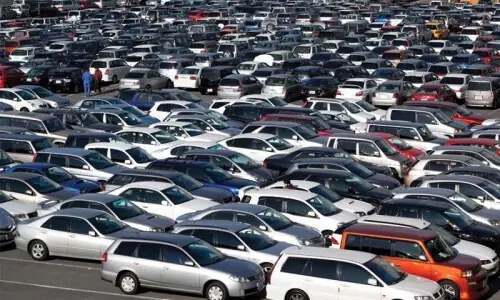
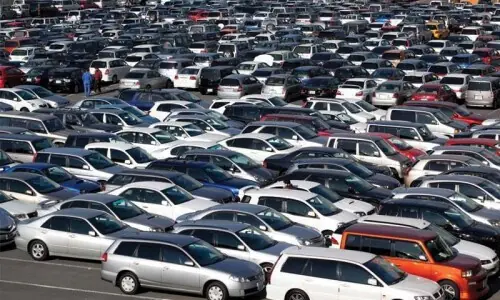
Sales of cars, vans, pickups and sports utility vehicles clocked in at 22,015 units in April 2026, up by 107pc year-on-year (YoY) and 42pc month-on-month, taking 10MFY26 cumulative sales to 166,044 units, up 49pc YoY.
‘Pakistan still has the lowest financing limit and time period in all of Asia, keeping in view the market size and foreign exchange availability’
Import of completely and semi-knocked down (CKD/SKD) kits by the local assemblers rose to $221m in April from $170m in March, while the 10MFY26 import bill swelled by 107pc to $1.69bn YoY, signalling a positive sales outlook in the coming months.
Recently, the State Bank on April 27 raised the interest rate by 100 basis points to 11.5 per cent from 10.5 per cent, which may make financing a bit costlier for consumers; in June 2023, the interest rate was 22pc. CEO of Indus Motor Company (IMC), Ali Asghar Jamali, sees a very little impact on auto financing in the wake of a 1pc hike in interest rate.
“Pakistan still has the lowest financing limit and time period in all of Asia, keeping in view the market size and foreign exchange availability,” he said.
Banks in Pakistan offer three-year auto financing with a cap of Rs3 million, while in India the time period is five years and the limit is set at 80pc of the car’s value, he said. In Thailand, the financing period is seven years based on 90pc of the car value, while Malaysia offers a 90pc financing limit based on the car’s value for a nine-year period, he added.
The Head of Research and Development at Pakistan Kuwait Investment Company, Samiullah Tariq, shares Mr Jamali’s sentiment, “I think financing is still affordable despite a 1pc rise in the interest rates.” He said people are generally inclined towards buying new models due to lower prices and fuel efficiency.
As for the CEO of Top Line Securities, Mohammad Sohail, he said, “Looking at rising car sales, we don’t see any major impact on auto loans after a 1pc jump in the interest rate. So far, higher interest rates have not affected the car market.”
An assembler said that the prudential regulations of the State Bank for auto financing remain unfavourable, but higher inflation has created additional demand for small-engine power cars, especially the 660cc locally assembled Suzuki Alto.
Authorised dealers, however, offer a different view. A dealer explained that auto financing is unlikely to take a hit in the coming months. Car bookings via bank financing have been proceeding normally since the State Bank raised interest rates on April 27, 2026.
Another dealer said that the short-term impact of the one per cent interest rate hike may delay purchases rather than cause a large impact on car financing. The delay is also generally expected due to the new budget and the new auto policy in July. The one per cent rise is more of a market signal to slow down rather than anything, he added.
“The bigger hurdle is the Rs3 million financing cap. If that’s lifted or increased, financing is expected to increase more,” he said.
Former Chairman of the Pakistan Association of Automotive Parts and Accessories (PAAPAM), Mashood Ali Khan, said the auto financing will remain more or less the same in the next few months despite an increase in interest rate by 1pc. A new budget, as well as a new auto policy, are also coming up, he shared, with taxes and duties for the auto sector changing, which may affect vehicle retail prices.
The government, he said, is also focusing more on promoting electrified vehicles, especially pure battery electric vehicles (BEVs), as well as on local vehicle assembly, for which tariffs will be changed.
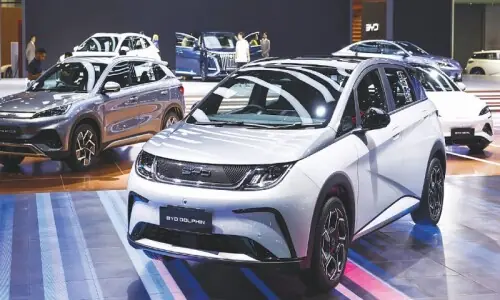
However, FY26 will end on a promising note for local assemblers and parts makers compared to FY25. Since petrol prices have increased manifold after the Middle East war, people have been rushing towards electric vehicles, particularly 660cc-1,000cc models, to save on transportation costs.
To incentivise demand and relax financing terms, the first draft of the Automobiles and Auto Parts Manufacturing Policy 2026-2031 notes that, in collaboration with the State Bank, targeted auto-finance schemes should be reintroduced for locally assembled vehicles meeting localisation tiers.
Extend tenure to seven years, lower down-payment to 15pc, and cap loan eligibility at Rs10m for locally manufactured vehicles, the draft says, adding that this relaxation shall be restricted to tractors, new energy vehicles and vehicles below 1,800cc during the policy period and may be extended to higher engine capacities, subject to approval by the Policy Steering Committee.
An assembler-led self-credit financing scheme may be encouraged to enable consumers to purchase vehicles directly through manufacturer-backed financing, thereby reducing reliance on government-supported credit channels and insulating demand from fluctuations in the policy rate, the draft further said.
Published in Dawn, The Business and Finance Weekly, May 25th, 2026