Alphabet Book
By Ali Kazim and Hammad Nasar
Ochre Books
ISBN: 978-1-0682265-0-2
144pp.
Most alphabet books, in any language, are quiet, humble objects — functional by design, forgettable by nature, and discarded once their lesson is learned, or not.
The struggle with the Urdu script is familiar to parents everywhere, whether in the diaspora or not. Even in Pakistan itself, English-medium schooling has quietly estranged children from their own script. It is the kind of loss captured in a recent anecdote — of students asked to write an exam essay on an Ajaaib Ghar [Museum], and what became of it. Most, not familiar with the term, submitted essays on haunted houses.
The Urdu qaidas [foundational books] art curator Hammad Nasar brought home from Pakistan for his sons studying in England were dutifully purchased and quietly shelved — the script unable to hold the attention of children for whom it had already felt foreign. It was Zarina Hashmi’s 101 Urdu Proverbs that offered a different possibility: her woodcuts animated the language, and his sons responded.
That encounter planted a conviction in Nasar — that if the images are sufficiently alive, the language will follow. From that seed grew Urdu Qaida/Alphabet Book, his collaboration with artist Ali Kazim — a significant artist’s publication that refuses the forgettable modesty of the genre it inhabits.
An extraordinary collaboration between an art curator and an artist transforms the humble Urdu qaida into a work of art — one that invites curiosity, wonder and pride
Ali Kazim’s work has entered the permanent collections of the V&A, Tate, the British Museum, the Metropolitan Museum of Art, and the Ashmolean — a trajectory his peers have watched unfold with quiet admiration, from its most unlikely origins: a young man dispensing medicines at Gulab Devi Hospital in Lahore.
Born in Pattoki and trained at the National College of Arts and later at the Slade School of Fine Art in London, Kazim practises miniature painting techniques at scale — the forensic attention to individual hairs, the layered watercolour wash, the quiet gravity of his figures, all immediately recognisable on every spread of this book.
The text, written by Nasar and translated into Urdu by Sumair Mustansar Tarar, tells the story behind this book and Kazim’s arresting visual practice. A Roman Urdu rooted in the true and consistent sounds of the script — meticulously considered and codified — might become a standard.
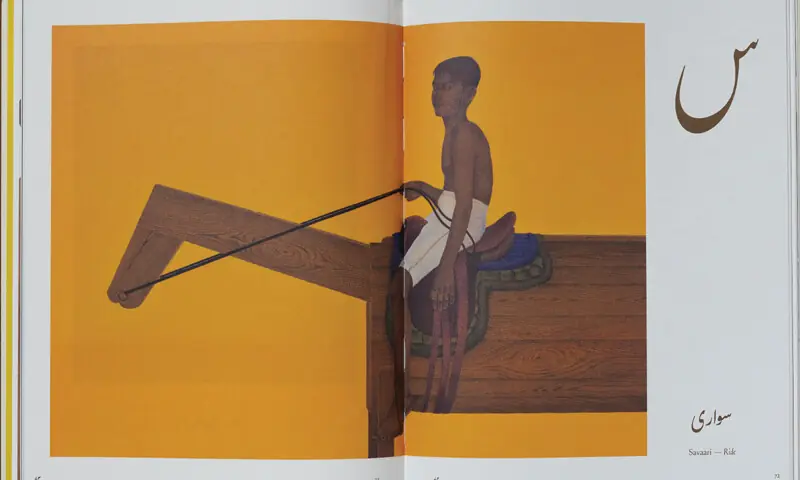
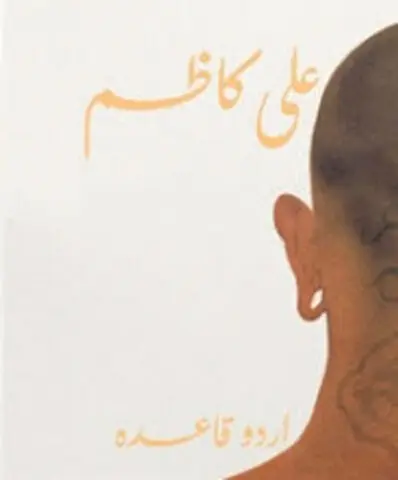
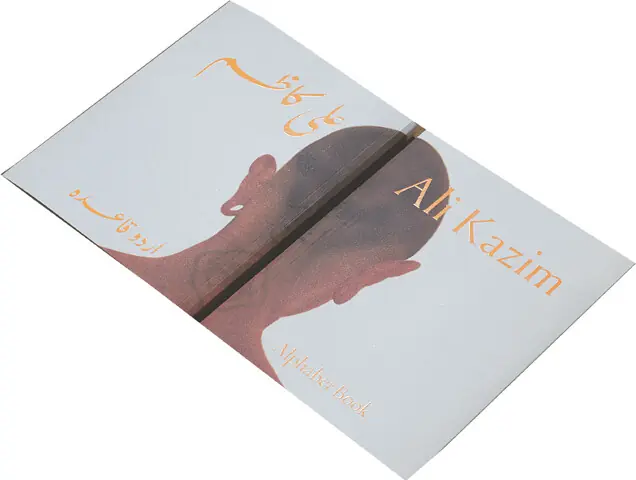
Behind this book’s form and vision, the curatorial decisions tell their own story — and leave a distinct impression. The visual range throughout the book is startling in the best sense, beginning with the cover, where a Rückenfigur from Kazim’s Man of Faith series is split in half, using a creative dual-aspect cover composition to accommodate both English and Urdu titles.
Similarly, the inside-gatefold covers present Conference of the Birds as a single image divided by the spine — one half opening on to the Urdu preface, the other on to the English. Both the figure seen from behind and the flock appear as forever mid-course between two languages, identities, countries, continents, cultures and more.
Once a reader enters the book, an image quietly draws attention, in which the body is absent and the cloud is present: an artist’s self-portrait rendered in the language of translunary disappearance; one can relate this to Urdu from its origin.
The lesson opens with ‘Alif’ for ‘Imaan’ and Kazim’s Faith series, affirming that Pakistan’s faiths are many and that inclusivity matters. Aankh Macholi [Hide & Seek] is a traditional street game that children have played long before screens took over. For ‘Bey Se Baal’ [Bey For Hair], the Qaida presents a work by Ali Kazim — constructed from real human hair bound with hairspray — its dense, tangled forms filling two pages with a hypnotic intensity closer to the subconscious than to anything representational.
Chaand [Moon] presents lunar phases in grids against black — a devotional atlas of the night sky. Parindey [Birds] and Hudhud [Hoopoe] reveal his command of natural form, winged creatures rendered in watercolour with breathtaking delicacy. Tufaan [Storm] fills its spread with tempestuous cloud formations.
The chosen words themselves are an argument. Alongside the everyday — ‘Pajama’ [pyjama], ‘Darakht’ [tree], ’Chai’ [tea], ‘Nashpaati’ [pear] — the ‘Loot’ spread is striking. Urdu gave English the word ‘loot’ [rob, plunder or steal] — a colonial inheritance hiding in plain sight — and the depiction in the book gathers Tipu’s Tiger, the Koh-i-Noor diamond rendered in precise, technical yet painterly detail, an ornate Mughal throne, and other historical pottery and ceramic ornaments: a very few of the items taken away with the colonial exit.
Theekriaan [potsherds] connects the reader to the Indus Valley civilisations millennia before Urdu existed. Fauj [army] gives us Mara’s Army — Kazim’s most philosophical image, in which the enemy and the self are the same person, and the only weapons are bodies, with tusked teeth and wooden lathis [sticks] serving as negative space.
One can also enjoy it as war distilled to its pre-imperial state, or as the essence of Lashkari Zubaan [military language]. Kazim’s figures — against jewel-coloured fields of orange, yellow, teal, deep rose and cobalt blue — are painted with an intimacy that refuses exoticism. They are people: specific, unhurried, present. The rest of the exploration is for the readers.
Readers in Pakistan may find one aspect particularly fascinating. The large Urdu lettering anchoring every spread — feeling both ancient and contemporary — is the work of Birmingham-based designer Abeera Kamran, who is pursuing a PhD in Urdu typography at the University of Reading. For this project, Kamran developed a new typeface, inspired by the Muraqqa-i-Zareen, a codified manual of the Lahori Nastaliq script by Ustad Tajuddin Zareen Raqam (1906–1955). The result carries genuine historical depth while sitting with complete confidence on the modern page.
The design collaboration is remarkable — London-based studio LG-HM (Luke Gould and Hannah Montague), neither of whom reads Urdu, produced spreads of such clarity and confidence that the book feels entirely of one mind, despite its complexity. Printed on uncoated paper, it feels considered and intimate.
Ultimately, Urdu Qaida/Alphabet Book delivers on Nasar’s ambition: a book that any reader enters at the level of feeling, before language arrives. Child, grandparent or stranger to South Asia — all find something here that needs no translation. Under the editorial eye of Anita Dawood at Ochre Books and the contributors, it insists that the Urdu-speaking world deserves to be shown in all its richness, to the children it is losing and to everyone else.
The reviewer is an art critic, curator and educator who spends his time between Birmingham and Lahore.
He can be reached at aarish.sardar@gmail.com
Published in Dawn, Books & Authors, May 24th, 2026