How does one decode a foreign language hung on a gallery wall?
A language outside one’s fluency subverts certainty, invites opacity and aesthetically fictionalises the script, while seemingly becoming a mark, a form where meaning migrates semantic clarity to embody perception. It exposes us to the politics of legibility. Thinkers such as the French philosopher Ronald Barthes expand such semiotic resonance to carry ideologies.
These questions envelop the exhibition ‘Urdu Worlds’, curated by Hammad Nasar at Dubai’s Ishara Art Foundation, which delineates a collaborative dialogue between the late Indian-American printmaker Zarina and contemporary Pakistani artist Ali Kazim. Through the command of their respective media, a cerebral visual dialogue is staged. And what emerges may seem like separate accounts delivered from different timelines, urging each case as a shared inquiry into how meaning is formed, sustained and disseminated across surfaces, scripts and time.
Zarina’s journey through migration and belonging unfolds from the quiet ache of displacement. From this charged interior landscape, where memory meets borderlines, she turns her gaze upward. Even the moon, suspended in apparent neutrality, shifts under the weight of political geography. What should be universal becomes unsettled.
The UAE’s first contemporary art exhibition dedicated to the Urdu language serves as a fascinating visual conversation between the artists Zarina and Ali Kazim
Through spare images and restrained language, she compresses archetypes without sealing them into a fixed story. The moon is no longer innocent, hovering above a world divided. And we are left to ask: how can something so constant appear unified, when the ground beneath is so divided?
Her relational connections to the world around her affirm her anxieties and present themselves as simulacra in her seminal series Home is a Foreign Place (1999), which deconstructs the spatial belonging of her own home, hinting that what you see carries other baggage.
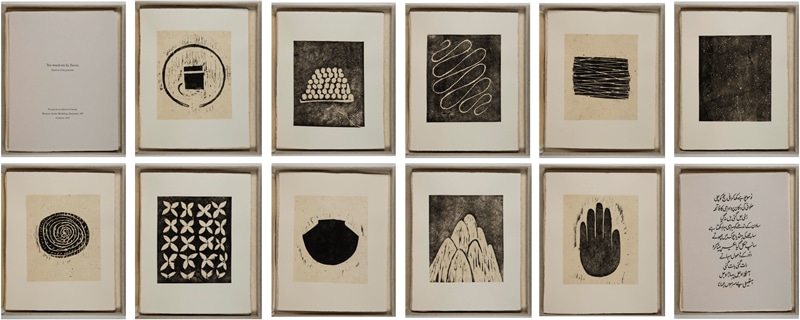
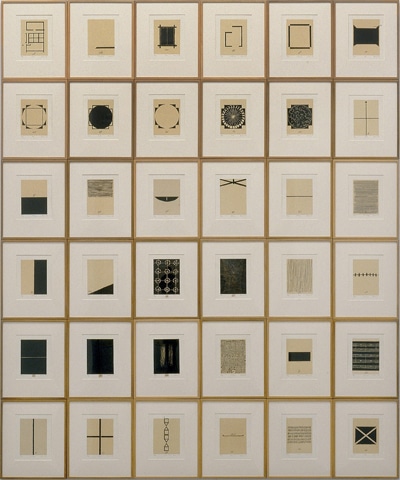
Among the modicum of works by Zarina are a series of 10 woodcut prints inscribed with Urdu proverbs. The English translation of one of these proverbs is, “After eating nine hundred rats, the cat goes on a pilgrimage.” Yet, to render it so directly is already to diminish it. In the gallery, Urdu appears without translation, situated spatially rather than linguistically, as its literal decoding completely flattens its cultural timbre and tonal inflection.
Here, a single language does not monopolise meaning. Zarina’s refusal of redundant formal, visual or explanatory narrative becomes potent in breaking ideologies. As the Italian novelist Umberto Eco suggests, “You can cheat the given language.” In her prints, Urdu here exceeds its semantic function and becomes structural.
In these works, meaning is not delivered as a fixed message — it lingers and withholds where an expression is not descriptive but rather forces you to become. As Allama Iqbal wrote, “The ultimate aim of the ego is not to see something, but to be something.” Zarina toys with political axioms, with her views reflecting a collective memory and dialectical systems that are satirical, echoing urgencies that hint at totality at large.
Opposite Zarina’s restrained geometry, Kazim’s paintings appear materially dense, sedimented with pigment and social reference. Where Zarina reduces, Kazim accumulates.
The most direct point of convergence between the two practices emerges through a reimagining of the Alphabet Book - Urdu Qaida, prompted by Zarina’s word-based series. This engagement propelled Kazim to produce works specifically for the exhibition, drawing on letters, visual associations and, at times, the deliberate absence of language itself. In one instance, the word ‘zebra’ becomes a site of inquiry, its absence in Urdu underscoring how language reflects colonial reverberations, as the animal is not indigenous to the region.
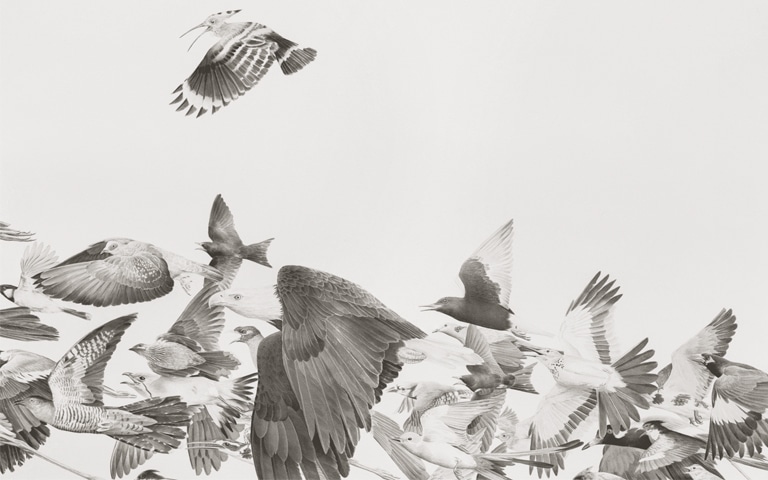
Similarly, the works Chaand (2025) and Firefly II [Jugnoo] (2006) take luminosity as a metaphor to weave literary connections. Further references to Farid-Uddin Attar’s influential masterpiece The Conference of the Birds to the Buddhist Mara’s Army take the form of poignant moments, where Kazim uses his adeptness to render similar collective philosophies while portraying himself as a protagonist in several of his works.
At moments, the exhibition gravitates towards Kazim’s practice, showing paintings, drawings, sculptures, prints and videos transcribing worldviews that underpin his anthropological impulses, whereas Zarina’s work is the proverbial birdsong, punched with irony, tethered to ghosts of histories.
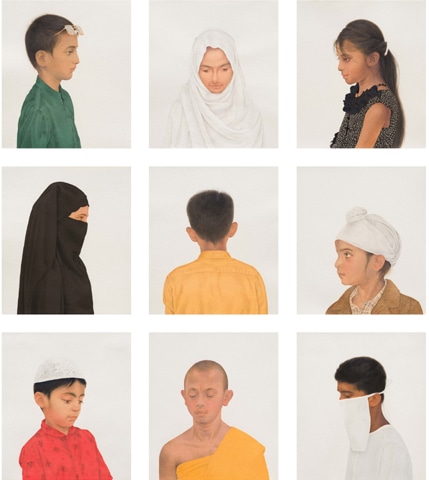
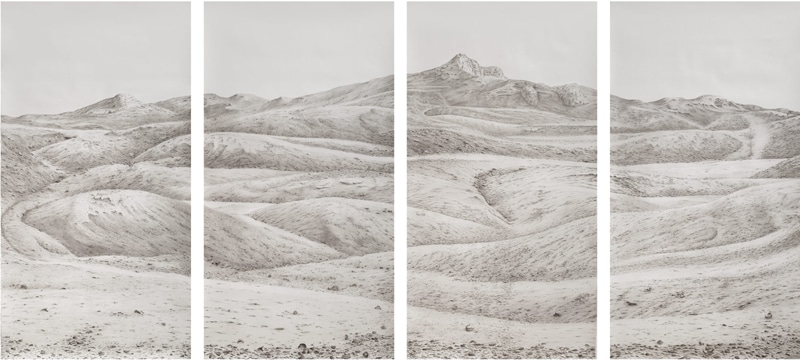
This is evident in Tteela (2025), a landscape drawing of Kazim’s village Patoki on the outskirts of Lahore, a site where remnants of the Harappan Civilisation continue to surface during the monsoon season. From this terrain, the artist gathers geological time itself, reframing those particles into a fictionalised landscape that reshapes what is lost as not erased but sedimented. It is atomised, layered, worked with aquarelle scores, where marks suggest holding history not as narrative but as weight embedded within matter. Kazim creates a sensorial pictorial tension that brings his figures to act as containers of diverse information from everyday life.
As one walks through the show, one notices that, unlike Kazim’s landscape, both artists remove the figure-ground relationship, toying with abstractions to assert their trust in the viewer to linger, to sit with uncertainty, to accept that understanding may arrive gradually, or not at all. In the case of ‘Urdu Worlds’, the curator attempts to knowingly resurface a linguistic reinstatement of a language as a script.
In places such as Dubai, this may be indirectly implicit, where Urdu is widely spoken as a diasporic dialect with shared Indo-Pak linguistic articulations, but the script largely remains estranged. It is this resurgence that makes the show plausible, even if it may arise from separate origins.
‘Urdu Worlds’ is on display at the Ishara Art Foundation, Dubai from January 16-May 31, 2026
The writer is a multidisciplinary artist and educator based in the UAE. She can be reached at zahra.jewanjee@gmail.com
Published in Dawn, EOS, March 8th, 2026