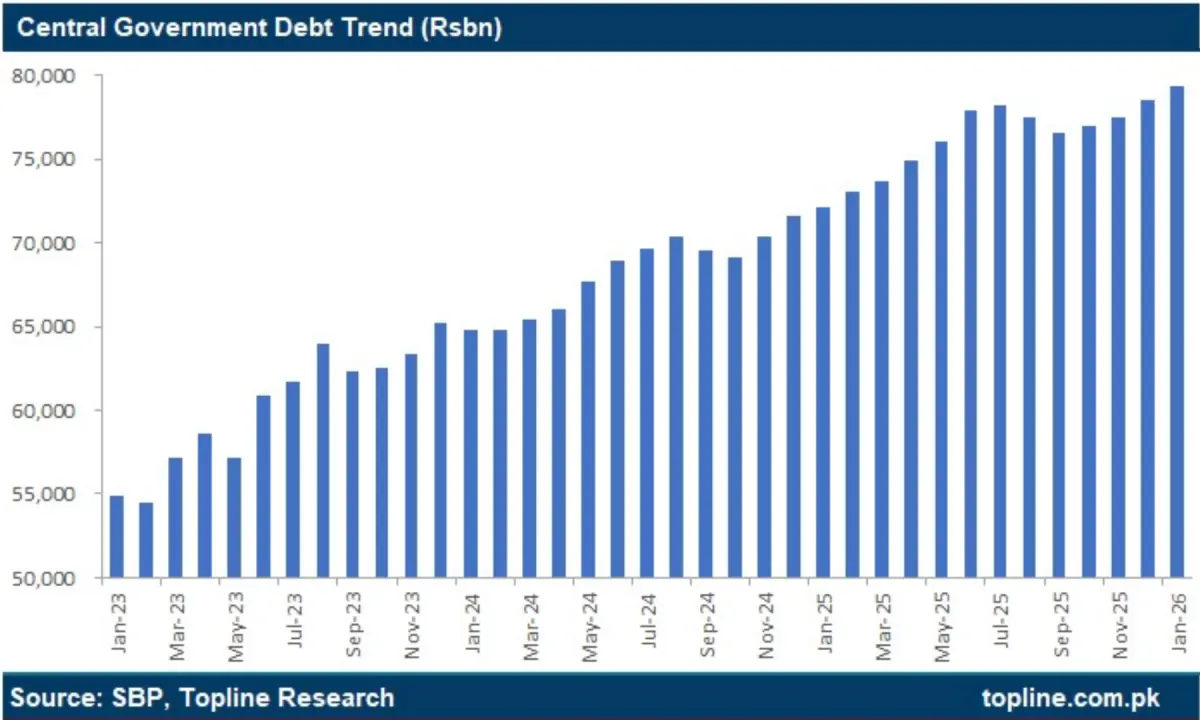
Pakistan’s total central government debt rose to Rs79.32 trillion in January 2026, reflecting an increase in government borrowing over the past year.
State Bank of Pakistan data showed central government debt at Rs72.12tr in January 2025, meaning the overall debt increased by Rs7.2tr, or roughly 10 per cent, over the past year.
Arif Habib Limited noted that the central government debt increased by 1pc month-on-month.
The rise was primarily fuelled by domestic borrowing, which continues to account for the bulk of the federal government’s liabilities.
Domestic debt dominates the debt structure
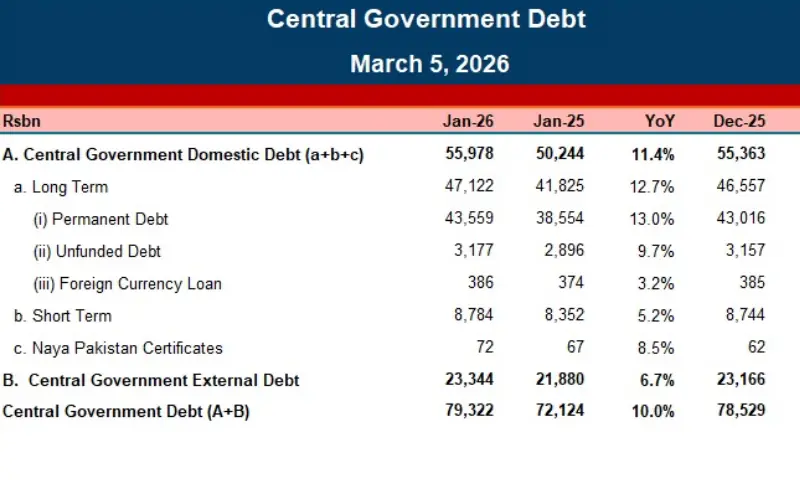
Central government domestic debt increased to Rs55.98tr in January 2026, up from Rs50.24tr in January 2025, marking an increase of around Rs5.73tr over the calendar year.
Domestic borrowing accounts for roughly 71pc of the central government’s debt.
Within domestic debt, long-term remains the dominant component, rising from Rs41.83tr in January 2025 to Rs47.12tr in January 2026.
Topline Research data showed domestic government debt rose 11.4pc year-on-year and 1.1pc MoM.
Pakistan Investment Bonds remain the largest instrument
Among permanent debt instruments, Pakistan Investment Bonds remained the largest contributor, standing at Rs35.27tr in January 2026, compared to Rs31.77tr a year earlier.
Similarly, the Government of Pakistan Ijara Sukuk increased from Rs5.84tr to Rs6.75tr over the same period.
The data also shows growth in Bai-Muajjal Sukuk, which rose significantly from Rs65 billion in January 2025 to Rs632bn by December 2025, remaining at that level in January 2026.
Savings schemes and unfunded debt edge higher
The government’s unfunded debt, which includes national savings schemes, also increased moderately during the period.
This category rose from Rs2.9tr in January 2025 to Rs3.18tr in January 2026.
Within this segment, saving schemes (net of prize bonds) increased from Rs2.81tr to Rs3.11tr, reflecting continued participation in government-backed savings instruments.
Short-term borrowing remains elevated
Short-term domestic borrowing also remained significant, standing at Rs8.78tr in January 2026, compared to Rs8.35tr in January 2025.
Most of this consists of Market Treasury Bills, which rose to Rs8.66tr in January 2026 from Rs8.26tr in January 2025.
External debt shows limited change
In contrast to domestic liabilities, central government external debt remained relatively stable.
External debt stood at Rs23.34tr in January 2026, compared to Rs21.88tr in January 2025.
Long-term external debt accounted for the majority at Rs22.99tr, while short-term external liabilities increased to Rs345bn, up from Rs277bn in January 2025.
Topline Research noted that “external Debt was up 6.7pc YoY and 0.8pc MoM in January 2026”.
They further highlighted that “in June 2025, the said debt was $82.5bn.”
Overall debt expansion
Overall, the State Bank’s data suggest that while Pakistan’s debt stock continues to expand, most of the increase is being absorbed domestically.