Survey finds Sahulat Bazaars missing in major areas of Lahore
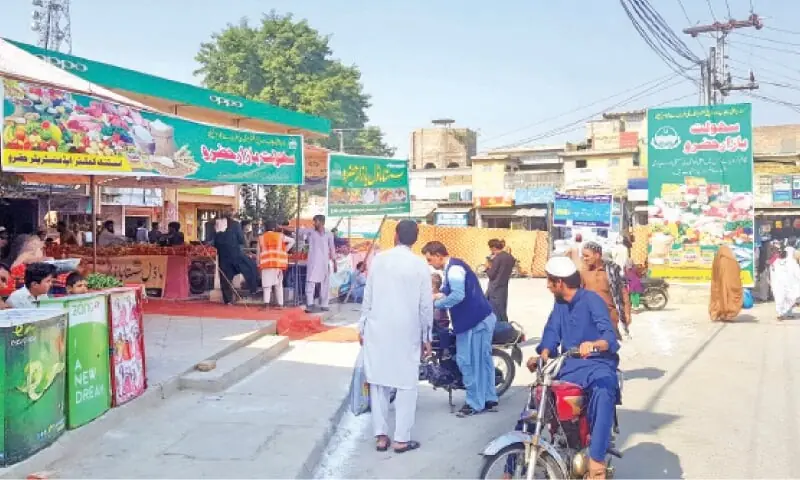
LAHORE: An official survey has identified various major residential areas without Sahulat Bazaar facility in Lahore and sought increase in number of such bazaars to ensure provision of daily-use items to the public at affordable prices.
The survey has been conducted by the Punjab Directorate General of Monitoring & Evaluation during which 339 responses were collected regarding the facilities being provided under the Punjab Sahulat Bazaar Authority (PSBA). It included 172 customers and 167 vendors from traditional Sahulat Bazaars, along with 167 customers and 80 vendors from the mobile ‘Sahulat-on-the-Go’ model.
Lahore’s estimated population is over 15 million according to recent official estimates. In this mega city, there are 10 permanent Sahulat Bazaars and 15 Sahulat-on-the-Go units. The findings of the survey show that for a city of 15m people, 25 relief markets are clearly not enough.
“Large residential zones such as Bhagwanpura, Mughalpura, Cantonment, Model Town, Ghazi Road and parts of Samanabad do not have adequate nearby Sahulat Bazaar coverage. Many citizens have to travel long distances. When transport cost increases, part of the price relief benefit is reduced. If a family spends fuel money to reach a relief market, the net saving becomes smaller,” the survey mentions.
At present, Punjab has 49 permanent Sahulat Bazaars operating throughout the year, 15 Sahulat-on-the-Go units, and 11 temporary Ramazan Bazaars. During Ramazan, the total number reaches 75. The survey recommends that every tehsil should ideally have at least two permanent Sahulat Bazaars.
“Larger cities like Lahore, Faisalabad and Rawalpindi should have more, proportionate to their population size. The objective should not be symbolic presence but meaningful coverage,” it argues.
The survey clearly shows that the model works. Customer satisfaction is high whereas the vendor confidence is strong under a functional complaint system. It claims that accessibility scores are impressive. And instead of treating this as a limited programme, it should now be expanded systematically.
Removal of middlemen is one of the most powerful features of this model. When farmers and primary suppliers connect more directly with regulated vendors, price distortions reduce. Transparent price boards, complaint counters and administrative oversight protect both buyers and sellers, the survey says.
It provides rare data-based insight into how Punjab Sahulat Bazaars are performing on the ground.
Among traditional Sahulat Bazaar customers, according to findings, 82pc termed prices affordable, 88pc were satisfied with product quality and freshness, 85pc were satisfied with cleanliness and hygiene, 90pc felt safe and secure while 87pc were satisfied with service efficiency. 92pc appreciated accessibility.
The Sahulat-on-the-Go model shows good performance in certain areas as 92pc of customers were satisfied with product quality, 90pc appreciated cleanliness and hygiene, 93pc felt secure while 95pc rated accessibility positively. The only area where concern remains is affordability where 73pc expressed satisfaction. This suggests that price sensitivity remains high and further strengthening of price monitoring can enhance impact.
The vendor side of the story is equally important. In traditional Sahulat Bazaars, 91pc of vendors were satisfied with rent affordability, 87pc were satisfied with infrastructure support, 84pc felt their business was viable, 82pc appreciated the complaint redress system, 89pc felt secure and 80 percent were satisfied with training and support from the PSBA.
The Sahulat-on-the-Go vendors reported similar trends as 94pc were satisfied with rent, 89pc appreciated infrastructure support and 85pc saw business viability, 88pc were satisfied with complaint handling while 91pc felt secure and 86pc were satisfied with training and support.
Among traditional Sahulat Bazaar customers, 72.6pc were male and 26.2pc female. The majority were between 25 and 40 years of age (58.33pc). Among mobile model customers, gender participation was almost balanced, with 47.6pc male and 52.4pc female. This shows that the mobile model may be increasing access for women.
Among vendors, participation is heavily male-dominated. 96.6pc of vendors are male and only 3.4pc female. Nearly 45.5 percent of vendors are aged between 25 and 40 years, and 34.1 percent between 41 and 60 years.
Published in Dawn, March 6th, 2026