0
0

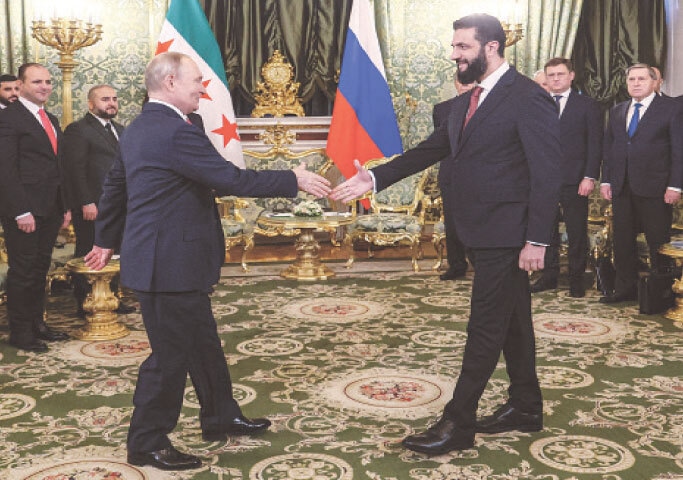
MOSCOW: Russian President Vladimir Putin met his Syrian counterpart Ahmed al Sharaa in the Kremlin on Wednesday for talks that were set to include the sensitive issue of Russia’s future military presence in Syria, sources on both sides said.
Since Sharaa’s coalition toppled Russia’s ally Bashar al-Assad in December 2024, Moscow has been working to build relations with him and ensure a continued military foothold in the country in order to bolster its influence in the Middle East.
Russia was withdrawing forces from Qamishli airport in northeast Syria, although it was expected to maintain its larger Hmeimim air base and Tartous naval facility on Syria’s Mediterranean coast.
A Syrian foreign ministry source said the move by Moscow was interpreted in Damascus as a gesture aimed at building goodwill and signalling that Russia would not be drawn into fighting between Syrian government forces and the Kurdish-led Syrian Democratic Forces as Sharaa attempts to assert central authority over the entire country.
Russian president praises counterpart for ‘momentum’ in restoring Syria’s integrity
In televised opening remarks, Putin told Sharaa: “I want to congratulate you on the fact that the process of restoring the territorial integrity of Syria is gaining momentum.” Sharaa, on his second visit to Russia since ousting Assad in 2024, thanked Putin for help in stabilising the situation in Syria and the wider region.
Redefining of status of bases
Russia’s presence in Qamishli had long irked Syrian authorities, who viewed it as a lever Moscow could use against Damascus and as a way to bolster the Kurds autonomous project by conferring a degree of legitimacy a relationship that dates back to Russia’s cooperation with Kurdish forces while supporting Assad against rebel advances.
The Syrian source said a key item on the agenda was redefining the status of Russia’s military presence at Tartous and Hmeimim, which Moscow is seeking to extend under a new framework in the post-Assad period.
The source said Sharaa also intended to discuss the risk of a strike on Iran, with Damascus keen to contain any spillover from a potential US or Israeli attack, particularly given Iran’s past use of Syrian airspace to target Israel.
Sharaa was also seeking greater Russian engagement in future security arrangements in southern Syria, including a military police presence in Quneitra, in the Golan Heights, to serve as a buffer against Israeli incursions, the source said.
A second Syrian source said Putin’s remarks appeared to offer a strong endorsement of Sharaa’s military campaign to regain control of territory.
Kremlin spokesman Dmitry Peskov told reporters earlier that the two leaders would discuss “all issues related to the presence of our troops in Syria”, as well as economic cooperation and the wider regional situation.
Peskov declined to comment when asked about the possibility that Russia might agree to extradite Assad, who fled to Moscow after his overthrow.
His fall, after a civil war lasting more than a decade in which Russia had provided him with extensive military support, represented a serious setback for Moscow.
The second Syrian source said Sharaa was also seeking assurances that Russia would not allow senior Assad loyalists and former army officers who fled to Moscow to use their sanctuary to finance or organise insurgent attacks.
Assad’s toppling at the hands of Sharaa’s rebel forces dealt a major blow to Russia’s influence in the region and threw the status of its prized military bases in Syria into doubt. Putin has been working to build relations with Sharaa since, though Russia’s sheltering of Assad and his wife remains a major obstacle to improving ties.
Published in Dawn, January 29th, 2026