4
4

LEADERS should trust no one. Dictators in particular should be careful when choosing their security staff. Many have paid the price for their negligence.
Mrs Indira Gandhi trusted her Sikh bodyguards and died at their hands in October 1984. In 2003, Iraqi militants led US-led forces to Saddam Hussein who was found hiding in a small underground bunker. He was tried and hanged by his own people. Libyan leader Col Muammar Qaddafi remained paranoid about security. Even on his travels abroad to Europe, Russia or the US, he preferred to live in a bulletproof tent. Such precautions could not protect him from attacks by Nato bombers and vengeful Libyans.
Perhaps the most dramatic betrayal of a dictator occurred in South Korea in 1979, when president Park Chung-hee was shot by Kim Jae-gyu, head of his own Korean Central Intelligence Agency. The killing took place over dinner in a KCIA safe house.
Is no refuge sacred? Apparently not, as Venezuelan president Nicolás Maduro discovered when US troops burst into his bedroom in the presidential palace in Caracas and abducted him and his wife. One report has described it as “the riskiest and most high-profile military operation sanctioned by Washington since the US Navy’s SEAL team killed Al Qaeda leader Osama bin Laden, in a safe house in Pakistan’s Abbottabad in 2011”.
Is no refuge sacred? Apparently not.
Similarities between the two are more than cosmetic. Operation Neptune Spear to capture Bin Laden had been planned for months. The assault team of SEALs practised on a full-scale replica of OBL’s compound. The actual operation was carried out by four helicopters, 79 SEAL commandos and a dog. It took 38 minutes to accomplish. The action was watched live by president Barack Obama, secretary of state Hillary Clinton and their team.
Operation Absolute Resolve on Jan 3 aimed at capturing Venezuelan president Maduro. According to Gen Dan Caine (chairman, US Joint Chiefs of Staff), it had been “carefully rehearsed for months”. President Donald Trump revealed that “they actually built a house, which was identical to the one they went into, with all the same — all that steel all over the place”.
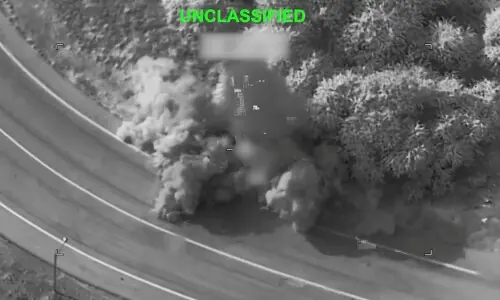
About 150 aircraft were involved, taking off from 20 different air bases across the Western Hemisphere. US forces disabled Venezuela’s air defence systems and plunged its capital Caracas into darkness, allowing US helicopters to land in Maduro’s palace grounds at 2:01 am. Within 30 minutes, the Venezuelan president and his wife were in US custody. An undisclosed number of casualties included Maduro’s more loyal security staff.
Trump watched the operation live from his Mar-a-Lago club in Florida, attended by US Secretary of State Marco Rubio and CIA director John Ratcliffe. “It was an incredible thing to see,” he crowed: “If you would have seen what happened, I mean, I watched it literally like I was watching a television show. And if you would’ve seen the speed, the violence … it was an amazing thing.”
Ironically, now that Maduro is out of the way, Trump’s plans to jump-start democracy in Venezuela do not include its opposition leader María Machado (a Venezuelan counterpart to Myanmar’s Aung San Suu Kyi). Aung San Suu Kyi won the Nobel Peace Prize in 1991. Machado was awarded the same prize in 2025 (as an affront to Trump). Even though she dedicated her award to Trump, it has obviously not been enough to relieve his bile.
A recent exposé — The Mission: the CIA in the 21st century by the Pulitzer prize-winning author Tim Weiner — concludes with these questions: “What would stop the president from declaring martial law or cancelling elections? Could Congress or the supreme court oppose him? Who would disobey him if he ordered the clandestine service to rebuild the secret prisons, overthrow a sovereign nation, or assassinate his political enemies?”
These are questions that may agitate European capitals. Beijing and Moscow are not bothered. While Trump may salivate over his next mouthful — Iran, Beijing will swallow Taiwan in fulfilment of its One China policy. Russia with unassuaged imperial longings looks beyond Ukraine.
And how do South American countries feel now that Trump has foreshortened his focus on a North-South axis? Brazil, Chile, Mexico, Uruguay and Colombia have chided the US for creating this “dangerous precedent for peace and regional security”. They are, however, reluctant to fight for the Venezuelan flag.
In 1982, South American leaders were quick to acknowledge the Colombian author Gabriel García Márquez when he won the Nobel Prize for Literature. They should re-read his award-winning book One Hundred Years of Solitude, and recall this advice to his fellow Hispanics: “Superpowers and other outsiders have fought over us for centuries in ways that have nothing to do with our problems. In reality we are all alone.”
The writer is an author.
Published in Dawn, January 8th, 2026