0
0
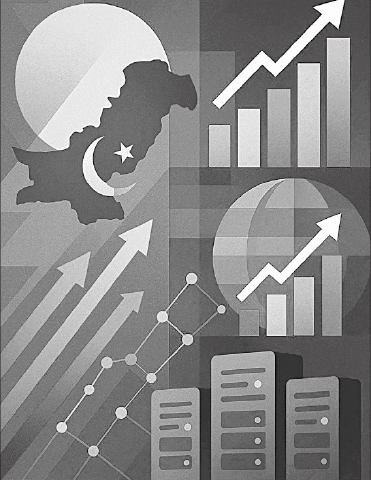
PAKISTANIS are a people perpetually caught between a difficult past and an uncertain future. The national conver-sation remains dominated by the politics of the moment. It is exhausting, and in this exhaustion, it is easy to dismiss any long-term plan as just another political slogan. The fact is that without lifting our gaze to the future, we are bound to go round in circles.
The year 2047, the country’s centenary, looks like a fair target to plan something meaningful. Instead of taking it as a distant fantasy, we should take it as a deadline. The focus should be on the kind of world we want to leave behind — a world built on a foundation of technology and production, not aid and remittances.
First, we have to stop treating artificial intelligence (AI) as a buzzword for conferences, and start seeing it as a tool for survival. Imagine an AI model trained on local data that can tell a farmer in Okara exactly when to plant his wheat to avoid a heatwave, or one that can help a doctor in Larkana diagnose a complex illness. We need to foster a generation of problem-solvers.
Second, we must look to the skies — not in prayer alone. Our space programme was once a source of pride. That can happen again. This is not about some vanity project, but about the practical necessity of having our own eyes in the sky. Sovereign satellite data means we can manage our water resources with precision, monitor our crops, and bring the internet to the remotest of villages, breaking the isolation that holds millions back.
Finally, we need to talk about making things again, but doing it the smart way. As such, our economic zones should be buzzing smart hubs where Pakistani engineers and technicians work alongside advanced robotics to produce the very components that power the global economy.
I can already hear the sceptics wonder how we can talk about satellites and AI when we cannot even keep the lights on. That is a fair point, but history shows us that crisis can be the mother of invention and, indeed, reinvention. Look at Indonesia. In the late 1990s, it was where Pakistan is now — shattered by a financial crisis, with its currency in freefall, and political system in turmoil. It used that crisis as a catalyst, making tough, unpopular decisions. Today, Indonesia is a rising economic power. Recovery is possible, but it requires a consistent vision that truly transcends governments and elections.
With 2047 in mind, the first decade must be about laying the foundation, and the second for connecting the dots and consolidating. None of this will happen, however, without one final, crucial ingredient: a national consensus. Our greatest enemy has never been a lack of potential. It has always been our divisive politics. Vision 2047 cannot be ‘their’ plan; it has to be ‘our’ plan. The Pakistan of 2047 is being shaped today. We can choose to be remembered as the generation that was so consumed by its immediate troubles that it mortgaged the future. Or, we can be the generation that, amidst the chaos, laid the first stones of a lasting edifice.
Zeashan Khan
Islamabad
Published in Dawn, October 25th, 2025