Twin cities under lockdown for second day as TLP protest looms


• Over 1,200 FC personnel moved to Gujrat, Lahore
• Few road blockades removed in Islamabad
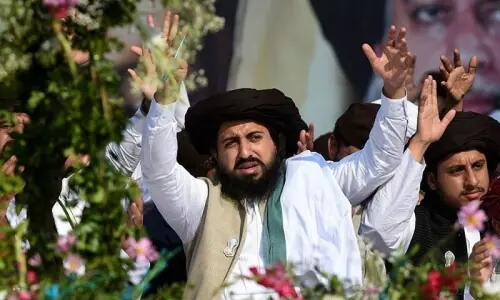
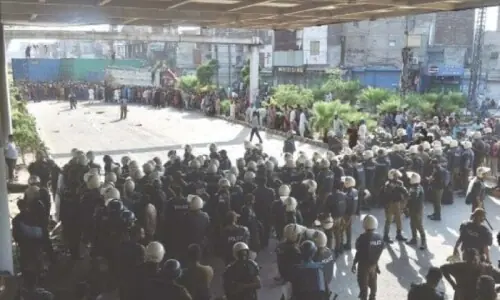
ISLAMABAD/RAWALPINDI: The twin cities of Rawalpindi and Islamabad remained under lockdown for the second consecutive day on Saturday in anticipation of a Tehreek-i-Labaik Pakistan (TLP) protest.
In a significant move, the federal government moved over 1,200 paramilitary personnel to Punjab to intercept protesters, who have been marching on the capital from Lahore via GT Road.
Meanwhile, the Islamabad Police registered separate cases against TLP activists for taking out rallies at different places.
Around 90 protesters were arrested in Tarnol, and 54 in Kati Pahari. The cases were registered under various sections of the Pakistan Penal Code and the Amplifier Act.
On Saturday night, the police also decided to lift blockades from a few roads.
The Tarnol case was registered after a rally at Tarnol Railway Crossing, about half a kilometre from the police station.
Police said a gathering of 300 people, carrying TLP flags, posters, and banners reached the crossing from Dhoke Abbasi and surrounding areas.
The rally chanted anti-government slogans and delivered speeches, provoking people to join the TLP protest.
The protesters also blocked the GT Road and refused to clear it when asked by the police.
In response, police used force, arrested 90 protesters, and seized sound systems, while others escaped.
Another case was registered over a rally of 120 protesters who arrived from Taxila and surrounding areas at Kati Pahari, near Nicholson Monument.
They were carrying TLP flags, batons, salt, and slingshots, along with posters and banners of party leaders. The group shouted anti-government slogans and delivered provocative speeches.
Police used force and arrested 54 participants during a crackdown as they prepared to move toward Faizabad for the protest.
Sources told Dawn that about 110 FC personnel were dispatched to Lahore, while the remaining force, supervised by a senior superintendent of police (SSP), was sent to Gujrat to assist the local police under the district police officer in blocking the TLP rally’s advance.
Meanwhile, Islamabad remained cut off from the rest of the country for the second day as all entry and exit points, along with main internal routes, were sealed.
Authorities had already imposed a near-complete lockdown in the capital, even though the TLP rally was still hundreds of miles away.
Large parts of the city remained isolated due to massive road closures.
The sealing of entry and exit points, along with motorway blockages, disrupted the supply of groceries, dairy, and poultry products.
Many dairy shops ran out of milk, while vegetable and fruit supplies dwindled, leading to sharp price hikes.
Poultry shop owners also complained of meagre supplies on Saturday. Traders expressed hope that supplies would be restored by Sunday to prevent further price escalation. Most educational institutions and businesses remained closed.
Activity in open commercial centres was much lower than usual, and public transport services, including metro and CDA electric buses, were suspended.
Only limited ride-hailing services were available. About 500 containers were used to seal the city’s entry-exit points and internal roads.
Late Friday night, deployed personnel were given rest, and between 11pm Friday and 11am Saturday, only 250 police officials remained on duty.
By late afternoon Saturday, a stand-down order was issued, though 250–300 officers continued performing duties at key points.
Police decided to ease a few blockades to provide citizens some relief. Entry and exit roads toward the airport, Zero Point, Srinagar Highway, Murree Road (Bara Kahu exit) and Expressway (Koral side) were reopened.
In the Red Zone, an additional entry via the Marriott Gate will open alongside the existing Margalla Road route from Monday.
For the second day, no protest of TLP was held in Rawalpindi and the situation remained peaceful. However, the closure of roads and entry-exit points caused severe difficulties for residents.
Shortages of wheat flour and sugar were reported, while traders warned that continued closure of the Grand Trunk Road would worsen the food crisis.
Grocery shops took advantage of the situation, increasing prices of vegetables and essential goods, while the district administration remained inactive.
For the last two days, containers were placed on Murree Road and adjoining routes as part of administrative measures to prevent protest rallies from entering densely populated areas.
Rawalpindi Merchant Association President Saleem Pervaiz told Dawn that grain supplies from central and southern Punjab had been halted due to the road closures.
He said traders had already informed the administration about the issue, but no action was taken. Supplies could improve within a day if the roads were reopened, he added.
“There is a shortage of wheat flour and sugar in the main retail markets,” he said, adding that wheat supplies from Islamabad flour mills were also suspended because connecting roads were closed.
Muhammad Anwar, a resident of Tipu Road, said he could not complete his weekly shopping from Raja Bazaar due to road blockages.
With intercity bus services suspended, railway stations were overcrowded.
Trains became the only means of connecting Rawalpindi and Islamabad with other cities.
“I came from Pirwadhai to go to Lahore, as there was no bus available due to the closure of GT Road and Motorway,” said Muhammad Saleem. “I had to walk because city roads were also blocked.”
Published in Dawn, October 12th, 2025