0
0
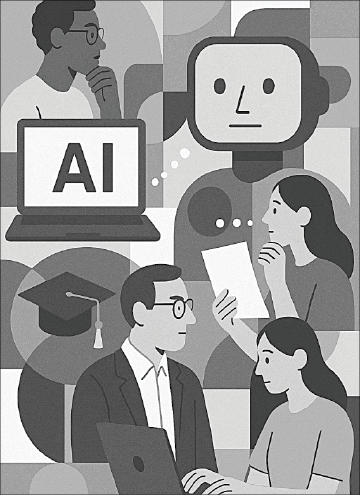
THE uninhibited use of artificial intelli-gence (AI) by students has created an atmosphere of mistrust globally between instructors and students. The matter has particular significance at the level of higher education where universities and regulatory bodies are are still in the process of crafting their policies around AI.
These policies need to be revisited and revamped regularly as more students discover new ways to circumvent them, blurring the line between ethical and unethical use of AI. Interestingly, students, too, have issues with the over-reliance of faculty members on AI.
There have been instances in which students have sued faculty for grading practices and feedback with the help of AI tools. Many students believe that instructors are relying too heavily on these tools, making their feedback irrelevant and disconnected.
Another challenge for universities is to find meaningful ways to curate their curriculum to prepare students for the AI-driven job market. Many fields are already considered outdated, and it is estimated that by the end of the decade, more professions and careers would be fully automated by AI, leading to an unprecedented loss of both blue-collar and white-collar jobs.
Studying critical thinking, liberal arts and ethics has become more important than ever, as the AI tools are still not intelligent enough to match the critical thinking skills of the human mind.
Therefore, leaving out liberal arts or undermining social sciences will only leave our students unable to use their soft skills to compete in the evolving world. This is what we are seeing in the United States, where liberal arts programmes are increasingly under attack.
A recent study at the famed Massachusetts Institute of Technology (MIT) compared a group of people who used AI to generate answers with another group of people who did not. The former showed a significant decline in cognitive functions compared to the latter.
It is not that AI can be restricted, but, as instructors, we need to be positively cautious in trying to incorporate AI usage in course content.
Universities must chart out policies allowing their students to use AI, but in a manner that helps in their critical thinking. The emerging element of ‘prompt engineering’ needs to be taught to the students so that they may use AI without compromising their cognitive thinking skills.
These skills are mostly taught in courses that fall under liberal arts and social sciences. Even students from Computer Science, Business Administration and Finance programmes get exposure to soft skills during such courses because they are usually not taught and discussed in their core courses.
In this new economy, it is becoming imperative to embrace AI in the education sector, specifically higher education. Pakistan must keep its focus in terms of raising the new generation equipped with modern tools without compromi-sing on the element of critical thinking.
Dr Ismat Abbas
Karachi
Published in Dawn, September 5th, 2025