CJP Afridi questions LHC’s ‘final observations’ in Imran’s May 9 bail cases


 0
0
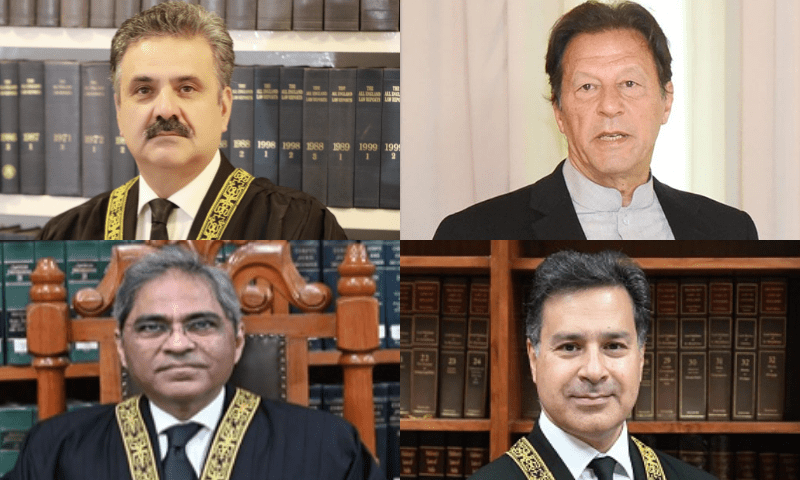

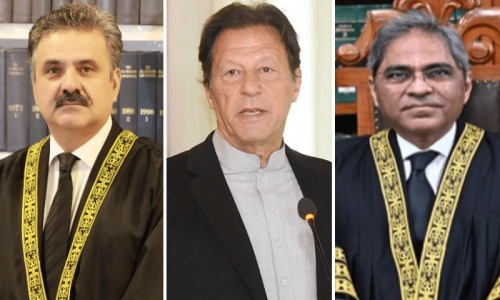
Chief Justice of Pakistan (CJP) Yahya Afridi on Tuesday raised questions over some observations made by the Lahore High Court (LHC) on former premier Imran Khan’s bail pleas in eight May 9 cases.
In November 2024, a Lahore anti-terrorism court had denied Imran bail in the cases related to the May 9, 2023 riots, including an attack on the house of the Lahore corps commander.
The incarcerated PTI leader’s plea challenging that was also rejected by the LHC on June 24. Subsequently, days later, Imran moved the Supreme Court against the high court’s decision.
A three-member bench led by CJP Afridi, which also included Justices Muhammad Shafi Siddiqui and Miangul Hassan Aurangzeb, resumed hearing the bail pleas today.
Barrister Salman Safdar appeared on behalf of Imran, while Punjab Special Prosecutor Zulfiqar Naqvi was representing the state.
During the hearing, CJP Afridi took note of some “findings” issued by the LHC in its detailed verdict of dismissing Imran’s bail pleas.
“Can final observations be given in a case for bail?” the chief justice questioned rhetorically.
Based on the same principle, he said, “For now, we will not touch upon whether the findings in this case are right or not. We will not go into the legal matters at the moment.
“If we touch upon the legal findings, then the case for either [party] can be affected,” CJP Afridi explained.
He directed the counsels of both respondents to assist the court with legal questions and complete their preparations by the next hearing.
“The Supreme Court will not issue any such findings that may affect the case,” the top judge reiterated.
At one point, Safdar requested the court to allow him to speak at the rostrum but CJP Afridi denied that plea.
Subsequently, the bench issued notices to the Punjab government and adjourned the hearing till August 19.
‘Engineered and fabricated evidence’
A two-member bench of the SC had taken up Imran’s bail pleas on June 29, but adjourned the hearing without issuing notices as Safdar could not appear.
Imran’s appeal, filed through Safdar, claimed that the PTI founder has been accused of conspiring and abetting violence on May 9.
However, at the time of the alleged offence, Imran was in the custody of the National Accountability Bureau. Therefore, his involvement in violence was “impossible”, the petition argued.
On LHC’s rejection of the bail pleas, the fresh appeal claimed that the court relied on “engineered and fabricated evidence” which included “stale, discredited and delayed statements of police officials”.
In its detailed verdict, the two-member LHC bench comprising Justice Syed Shahbaz Ali Rizvi and Tariq Mahmood Bajwa observed that the prosecution had evidence that reflected Imran’s role in the violence that broke out on May 9 following his arrest.
The bench reproduced the statements of two police officials and prosecution witnesses, who claimed to have secretly attended PTI’s meetings wherein Imran allegedly gave instructions to other leaders to attack military installations in case of his imminent arrest from the Islamabad High Court (IHC).
The meetings were allegedly held at a rest area of Chakri, Rawalpindi, on May 4 and at Imran’s Zaman Park residence in Lahore on May 7-9, 2023.