• Indian media’s heavily slanted account prompted its external affairs ministry to accuse Pakistan of ‘nuclear sabre-rattling’
• Islamabad blames New Delhi’s chronic tendency to distort facts; terms insinuations against military command structure ‘self-serving construct’
ISLAMABAD: A major controversy erupted after Indian officials and media outlets tried to blame Pakistan for what they called threats of “nuclear blackmail”.
Islamabad termed the claim a “distorted” interpretation of remarks made by Field Marshal Asim Munir during his US visit, calling it “immature”.
The fracas began after an Indian news outlet claimed to reconstruct comments made by the army chief in Tampa last week.
Attributed to unnamed participants, the Indian media’s account of the event alleged the army chief had threatened the use of nuclear weapons, and missile strikes against New Delhi.
The report prompted a venomous statement from the Indian external affairs ministry, pointing accusatory fingers at Pakistan’s command and control structure and alleging links with militant groups.
Pakistani officials, however, insisted the narration was heavily slanted to malign the country and advance an Indian agenda.
On Friday, the field marshal addressed a gathering of the Pakistani community in Florida, where — in wide ranging remarks — he spoke about how both India and Pakistan were nuclear armed countries.
In that context, he reportedly said, the comments from Indian side haven’t been encouraging when it comes to peace between the two nations.
Reportedly referring to India’s tall claims about erasing Pakistan from the face of the earth, he said that any conflict between the two nuclear-armed neighbours would have a catastrophic impact for the region and beyond.
According to one of the participants of the gathering, the field marshal reportedly said that if the Indians think they can nuke Pakistan and get rid of it, they don’t seem to understand that the impact of such a move would not just be limited to South Asia’s borders alone, and possibly half of the world will be impacted.
However, Indian outlet The Print offered what seemed to be a more slanted account, claiming that the field marshal had threatened India with nuclear war.
It quoted the army chief as saying: “We are a nuclear nation, if we think we are going down, we’ll take half the world down with us”.
This characterisation prompted the Indian Ministry of External Affairs (MEA) to describe the alleged comments as “nuclear sabre-rattling”.
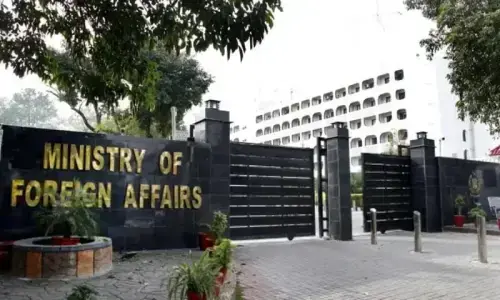
Rebutting Indian claims, Foreign Office Spokesperson Amb Shafqat Ali Khan said, “Pakistan strongly rejects the immature remarks made by the Indian Ministry of External Affairs earlier today, which is yet another demonstration of their chronic tendency to distort facts and twist statements out of context.”
He described the “nuclear blackmail” charge as a misleading “self-serving construct” that did not reflect the reality of Pakistan’s nuclear policy. “Pakistan remains firmly opposed to the use or threat of use of force,” he maintained.
The MEA further alleged that extremist influence could compromise Islamabad’s decision-making. Responding to these insinuations, the FO spokesperson said, “Pakistan’s sustained and credible counterterrorism efforts are internationally-acknowledged. Our security forces remain the bulwark against terrorism. The Indian MEA’s spurious insinuations are irresponsible and without a shred of evidence.”
Amb Khan emphasised that Pakistan is “a responsible nuclear weapon state with an elaborate command and control structure under full civilian control” and that it “has always exercised discipline and restraint, while dealing with the issues of such importance.”
He accused India of “sabre-rattling and warmongering,” adding that whenever New Delhi’s aggressive rhetoric is challenged, it turns to “baseless and irrational accusations.”
The center plank of MEA statement was that the alleged remarks were made “from the soil of a friendly third country” – a clear reference to US – in what appeared to be an attempt to raise concerns in Washington and disrupt Islamabad’s improving ties with the US.
In response, Pakistan voiced concern over India’s attempt to involve third countries in the dispute, calling it a “futile attempt” to pressure Islamabad, with Amb Khan saying that the reference reflected its “lack of diplomatic confidence.”
Munir’s trip to the US, which included attending the retirement ceremony of US Gen Michael Kurilla, has been closely monitored by Indian intelligence agencies amid concerns over a revival of US-Pakistan ties.While the visit was officially linked to Kurilla’s farewell, Munir also reportedly made an unannounced stop in Washington for meetings with senior US officials further heightening Indian apprehensions.
Published in Dawn, August 12th, 2025