SOCIETY: THE STAIN OF HONOUR
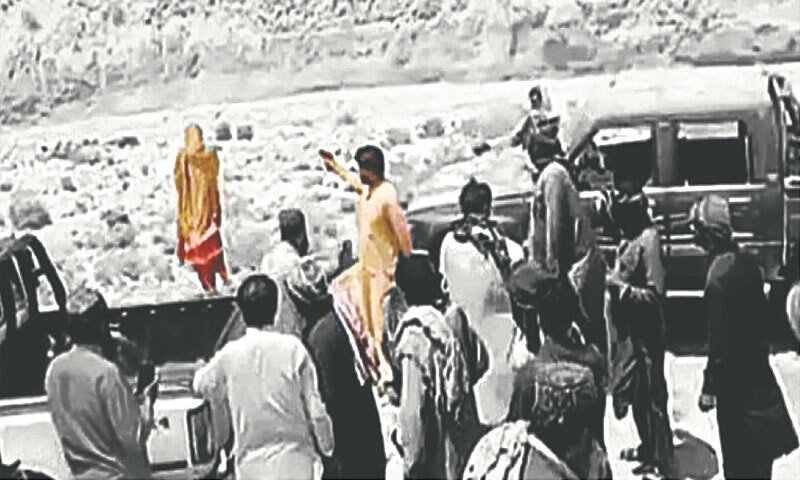

There has been a pallor of gloom mixed with outrage in Quetta, the provincial capital of Balochistan, over the grisly murder of a couple in the name of “honour”. This follows the emergence of a gruesome video that went viral on social media. In it, a couple can be seen being shot at point blank range.
The couple were later identified as Ehsan Sumalani and Noor Bano Satakzai, who were killed on the outskirts of Quetta in the Degari area — around two months before the video surfaced at the end of July.
THE CONVOLUTED TRIBAL CODE
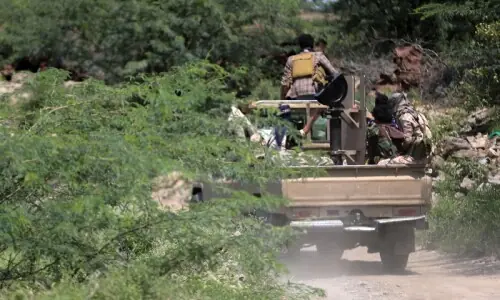
While driving to Degari, which is dominated by Satakzai tribesmen who live in villages tucked between the mountains surrounding Quetta and Mach districts, there is a deafening silence. But in the villages, there is outrage — albeit of a different sort from Quetta.
The tribals are miffed at the arrests, including of their tribal leader, Sardar Sherbaz Satakzai. “The couples were punished as per the tribal norms,” says Noor*, a tribal youth from the area who did not want to be named due to the sensitivity of the issue. “They were killed for having an extramarital affair, despite having children,” he tells Eos. “That is why they were punished for bringing disrepute, not only to their tribes but also to their families.”
Like Noor, other tribesmen Eos spoke to echoed the same sentiments.
This includes Gul Jan Bibi, the mother of the murdered woman, who justified the killings in a video. In the video, she also claimed that the sardar [tribal leader] had nothing to do with the killing. Following her video, she too has been arrested by the police.
A viral video reveals the cold-blooded murder of a couple in Balochistan, sparking outrage. But in the tribal heartland, many defend the killing as ‘justice’…
Unfortunately, this mindset seems to be widespread among tribal clans in Balochistan. This is one reason why such murders take place with absolute impunity, while the state is reduced to the role of a silent spectator.
One such instance in the grisly murders in Barkhan in 2023, when three bullet-ridden corpses — of one woman and two young men — were found in a well near the house of Sardar Abdur Rehman Khetran. One of the victim’s family members accused Khetran, who is not only the head of his tribe but was also a minister at that time, of keeping his relatives in prison and murdering them.
Having previously been mired in controversies, including allegations of keeping people captive in private jails as far back as 2006, Khetran was able to acquire bail over “lack of evidence.” Even today, he holds a ministerial portfolio in the cabinet of Chief Minister Sarfraz Bugti. It is widely believed that Khetran and others like him enjoy impunity because of their proximity to the country’s establishment.
LIMITED DETERRENCE
The Degari incident is neither the first nor the last incident of gruesome murders in Balochistan. Just a few days ago, before the emergence of the Degari incident video, another woman was reportedly shot dead by her uncle in the name of so-called honour in Jaffarabad district.
But the Jaffarabad incident has failed to send shockwaves through the country, as the incident was limited to a police report, unlike the Degari incident, with its gruesome video seared into our collective conscience. This begs the question: what about the other cases which are not reported due to Balochistan’s remoteness?
According to Sustainable Social Development Organisation, an Islamabad-based independent organisation, more than 32,000 cases of gender-based violence were reported in Pakistan in 2024, including 547 instances of “honour killings” — 32 of them in Balochistan, with only one resulting in conviction.
Fauzia Shaheen, who has previously served as the chairperson of the Balochistan Commission on the Status of Women where she dealt with cases of honour killings, believes there is greater scrutiny on such incidents now, due to which, she believes, cases of honour killing are not increasing as compared to the past.
“It is because cases of honour killings are now being reported and highlighted, unlike in the past, in places such as Naseerabad, where nobody dared talked about it before,” she tells Eos. Now, cases are reported by the media and the police takes action, and people are also not accepting and tolerating these murders in the name of so-called honour, she adds.
A SLOW CHANGE
Shaheen is right to assert that things are changing now, perhaps a little. For instance, in 2008, three girls were buried alive in Balochistan in the name of so-called honour. Mir Israr Zehri, who was a senator at the time, categorically stated on the floor of the upper house that the killings were a part of their traditions. Today, no one can dare utter a single word to defend such murders.
“There is already a law on the federal level on [so-called] honour killing,” says Shaheen, referring to the 2016 amendments in the wake of celebrity Qandeel Baloch’s murder by her brother. The legislation mandates life imprisonment — 25 years in prison — for convicted murderers, even if the victim’s relatives forgive them.
However, Quetta-based women rights activist Qamar-un-Nisa thinks that tribal customs, such as the ones in which a woman is deprived of her life in the name of so-called honour, remain above the law.
“Even when people are arrested [in connection with ‘honour killings’], they are released once the dust settles,” she tells Eos. “There should be stricter laws, deterrence and punishment to discourage the practice of [so-called] honour killings,” she adds.
The tragic incident that occurred in Degari and ended the lives of Ehsan Sumalani and Noor Bano Satakzai may fade from memory sooner or later. But we would do well to remember one thing, as seen in the video:
“You are only allowed to shoot me, nothing more than that,” Noor Bano tells her brother, with courage and conviction in the face of impending death. As she falls to the ground after her brother shoots her — seven times — her lifeless body stares back from the ground, putting to shame this very concept of “honour” that has failed our women and girls.
** Name changed for privacy*
The writer is a member of staff.
He can be reached at
akbar.notezai@gmail.com
Published in Dawn, EOS, August 3rd, 2025