CONTAINING THE PRICE SPIKE OF RAMAZAN
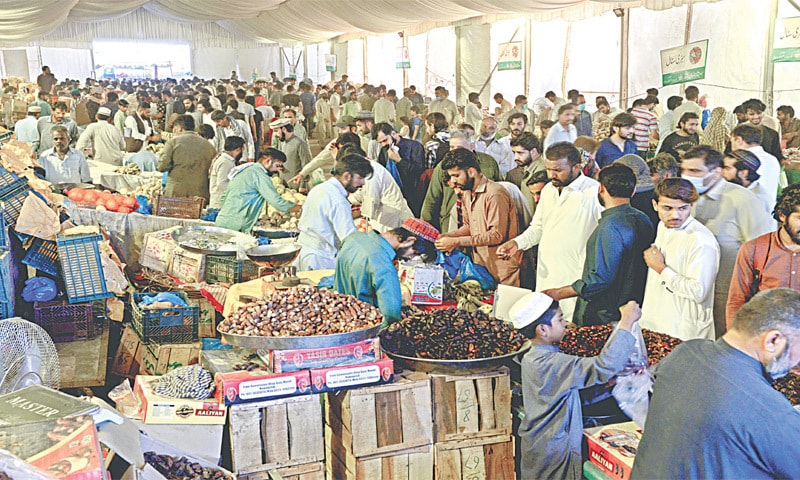
Every Ramazan, like clockwork, the markets begin to change their rhythm. The footpaths thicken with shoppers, as fruit stalls glow brighter, stacked high with bananas, apples and other seasonal fruits. The vegetable sellers speak faster, not because they want to deceive you, but because there are simply too many customers and too little time.
This isn’t an anomaly, this is seasonality. The patterns repeat every year and disposable income keeps shrinking further.
Over the last six years, prices across the board have increased by more than 111 percent, while prices of a broad-based basket of food has increased by 116 percent. Effectively, prices have more than doubled in many cases and remain around that range. Despite the run-up, a price bump is also a regular occurrence. When you track food prices week-by-week and month-by-month, you see a recurring ‘Ramazan Premium’, a step-up in prices that arrives with remarkable regularity.
It does not hit every item equally. It concentrates in the foods people buy more of during the month: vegetables, fruits and proteins. It is sharpest where the supply chain is weakest: perishables that spoil quickly and items where market power is concentrated at a few chokepoints.
It is estimated that, over the last five cycles of Ramazan, the price of the most basic basket of food, as tracked by the Sensitive Price Index (SPI), has increased by an average of 27 percent every year. This is the spike that is in addition to overall inflation at play. Before the start of the holy month, as demand picks up, prices of food items start picking up, with perishable items leading the charge.
After death and taxes, the biggest certainty in Pakistan is the annual spike in the price of basic commodities, especially fruits, vegetables and proteins, during the holy month of Ramazan. The price hike not only constrains household consumption but also leads to negative long-term repercussions in terms of health and social inequality, since it affects the economically vulnerable the most. What is the real cause of this seasonal price inflation and can we muster anything other than moral outrage to control it?
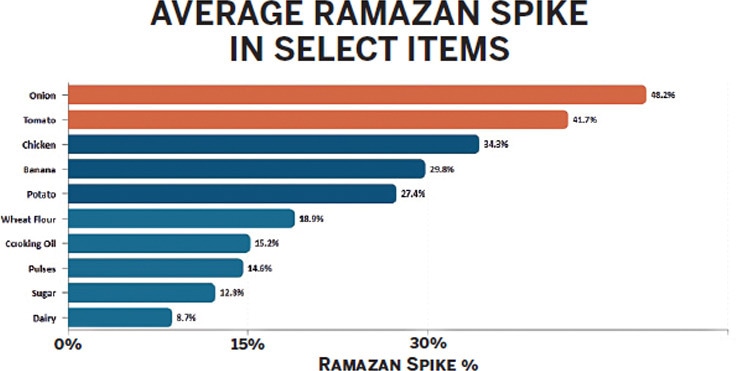
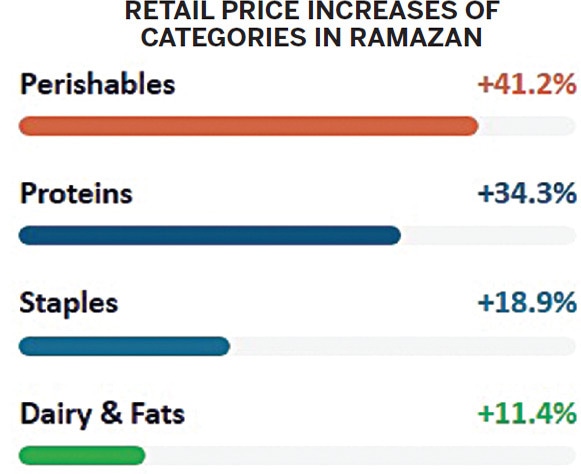
Banana remains the most volatile fruit, with prices increasing on average by 30 percent during Ramazan, relative to adjacent months, but sometimes increasing by as much as 70 percent during the first two weeks of Ramazan. It is estimated that, on average, the price of perishable items — which includes fruits and vegetables — increases by an average of 41 percent during Ramazan, while non-perishables increase by 20 percent.
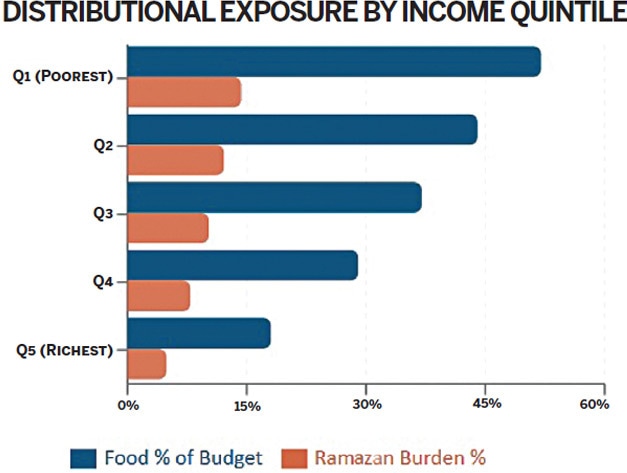
For many families, this is not a minor concern. Food is already the biggest monthly expense, making up almost 48 percent of the monthly budget of the poorest 40 percent of the country’s households (more than seven million households). A lazy assessment of the same would suggest that people consume a lot, but the reality is that they do not have sufficient incomes. Hence, whatever they have, most actually gets spent on food, leaving very little for other essentials, such as education, health or any other shocks.
When prices jump, there is no ‘extra’ money to absorb the shock. Something has to give. Milk becomes less frequent, meat disappears from the week (or even month), fruit turns into a luxury, and the household’s nutrition quietly deteriorates in the very month built around restraint, empathy and care.
But if a pattern can be observed, if there is seasonality, the same can also be managed through targeted policy interventions. This is not a feeling. It is a pattern, and it is avoidable. To understand why prices escalate so much, and what it will take to prevent it, we need to evaluate the problem through two lenses.
One is the consumer’s lens, wherein we look at what people actually pay at the retail level. The other is the supply chain lens, wherein we see what is happening in wholesale markets, where prices are discovered before they travel to your neighbourhood shop. When the two lenses are combined, the picture becomes clearer, and so do the solutions.
MEASURING THE PROBLEM
Economists hide behind complicated models. This problem doesn’t require that, but it requires careful measurement and honest interpretation. In the work behind this piece, two separate methodologies were used to track food inflation and its Ramazan pattern.
Pakistan’s SPI tracks weekly retail prices for essential items. It is like a pulse check of what households are paying, especially for frequently purchased and essential goods. To make the SPI more meaningful for Ramazan, it was disaggregated into an SPI Food Basket Index, built from a defined set of essential food items, such that the food basket reflects household consumption patterns more realistically than a simple average. The result is a single line that moves with food prices on a weekly basis, showing both the trend and the seasonal shocks.
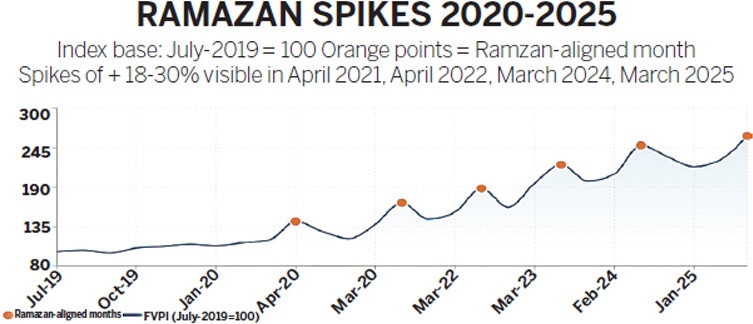
Evaluating this food basket index from early 2020 to early 2026, one feature stands out during each Ramazan period: the index spikes above its normal path. Not once, but repeatedly and consistently. More importantly, the spike is not small. Depending on the year, escalation in prices during Ramazan has been in the range of 25-35 percent, above the ‘baseline’ level suggested by adjacent months. It persists even when overall inflation is rising or falling. It is not just inflation; it is inflation plus a seasonal surge with a very predictable timing.
Consumption patterns during Ramazan are largely tilted towards fruits and vegetables. Before a tomato reaches your kitchen, it passes through wholesale markets, transporters, commission agents, storage decisions, wastage and often several layers of bargaining. Moreover, a tomato that reaches your kitchen can come from different parts of the country at different times of the year, hence the sheer volatility in the price of a tomato. Despite such predictable volatility emanating from supply chain weaknesses, any policy efforts to address the same have been half-hearted at best.
Moreover, there is a lot of seasonality in fruits and vegetables. Some fruits and vegetables are consistently available throughout the year, hence any representative index that tracks prices of fruits and vegetables must take that into consideration. To keep things simple, a Fruits and Vegetables Price Index (FVPI) was constructed, with equal weightage given to onions, potatoes, tomatoes, bananas and apples — a staple of every household, perishable to various degrees.
This second lens is crucial for two reasons, it tells us whether prices are rising because supply is tightening and wholesale prices are genuinely climbing, or whether retail prices are rising more than wholesale, suggesting margins, mark-ups and market power are playing a role. It also allows us to identify whether the problem is ‘everywhere’ or concentrated in specific markets.
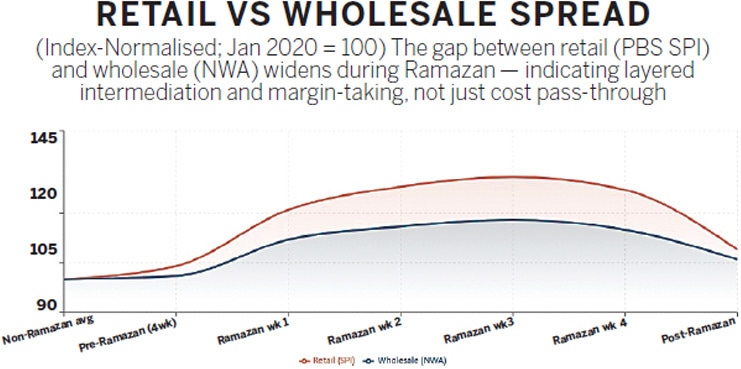
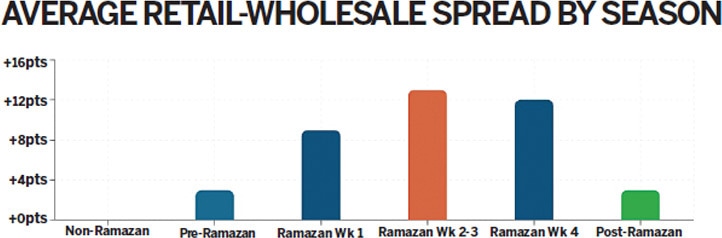
Prices at both wholesale and retail level were evaluated to ascertain the spread between the two prices, resulting in computation of the retail-wholesale ‘wedge’, which is effectively the spread between what consumers eventually pay and what the wholesale markets imply. The ‘wedge’ story is what the Ramazan premium is largely all about.
Ramazan is not just expensive, it is systematically expensive. Across multiple years, two things appear consistently — firstly, prices rise faster during Ramazan than in the adjacent months. When you isolate Ramazan months and compare them with non-Ramazan months in each year, the ‘Ramzan premium’ shows up clearly. The retail food basket jumps. Then, after the month passes, prices often ease, though not always fully, towards the pre-Ramazan trend. This is the hallmark of a seasonal shock: a predictable, temporary distortion rather than a slow, structural drift.
Secondly, the biggest spikes are concentrated in perishables. Not all foods behave the same way. Vegetables and fruits tend to show the largest Ramazan impact. In category terms, the average increase during Ramazan has been highest in vegetables and fruits, well above staples and pulses, and often higher than proteins too. Onion prices, tomato prices and potato prices are often the most volatile. Eggs and chicken also show meaningful Ramazan movement. These are not luxuries. These are the building blocks of everyday meals.
But why these items specifically? Because perishables are where the market is most fragile. They cannot be stored for long without proper infrastructure, they are easily disrupted by transport delays, they are sensitive to weather and they are vulnerable to information games, such as rumours of shortage, expectations of price hikes, speculative holding and the strategic release of stock.
The retail-wholesale price wedge we discussed earlier, which often widens during Ramazan, and predictably so, is the most policy-relevant insight. If wholesale prices rise, retail prices rising is not surprising. But when retail prices rise more than wholesale prices, especially in a short predictable window, it signals that the supply chain is not just responding to costs — it is amplifying them.
When the wedge widens, consumers are not merely paying for higher farm-gate or wholesale prices. They are paying for inefficiency, bargaining power and, sometimes, opportunistic behaviour in the chain between wholesale and retail. That wedge is not always evidence of wrongdoing. It can reflect genuine costs, which may include higher wastage, longer queues, more trips, higher transport rates or temporary shortages in certain markets. But it is a red flag — it tells the state where to look and which links of the chain require reform.
WHY PRICES SPIKE
The common response to a spike in prices is moral outrage, which largely revolves around the notion that people are greedy. That may be emotionally satisfying, but it is not a policy. Greed does not change year-to-year, yet the size of the spike does. The real explanation is structural: Ramazan creates a demand shock in a system that is already weak.
Ramazan changes household consumption patterns. Iftar and sehri create predictable changes in what is bought: fruits, vegetables, gram flour, lemons, dates, chicken, eggs and beverages. It is not just more demand, it is concentrated demand. If supply chains were elastic, if they could respond quickly, prices would rise modestly and then stabilise. But Pakistan’s perishable supply chains are not elastic. They are brittle.
A bag of wheat can sit for months. A tomato cannot. Pakistan’s cold chain is thin and non-existent for fruits and vegetables at scale. Storage is inadequate, electricity is expensive, while grading, sorting and packaging are rudimentary. Transport is often inefficient and costly, potentially belonging to the early part of the last century. A chunk of produce is lost to wastage before it reaches consumers. Due to this, as demand rises, wastage rises too, because volumes increase but handling capacity does not. In this context, as wastage rises, prices rise, even if total supply in the country is not dramatically lower.
In modern produce markets, prices are transparent. Buyers and sellers can see volumes, arrivals and rates across markets daily. In Pakistan, transparency is non-existent, or partial at best. When information is weak, ‘expectations’ become powerful. If buyers believe prices will rise tomorrow, they buy more today. If wholesalers believe shortages will emerge, they hold stock. If retailers see everyone raising prices, they do the same, often without real knowledge of upstream prices. Such opacity rewards actors who have better information and punishes households who buy at the end of the chain.
But why even is there opacity when we know exactly when prices will increase and specifically of which products? This is where policy failure reigns supreme. At a macro level, everyone knows there will be an escalation in prices during Ramazan, but the policy tools used are blunt at best and have not worked for many years. Ramazan packages that give a direct subsidy do not solve the supply chain problem, they just expand the wedge.
The state needs to focus more on fixing supply chain inefficiencies and less on policy adventures that do not work, such as price controls, magistrate raids and fines. We need more supply chain reform and less theatrics. If the core issue is supply chain bottlenecks and lack of transparency, then raids treat symptoms. They do not treat the disease.
On a similar note, Pakistan routinely waits for shortages to become headlines before moving policy. By then, import decisions face lead times, logistical constraints and political noise. A predictable seasonal spike requires pre-emptive planning months in advance, not announcements in the last week before Ramazan.
The cost of inflation in Ramazan is not just financial, it is nutritional. When food becomes expensive, the rich adjust preferences while the poor adjust quantities. The quantity adjustment has been such that, over the last 10 years, there has been a decline in consumption of food across the board, with the highest loss coming among the most vulnerable segments.
A household that spends a large share of income on food has limited room to manoeuvre. When prices jump, they cut protein, fruit and dairy first, exactly the items children need most. They shift towards cheaper calories. This is how seasonal price spikes translate into long-term human costs — stunting, micronutrient deficiencies, poorer learning outcomes and a higher healthcare burden.
This is why the issue deserves to be treated as more than a monthly inconvenience. It is a public health and inequality problem, and it cannot be solved by throwing more money (or subsidies) at the problem, thereby exacerbating the same.
WHAT CAN BE DONE?
The goal is not to ‘control prices’ in the crude sense, but the goal ought to be to make markets work better. We need to evaluate the problem along three paradigms: what can be done immediately, what can be done in one season and what must be built over several years. A simple public dashboard can change buying behaviour, and compress the wedge that exists between retail and wholesale prices.
A widely disseminated dashboard that covers wholesale prices across major markets, retail prices in major cities, volumes/arrivals where available etc can shape demand preferences and reduce information asymmetry. When information becomes public, the space for manipulation narrows, panic-buying reduces and media narratives improve. More importantly, policy becomes data-driven.
A coherent demand and supply forecasting framework needs to be in place at some federal or provincial level to ascertain exactly how much concentrated demand actually emerges during Ramazan and what supply interventions are required to address the same. Understanding demand-supply patterns holds the key in unlocking this puzzle, as that allows planning to raise supply well in advance, rather than scampering right at the end and sending panic signals to the market. Even if such bodies exist, their output is non-existent and, thereby, their ability to mollify any price-driven panic is negligible.
The Ramazan Bachat Bazaar is a policy intervention that actually works and that can be expanded further, since it expands the distribution of the wholesale market, creating sub-wholesale markets. District administrations can play a pivotal role in expanding the scale and scope of the same, considering the concentrated nature of demand during the month. Such an intervention delivers outsized social returns, relative to the theatre of price controls and magisterial raids shot for a TikTok audience.
Easier said than done, but solving the problem requires genuine on-ground reforms in the mid-to-long-term. The heart of the problem is often the wholesale yard, or the mandi, which is congested, opaque, dominated by intermediaries and resistant to reform. A practical reform package should include digital price reporting at a district, provincial and then national level, and auction platforms where feasible, as well as standardised grading/packaging rules to reduce disputes.
Even small improvements here can reduce the retail-wholesale wedge. But who is going to bell the cat, or skin the fruit, remains the question.
There is a lot of noise and conversation around storage, but the conversation largely focuses on wheat. It is important to incentivise the development of strategic cold storage in a targeted manner, particularly in high-consumption corridors, for items with high wastage and for market nodes that serve multiple districts. The same can be rolled out through public-private models and would deliver substantial returns on any public investment, relative to blunt force instruments such as direct subsidies or loss in public welfare due to high prices.
There is a moral dimension to this issue that goes beyond economics. Ramazan is meant to cultivate empathy, to feel what hunger feels like, to understand vulnerability and to soften the heart, if its true spirit is to be adhered to. When food becomes systematically costlier in this month, the burden shifts precisely on to those least able to carry it. It turns a spiritual month into a financial trial.
THE NEED FOR RAMAZAN REFORMS
The data tells us clearly that the price surge is measurable and not mysterious. It repeats often and in such a predictable manner that planning can beat panic. A large part of the spike is tied to systems, information asymmetry, logistics and market structure — things that policy can improve.
We do not need miracles or subsidies. We need discipline. A country that can run complex national operations, elections, vaccination drives and large-scale security deployments can certainly organise a seasonal food supply plan. The month arrives on the calendar every year. Its demand patterns are known, while the pressure points are predictable, down to the district level.
The most powerful reform would be to treat Ramazan price stability not as a media scandal to manage but as an operational goal to deliver. If we can deliver on that, the benefits are immediate and widespread, which would reduce food expenditure for vulnerable families, enhance nutrition for children, reduce anxiety in households already stretched thin, while creating a market system that feels fairer.
That is not just good economics, it is good governance. If we truly want to honour the spirit of the month, we should start by making sure that worship does not come with a predictable price penalty while buying something as mundane as a banana.
The writer is a macroeconomist and professor of practice at IBA, Karachi. He can be reached at ammar.habib@gmail.com
Published in Dawn, EOS, March 1st, 2026