SINCE the Musharraf era — that is, for over two decades now — KP, particularly the ex-Fata region, has been a war zone, suffering from terrorist attacks, as well as the effects of repeated military campaigns.
Yet despite these operations, terrorist groups, particularly the banned TTP, have yet to be completely defeated. For example, in Tirah, local tribes have apparently asked TTP fighters to leave the region. As per reports, the militants said they would ‘consult’ their leadership in Afghanistan regarding their withdrawal from the area.
This shows how entrenched the terrorists are in parts of KP, besides highlighting the fact that the TTP command structure remains intact in Afghanistan. It is because of the continued militant presence in parts of KP that the military has yet again launched an operation in parts of Bajaur tribal district.
With the launch of Operation Sarbakaf, the local people once again find themselves caught in the crossfire between the terrorists and the military. Bajaur’s people had staged protests against the latest military campaign, with the tribal population saying they were not given advance warning of the operation and the related curfew. Fear of more death and displacement haunts them.
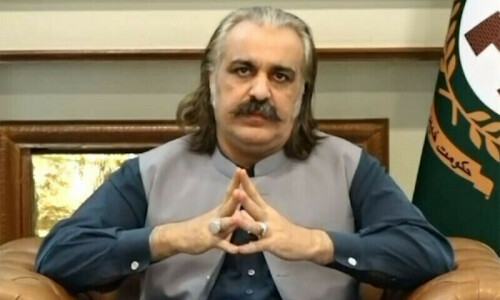
The PTI government in KP had initially criticised the campaign, but the chief minister, in an apparent U-turn, backed the action. However, the PTI continues to oppose military action in KP’s affected areas. The tribal people’s reservations about repeated operations are understandable, and there have been large demonstrations against both militancy and military campaigns after terrorism resurfaced in KP following the Taliban’s return to power in Afghanistan in 2021. They rightly ask why terrorism has still not been eliminated after decades of counter-insurgency campaigns.
Perhaps the main issue with counterterrorism operations in KP is that while security forces have fought hard and given sacrifices — succeeding in the ‘clear and hold’ phases — the ‘build’ phase of CT campaigns has failed to deliver. For this, both the civilian and security leaderships are responsible; the former for not building the capacity of civilian LEAs, and the latter for not completely stopping infiltration attempts from Afghanistan.
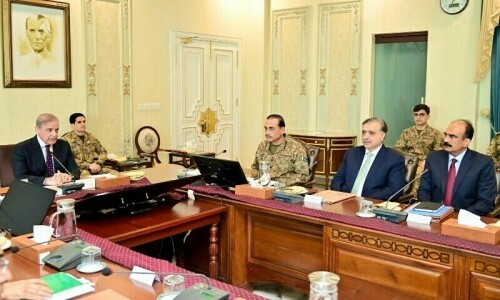
However, during a meeting of the ‘Harden the State’ committee on Thursday, the PM discussed a multipronged strategy involving operations, legislation and public outreach to combat extremism. While the issue of terrorism must be taken up with Afghanistan, local responses should ensure that this time, CT actions are thorough, so that KP’s people do not suffer endlessly.
The state must establish its writ across the country, and there can be no fiefdoms where terrorists dominate. All points highlighted in the revised NAP need to be implemented, as kinetic action alone is not enough. Moreover, CT operations should ensure that there is minimum collateral damage and that terrorist groups such as the TTP are uprooted permanently.
Published in Dawn, Aug 2nd, 2025