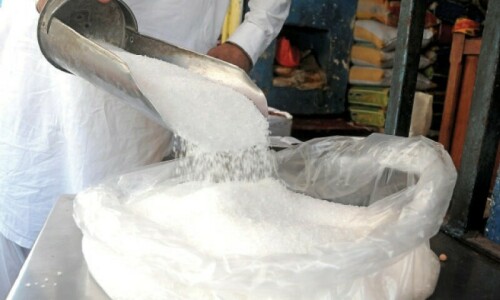
DESPITE claims of adequate sugar stocks, Pakistan faces another crushing price hike in 2025. At the heart of the crisis lie structural inefficiencies, elite capture, and institutional failure. Urgent reforms are needed to protect farmers, consumers, and the economy.
Pakistan is once again in the grip of a familiar affliction: the annual sugar crisis. In 2025, retail sugar prices have surged past Rs200 per kg in many urban and peri-urban markets, despite official statements insisting on sufficient stocks.
In the 2024-25 season, Pakistan’s sugar production is estimated to be 6.8 million tonnes, while consumption is expected to be 6.6m tonnes, leaving a very little surplus and minimal opportunity for market swings.
Rather than a problem of genuine scarcity, this crisis appears to be largely manufactured, fuelled by a toxic combination of speculative hoarding, market manipulation, weak governance, and poor regulatory oversight. The result is that consumers are burdened, farmers are shortchanged, and trust in public institutions continues to erode.
Without transparent and inclusive reforms, Pakistan will remain trapped in a cycle of sugar surpluses on paper and shortages in reality
At the core of this issue lies the unchecked power of a small group of politically connected sugar mill owners. These influential players have repeatedly benefited from preferential treatment in export policies, subsidies, and lax enforcement. The lack of transparency in how sugar production and stocks are monitored has created space for cartels to manipulate supply chains, control prices, and reap windfall profits.
The Competition Commission of Pakistan (CCP) has raised red flags about cartelisation in the sugar sector, but implementation remains weak. Previous enquiries and reports have led to few structural changes. Meanwhile, millers are accused of delaying payments to farmers or paying below the officially mandated support price and exploiting their economic vulnerability.
While mill owners profit, sugarcane farmers suffer. Poor yields, rising input costs, and inconsistent procurement practices have discouraged investment in sugarcane cultivation. Climate change — particularly erratic monsoon patterns and water scarcity — has further hit productivity. In provinces like Sindh and Punjab, growers have been vocal about millers refusing timely procurement or manipulating weighbridge measurements to reduce payments.
It was investigated that a critical situation in the sugar industry, where a major decline in sugarcane recovery and cultivated acreage has resulted in a supply crisis. Sugarcane recovery has dropped up to 12 per cent, while the area cultivated under sugarcane has been reduced 20pc. The combination of decreased yield and limited production area is placing pressure on the sugar supply.
In 2024, many farmers had cut back sugarcane acreage, anticipating delayed payments and uncertain profits. That reduction, now weaponised by market manipulators, has contributed to the artificial scarcity seen today.
The government’s inconsistent sugar export policy has contributed to the current crisis. In 2023 and early 2024, Pakistan allowed substantial sugar exports despite projections of domestic shortfall. Exporters cashed in on international markets, leaving local markets exposed to price volatility.
During 2024-25, Pakistan exported around 757,597 metric tonnes of sugar. The government’s loosening of export regulations contributed to the boom in exports, which increased by 1,832pc year on year. Specifically, 750,000 metric tonnes of sugar have been allowed for export between June and October 2024.
There has also been a lack of coordination between federal and provincial institutions, especially in price regulation, monitoring, and the establishment of buffer stocks. Price control mechanisms have proved ineffective in the absence of reliable market intelligence and on-the-ground enforcement.
Sugar is not just a commodity — it’s a daily essential. With prices hitting record highs, low- and middle-income households face another blow to their already strained budgets. Inflationary pressures on food staples are contributing to widening food insecurity, especially in urban slums and rural households.
Moreover, the credibility of the government’s ability to manage the economy is again under scrutiny. The repetition of this crisis year after year points to systemic dysfunction, not seasonal misfortune.
It may be concluded that the sugar crisis in the country is a man-made economic damage caused by over-export, political capture, mafia activity, and failure of regulatory authorities rather than just a scarcity of supply. The elites continue to profit in a growing market as prices veer closer to Rs200 per kg, leaving households to experience the sour aftertaste of manipulation. These crisis cycles will inevitably recur in the absence of clear reforms, efficient regulation, and improved governance.
Based on current analysis, certain steps must be prioritised, such as introducing a real-time sugar production and stock monitoring dashboard, accessible to both policymakers and the public. Empowering the CCP and provincial authorities is also crucial so they can act decisively against hoarding, underpayment to farmers, and price manipulation. On that note, farmers must also receive timely payments at government-set rates and streamline digital payment tracking to avoid exploitation.
Moreover, future sugar exports must be based on a verified surplus, with clear benchmarks and public reporting, while research in high-yield sugarcane varieties must be encouraged, as should improved access to irrigation and farming technology. Finally, activate price monitoring committees at district levels, which must be set up to play an active watchdog role.
The sugar crisis of 2025 is not merely an economic inconvenience; it is a symptom of deeper governance and policy rot. It underscores how elite capture and institutional inertia can repeatedly harm public interest.
Unless bold, transparent, and inclusive reforms are implemented, Pakistan will continue to oscillate between abundance on paper and scarcity in practice.
Dr Muhammad Ismail Kumbhar is professor at the Sindh Agriculture University, Tandojam, and Aslam Memon Director of PARC-SSRI, Tandojam
Published in Dawn, The Business and Finance Weekly, July 28th, 2025