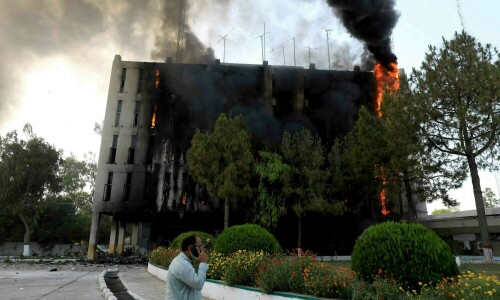
ISLAMABAD: The Supreme Court has asked ex-PTI leader Fawad Chaudhry to approach the Lahore High Court (LHC) to merge all FIRs registered over his alleged involvement in violence on May 9, 2023.
A three-judge bench headed by Chief Justice Yahya Afridi took up Mr Chaudhry’s plea on Thursday.
The former PTI leader had filed an appeal against the LHC’s order issued on May 20, which rejected the plea.
Advocate Faisal Farid Chaudhry, who represented Mr Chaudhry, argued the high court dismissed the plea without perusing the case record and relying upon facts “sourced through AI and social media platforms”.
The petition had also questioned whether multiple FIRs over a single offence violated fundamental rights guaranteed by the Constitution and whether a single trial should be conducted under the doctrine of similarity to ensure fairness and justice.
During the hearing, CJP Afridi observed the court will dictate the order in the presence of both parties to protect their rights.
He then called Punjab Special Prosecutor Zulfiqar Naqvi and Mr Chaudhry to his chambers.
Earlier on April 8, the apex court had ordered the Anti Terrorism Courts (ATCs) to conclude within four months the trials of suspects allegedly involved in violence on May 9.
It also directed the ATCs to submit progress reports on trials to relevant high courts every two weeks.
On Thursday, CJP appreciated that the trial courts were working and the litigants were exempt from attendance in different districts. The CJP reminded Mr Chaudhry he also got an exemption from personal attendance from the LHC.
During the hearing, Mr Naqvi raised objections to the plea, stating the case at the high court was never heard on merits.
The LHC had ruled on the petition’s admissibility.
The Supreme Court also rejected a plea to halt cases relating to May 9 violence until the present case was decided.
The CJP stated the high court will consider and decide whether to stay the proceedings at the trial court or not.
In case the Supreme Court issues any decision, the case of the parties at the trial court may be affected, observed CJP.
The petitioner highlighted that he was primarily alleged to have committed abetment in connection with the events of May 9 and following his arrest, the authorities engaged in a systematic pattern of malafide conduct to substantiate base-less allegations.
The petitioner remained in police custody for nearly six months, during which no meaningful investigation was conducted, nor was his statement recorded as mandated by law, the petition alleged, adding he was booked in 11 “false, frivolous and politically motivated” cases in Lahore.
The petition stated the malafide intent became apparent when all FIRs implicating the petitioner were initiated through complaints lodged exclusively by police officers.
These complaints were registered on identical dates, with the reported times conspicuously overlapping.
The petitioner was not originally nominated in all FIRs. Instead, his alleged involvement was contrived through supplementary statements recorded at later dates, a practice evidently employed to manufacture charges retroactively.
The fragmented and duplicative proceedings across multiple FIRs violated the principles of justice but also subjected the petitioner to undue harassment and prejudice, the petition alleged, adding the failure to consolidate the cases under one trial has compelled the petitioner to approach the Supreme Court.
The fragmentation of cases across multiple stations not only created unnecessary procedural complexities but also subjected the petitioner to “undue harassment and prejudice”.
“Such an approach undermines the principles of fair trial and judicial economy, which demand that justice be administered efficiently and without duplication.”
Published in Dawn, July 11th, 2025