0
0

ISLAMABAD, May 12: Pakistan said on Friday it needed duty-free access to US and EU markets for its products to give a future boost to its economy and help cope with the fallout of the Afghan war on the economy.
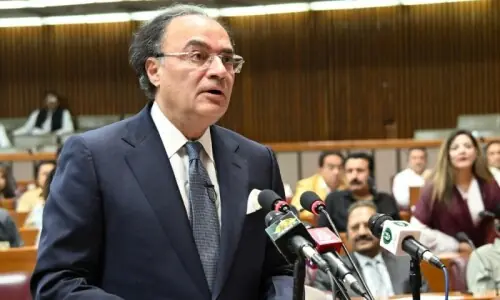
Prime minister’s adviser on finance Dr Salman Shah told an 11-member team from the National War College of the Unites States that the US and EU markets were very vital for Pakistan to further improve its exports.
He said Pakistan and the US were currently negotiating a bilateral investment treaty (BIT) which would ultimately lead to a free trade agreement between the two countries.
Welcoming members of the delegation, the adviser gave an overall view of the economic performance of the country that had witnessed rapid growth and transformation over the last six years.
He said the Pakistan government had taken bold steps by launching structural reforms that had laid the foundations of a vibrant market economy, adding that deregulation, privatisation and liberalisation along with revenue generation reforms had been the hallmark of present economic policies, as a result of which macro-economic imbalances had been removed and economic growth had considerably increased.
“We want to sustain a GDP between six and eight per cent,” Dr Shah emphasized, adding that due to opening up of the economy to private entrepreneurs, telecommunications, manufacturing and banking sectors stood deregulated and privatised.
Dr Shah said the Pakistan economy was now driven by the private sector and the role of bureaucracy in running business enterprises had been eliminated. “The government will now ensure that private entrepreneurs were provided a level-playing field so that they get benefit from their business plans.”
He expressed the hope that the private sector would introduce innovative technologies, latest expertise and knowledge in their business and become the engine of growth and employment generator in the country.
In reply to a question, the adviser said 25 per cent of the population was below poverty line, especially in the rural areas, but the government was committed to developing the rural areas by allocating more funds for socio-economic development of masses.
Dr Shah pointed out that the government had introduced economic reform programmes, including Khushhal Pakistan Fund and community development projects, to provide infrastructure, pure drinking water, sanitation and vocational training institutes to enable the rural population to participate in the overall national development programme.
He said energy and power sectors played a vital role in the development of an economy and for this purpose the government was engaged in dialogue with Iran and Central Asian states and was planning to build road and rail link to Central Asia and develop the Gwadar seaport to provide logistics and communication network.