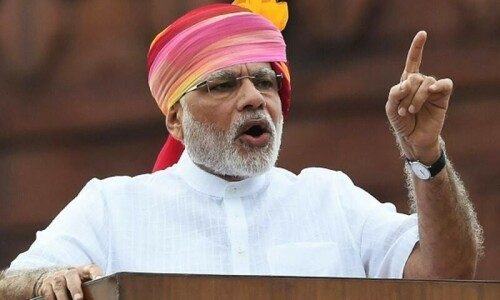
The Foreign Office on Friday categorically rejected the “baseless, provocative, and irresponsible allegations” made by the Indian Prime Minister Narendra Modi, who in a heated speech accused Pakistan of carrying out terrorist attacks in his country.
The military confrontation between New Delhi and Islamabad came as tensions over last month’s Pahalgam attack continued to build up, as India —without evidence — blamed Pakistan for the attack. On the night of May 6-7, India launched a series of air strikes in Punjab and Azad Kashmir, resulting in civilian casualties. Islamabad responded by downing five Indian jets.
After intercepting drones sent by India and tit-for-tat strikes on each other’s airbases, it took American intervention on May 10 for both sides to finally drop their guns and declare a ceasefire. India has since continued its aggressive posturing even as Pakistan has warned against any further military aggression and offered talks.
Yesterday, the Indian premier said that Pakistan would not get water from rivers over which India has rights.
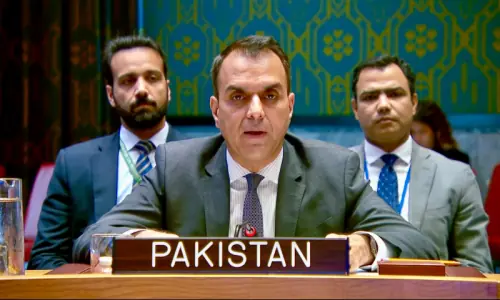
According to a statement issued by the FO on X today, “Pakistan categorically rejects the baseless, provocative, and irresponsible allegations made by the Indian prime minister during a recent public address in Rajasthan.
“The remarks, replete with distortions, misrepresentations, and inflammatory rhetoric, are clearly aimed at stoking regional tensions for narrow political gains,” the FO said, adding that such statements not only reflect a deliberate attempt to mislead the public but also violate the norms responsible statecraft.
“Resorting to threats and boasting about military action against a sovereign nation is a grave breach of the United Nations Charter and established principles of international law,” the FO said.
“This dangerous approach undermines regional peace and stability,” it added.
The foreign ministry said that Pakistan remained a “consistent and proactive partner in the global fight against terrorism”.
“Any insinuation seeking to associate Pakistan with acts of terrorism is factually incorrect and patently misleading,” it continued.
It noted that the Indian premier’s tactic was “often employed to divert attention from India’s own internal challenges”, adding that the Indian attempts to mask its “serious human rights violations” in occupied Kashmir by scapegoating Pakistan were well-documented and increasingly recognised by the international community.
“The plight of the Kashmiri people and their just struggle for self-determination cannot be obscured by aggressive rhetoric and political deflection.”
Pakistan urged the Indian leadership to “exercise responsibility and restraint”, the FO said.
“Escalatory statements and belligerent posturing serve no purpose other than exacerbating tensions.
“Rather than resorting to fictitious narratives and warmongering for electoral mileage, India should demonstrate maturity by resolving outstanding disputes through peaceful dialogue and diplomacy,” the FO noted.
It added that Pakistan remained firmly committed to “peaceful coexistence, regional stability, and constructive engagement”.
“However, our desire for peace should not be misconstrued as weakness,” it said, adding that the people and the armed forced were “fully prepared and capable of defending the country’s sovereignty and territorial integrity”.
“Any misadventure or aggression will be met with a resolute and proportionate response,” the FO added.
It said that Pakistan has demonstrated its resolve in the past and will do so again, if required.
“The international community must take serious note of India’s aggressive posture and hate-driven narratives that threaten regional peace,” it said, adding that it was “imperative to discourage such rhetoric and actions to preserve stability in South Asia”.
“Glorification of conflict benefits no one, and the path to lasting peace lies in dialogue, mutual respect, and adherence to international law,” it concluded.