KLF 2025: Legal veterans lament failure of constitutional institutions to provide fundamental rights


Veteran litigators lamented the failure of constitutional institutions to provide fundamental rights, urging people to “revive the culture of resistance”, on the second day of the 16th Karachi Literature Festival (KLF) on Saturday.
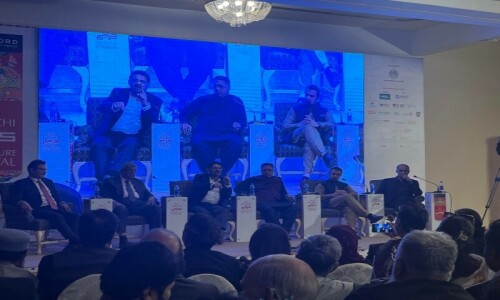
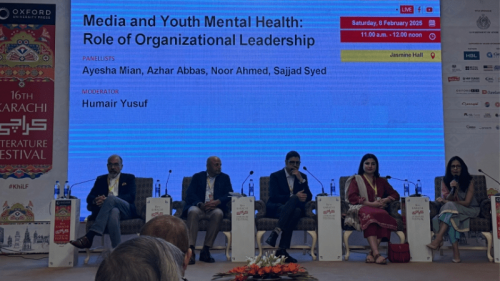
The panel included former Supreme Court Bar Association (SCBA) president Abid Shahid Zuberi, former senator Raza Rabbani, Senator Zamir Ghumro and renowned lawyers Sara Malkani and Salahuddin Ahmed who discussed the topic titled: “We the People: Our Constitution and the Rule of Law.”
On the Constitution’s impact on the public, Rabbani said practical implementation was missing despite continuous discussions on this theme.
“Gradually the culture of resistance in stakeholders, especially civil society, has finished. The result is that the rule of law and constitutional supremacy has been affected,” he added.
Salahuddin Ahmed pointed out that the reason behind the diminishing culture of resistance is that “our constitutional institutions have not succeeded in providing constitutional rights”.
He continued: “Until our institutions — whether it is the parliament, judiciary or executive — meaningfully give and enforce people’s fundamental rights, this [Constitution] will remain an academic concept.”
Sara Malkani spoke on the diminishing relevance of the Constitution. “Constitutions are relevant when the main power structures and power elite accept and own the Constitution and restraint of powers. Our main power structures have not owned the Constitution which is why it has not endured.”
Abid Zuberi discussed the importance of education in this regard. “Constitution and rule of law is not relevant to people until education is there,” he said.
He highlighted that there is a lack of education saying: “The public always accepts constitutional relations.”
Referring to the 26th Amendment, he said, “The way the Constitution has been changed … judiciary has been tampered with, shaking the country’s whole foundation [is lamentable],” adding that the rule of law has ended.
Speaking on the role of the judiciary, Ghumro noted that fundamental rights are affected when the institutions fail to play their role. He said, “Each institution does not play its role … hence, the people must struggle for their rights.”
Responding to a question by the moderator, Rabbani said that the 26th Amendment came much later. “We have always been talking in philosophical terms about the basic structure of the Constitution, trichotomy of power, fundamental rights … but we shy away from the basic question which is the state of Pakistan.”
“When Pakistan came into existence, Quaid had a different vision. The state has turned into a national security state, a garrison state,” he said.
He added, “The primary question is that the civilian ascendancy that was envisioned in 1947 is gone. Civilian ascendency has never been at such a low.”
Ahmed highlighted the role of civilian leaders in the failure of providing rights. He said, “When any power elite has received power, they have not left any opportunity to destroy the Constitution. The ‘victim narrative’ from politicians is also not correct.”
He said that political leaders also came into power with military support adding, “Political parties must move on from this narrative.”
Malkani concluded the session with suggestions to end the “crisis on constitutionalism” in the country. She described the concept of an “elite bargain” which is practised in different countries.
“We should look at other countries like India. There are crises of constitutionalism everywhere. There was also consensus among the power elite to abide by a minimum level of restraint and power sharing in the constitution. It is called ‘elite bargain’ and when it fails, that is where you see the crisis of constitutionalism.”
“Leaders must abide by elite bargain,” she said adding that the Constitution will be relevant when it is allowed to do its job.