Turkish doctors successfully separate 11-month-old Pakistani conjoined twins in marathon 14-hour surgery

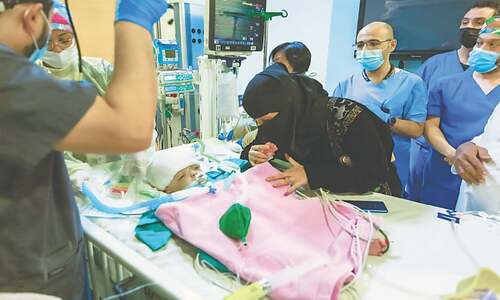
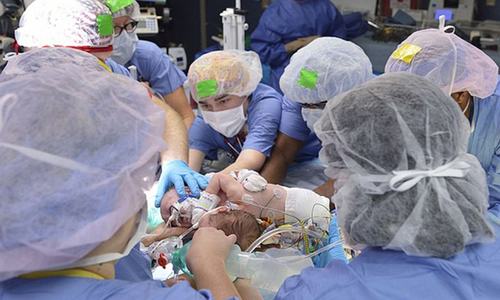
A team of 60 medical professionals in the Turkish capital Ankara successfully separated 11-month-old conjoined twins from Pakistan after complex, two-stage operations lasting some 14 hours.
The twin girls, Mirha and Minal, were born in Pakistan with their heads fused. Unable to find suitable treatment, the family’s plea for help caught the attention of Turkish President Recep Tayyip Erdogan.
After being contacted by renowned London-based pediatric neurosurgeon Owase Jeelani, Erdogan assured Jeelani that the babies’ treatment would be carried out in Turkiye.
The twins arrived in Ankara this May and were placed under close medical supervision at Bilkent City Hospital. The separation was done in two stages. The surgical team was led by Dr Jeelani, along with Turkish physicians Dr Harun Demirci and Dr Hasan Murat Ergani.
The final 14-hour operation took place on July 19, successfully separating the twins, who were conjoined at the skull.
Dr Aziz Ahmet Surel, the hospital’s coordinating chief physician, highlighted the significance of the operation, noting the successful transfer of knowledge and expertise between Turkish and British medical teams.
“Seeing the healthy, smiling faces of the babies now, compared to their conjoined state when they first arrived, is an indescribable joy,” Surel told Anadolu.
Namik Yasar Ozbek, head of the Department of Pediatric Hematology-Oncology at Bilkent City Hospital, emphasised the extensive teamwork involved in the operation.
“The babies had some issues with sitting and hand movements due to their conjoined state. Post-surgery, our neurologists, physical therapists, and neurodevelopmental specialists resolved these issues,” he said.
“The babies are now doing very well, starting to use their hands and arms, and gaining head control. In 10 days, they will celebrate their first birthdays separately,” Ozbek said.
Detailing the process, reconstructive physician Ergani said: “To prevent tissue deficiency after the separation, we first performed balloon tissue expansion surgery. We placed a material in their heads that gradually expanded, increasing the tissue over about two months.”
Ergani also described the meticulous planning for the second surgery to separate the twins.
“When we separated the babies, the tissue to cover the brain was crucial because their brains would be exposed. Any complication could harm the children, so we planned very carefully. On July 19, we successfully separated the twins, sharing the tissue,” he said.
“Seeing the babies healthy now is an incredible joy. When we successfully separated them, the entire medical team looked at each other and applauded. It was one of the most memorable moments of my life,” he added.
Pakistani family expresses profound gratitude
Demirci, a pediatric neurosurgeon, said the babies initially struggled with being separated.
“They were uncomfortable, so we kept them together in the same room and bed for a while. Eventually, they adapted, and their health is now very good. We expect to discharge them in two to three weeks and will monitor their brain and bone development every three months,” he said.
The twins’ parents, Rehan Ali and Nazia Parveen, expressed their profound gratitude to President Erdogan, the medical team, and everyone involved in their children’s treatment.
“We are very happy and indebted to everyone who contributed,” said Ali, adding that they hope to meet Erdogan to thank him personally.
The family was first told in Pakistan that the treatment could not be done. After that, they contacted Jeelani in London and sent him photos of the twins and medical reports, Ali said.
“After reviewing them, Jeelani told us that separation surgery was possible. However, we lacked the financial means for the operation in the UK. Jeelani then contacted President Erdogan, explained our situation, and thanks to him, the necessary arrangements were made, and we were brought here,” Ali added.
Turkish Health Minister Kemal Memisoglu also recently visited the twins to check on their health and convey his well-wishes to the family.
Life-changing surgeries for children worldwide
Speaking to Anadolu about the surgeries, Jeelani highlighted Turkiye’s effort, saying: “They (kids) are in different parts of the world. They don’t have help. Where they are, they contact us in another part of the world. We then contacted Turkiye, and the people of Turkiye as a country said ‘Yes, we will help.’ And then we brought people from different parts of the world to Ankara, did the complex surgeries, and then produced a beautiful result.”
He emphasized that this is a bigger story about global unity.
“This is about how the world should be, where when you have children that need help, the whole world comes together, the whole world supports and you get this result for these children,” he said.
“So for me, I am delighted. A big, big thank you to Turkiye. A big, big thank you to the Ministry of Health and the doctors and the nurses and everybody in Turkiye who helped support this work. It is an example of how we should be doing things,” he added.