Shares jump 673 points on year-end buying, IMF hopes


 1
1

Shares at the Pakistan Stock Exchange (PSX) continued to rally on Friday, with analysts attributing the uptrend to year-end buying and expectations of completion of the International Monetary Fund’s (IMF) ninth review which would boost critically low foreign exchange reserves.
The benchmark KSE-100 index jumped 673.09 points, or 1.69 per cent, to reach 40,420.45 points by the end of trading.
Head of Equity at Intermarket Securities Raza Jafri noted that the government has “belatedly started to comply with IMF conditions, going by the removal of import curbs and reduction in concessionary loans”.
“The market may be taking heart from this,” he said, adding that the element of year-end window dressing could also be at play.
Fund managers use the window dressing strategy — selling shares with big losses and buying ones with large gains — to improve a fund’s performance before presenting it to their clients.
Three other analysts who spoke to Dawn.com also attributed the stock market’s rise to year-end buying among other reasons.
“The primary reason is year-end buying. Institutions buy shares to improve balance sheets,” commented Aba Ali Habib Securities’ Salman Naqvi commented. He said the market also expected the IMF’s ninth review to be completed at the start of the next year, which would unlock inflows from bilateral countries and multilateral lenders in a much-needed boost to Pakistan’s foreign reserves.
“If the review is completed, the chances of default will reduce as countries such as China, Saudi Arabia and the UAE and multilateral lenders such as the World Bank will provide aid and the [economic] situation will improve.
“Shares are available at low rates and investors have been on a buying spree,” he added.
First National Equities Limited Director Amir Shehzad said that while fund managers buying shares to improve their portfolios had led to the index’s uptrend, the major contribution was by the oil and gas sector’s rise following the government’s plans to settle circular debt.
Dalal Securities CEO Siddique Dalal also noted the oil sector’s good performance, saying that Pakistan Petroleum Ltd (PPL) shares were up Rs4.75 or 7.49pc at 2:58pm.
Meanwhile, Oil and Gas Development Company Ltd (OGDCL) shares gained Rs3.59 or 4.7pc.
“One reason for the stock market’s rise is year-end buying. Secondly, the oil sector has gained because of expectations the government will end circular debt next year,” Dalal said.
However, he cautioned the current uptrend was simply a “temporary technical correction” and would not sustain because economic fundamentals had not improved and political instability still remained.
IMF review and circular debt
Pakistan entered a $6 billion IMF programme in 2019, which was increased to $7bn earlier this year. The programme’s ninth review, which would release $1.18bn, is currently pending. It had earlier been put off for two months due to the PML-N-led government’s unwillingness to accept certain conditions placed before it by the Fund, and the disagreements have yet to be resolved.
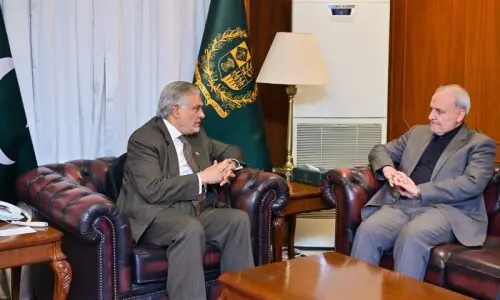
Prime Minister Shehbaz Sharif said earlier this week that the government had “no other option” but to implement the International Monetary Fund (IMF) programme, calling it a “painful reality”. Finance Minister Ishaq Dar also said that Pakistan would fufil its commitments to the IMF.
It is essential for Pakistan to clear the ninth review for the release of $1.18bn, given its low foreign exchange reserves which are barely enough to cover a month’s imports.
The State Bank of Pakistan’s foreign exchange reserves have declined by $11bn during a year. In Dec 2021, the central bank’s reserves were $17.686bn which now stand at $5.8bn as of Dec 23.
Pakistan has to repay at least $13bn in the remaining part of the financial year. But it is unclear when it will receive more inflows from bilateral and multilateral institutions, giving rise to default fears.
A report published by The News last week had quoted government officials as saying the IMF had asked Islamabad to “take actions on account of fixing cash-bleeding energy sector including power and gas, take additional taxation measures and pursue structural reforms in the remaining period of the Fund programme”.
A day earlier, Dar directed the committee constituted for settlement of circular debt in the gas sector to finalise its report within three working days to resolve the issue.
The finance minister emphasised the priority of the government to address issues confronting the energy sector, including circular debt, to bring financial sustainability to the sector and economic growth in the country.