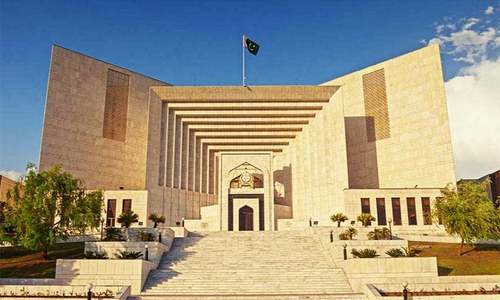
ISLAMABAD: The Supreme Court held on Wednesday that since the government’s amnesty scheme was a beneficial piece of legislation, it must be exercised liberally to help achieve recovery of stuck tax revenue instead of penalising voluntary tax payments.
“The amnesty notification, being a beneficial subordinate legislation, must be viewed liberally in favour of the taxpayer in order to achieve the solitary fiscal objective of quick recovery of stuck tax revenue,” observed Justice Syed Mansoor Ali Shah in a judgment he wrote.
Justice Shah was a member of a three-judge Supreme Court bench, whose other members were Justice Umar Ata Bandial and Justice Sajjad Ali Shah.
The bench had taken up an appeal by the Commissioner of Inland Revenue (CIR) against a Feb 13, 2019, order of the Lahore High Court (LHC). The issue before the apex court was: should the benefit of a June 1, 2012, Statutory Regulatory Order (SRO), or amnesty scheme, be extended to Messrs Mughal Board Industry (the respondent) or not.
In the present case, the respondent (a registered individual) deposited the entire principal amount of the sales tax payable in lieu of an illegally adjusted input tax much before June 1, 2012, when the amnesty notification was issued.
Denial of relief to a registered person would imply that the amnesty scheme penalises voluntary deposit of tax by a taxpayer and adds premium on an intentional withholding of the tax and delay in payment, the apex court observed.
This cannot be the purpose of any taxing law or of any amnesty scheme, the judgement added.
The amnesty scheme, which was introduced by the PPP government, grants exemption from payment of the entire amount of default surcharge and penalties to a person against whom an amount of sales tax is outstanding on account of illegally adjusted input tax provided two conditions are met.
The first is that the whole principal amount of illegally adjusted sales tax was paid by June 25, 2012, and any complaint or proceedings filed by the registered person before any court of law were withdrawn by this date.
End of criminal proceedings
According to the June 1, 2012, notification of the finance ministry, once these conditions are complied with, all criminal proceedings lodged against the taxpayer by the department should also stop with effect from the date of compliance with these conditions.
Since the main purpose of the amnesty scheme is to incentivise payment and collection of stuck tax revenue, what matters is the payment by the cut-off date, the court observed.
It asked the government to welcome any voluntary payment made by a taxpayer before the cutoff date. In any case, extension of the benefit of the amnesty notification to the petitioner ensures a level playing field, it said.
Proceedings were initiated against the respondent for the recovery of default surcharge and penalties by issuance of show cause notice on Nov 20, 2012, the judgment said.
It added that the respondent sought the benefit of the amnesty notification, which came after the deposit of the principal amount of sales tax by the CIR.
But the benefit of the amnesty scheme was denied to the petitioner by the department on the ground that it was only applicable to the registered persons against whom the principal amount of sales tax was outstanding on June 1, 2012.
The LHC, while hearing the sales tax reference filed by the respondent, disagreed with the department’s view and allowed the amnesty scheme’s benefit to the respondent, the judgment said.
Consequently, the high court order was challenged by the department before the Supreme Court.
The Supreme Court observed that a plain reading of the amnesty scheme showed that if the default surcharge and penalties payable by a registered person were outstanding on account of illegally adjusted input tax, the registered person may avail exemption against default surcharge and penalties provided the entire of the principal amount of illegally adjusted input tax was deposited by June 25, 2012, and any case or complaint filed by the registered person against the department was withdrawn by this date.
The contention of the department that the amount of sales tax must be outstanding against the person on June 1, 2012, for the amnesty scheme to apply is not convincing, the judgment said.
The spirit and object of the scheme was to offer ensure a quick recovery of tax revenue.
The notification makes it clear that if only the principal amount of illegally adjusted sales tax is deposited by June 25, 2012, the default surcharge and penalties stand exempted, it said.
The importance is of the cut-off date, June 25, 2012, and there appears to be no bar in the notification and no possible disadvantage caused to the department if the principal amount of the sales tax is deposited before the date of the amnesty notification, the judgement said.
Moreover, the respondent deposited the principal amount of sales tax before June 1, 2012, and has not filed any case against the petitioner department except the instant case, hence the respondent successfully meets the conditions of the amnesty notification and is, therefore, entitled to its benefit, the Supreme Court added.
‘Any other interpretation of the amnesty scheme will lead to anomalous results.”
In such a situation the taxpayer is encouraged to withhold the principal amount of sales tax, draw benefit on it till the last date and then deposit the same to avail the benefits of the amnesty notification.
However, on the other hand, in the present case, the petitioner, in the absence of an amnesty scheme, voluntarily deposited the entire principal amount of illegally adjusted input tax before the cut-off date of June 25, 2012, while the amnesty scheme was notified subsequently.
The Supreme Court dismissed the appeal with an observation that no justification was made out to deny the benefit of the amnesty notification to the respondent taxpayer.
Published in Dawn, January 27th, 2022