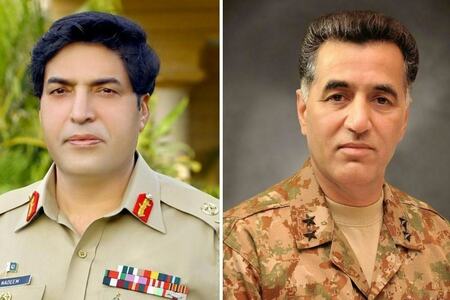
THE much-vaunted ‘one page’ appears increasingly frayed. It has been a week since matters have been in a slow-burn mode between the military and the government over the posting out of Lt Gen Faiz Hameed as DG ISI and the appointment of a new army officer in his place.
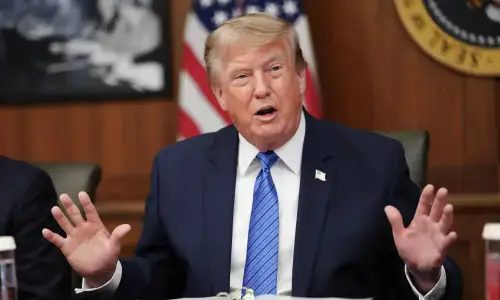
Simply put, Prime Minister Imran Khan does not want Lt Gen Hameed transferred; in fact, he told the federal cabinet on Tuesday that the precarious situation in Afghanistan demanded that the ISI chief stay on for some time. A routine procedural matter has now escalated into a lack of consensus over whom to appoint in his place, and how to do so.
A press conference by Information Minister Fawad Chaudhry, also on Tuesday, said the matter had been ‘resolved’ following another meeting between the army chief and the prime minister and that the government would follow the “legal and constitutional procedure” in appointing the next DG ISI. Given that the ISPR announced last Wednesday that Lt Gen Nadeem Anjum was to be the new ISI chief, is the minister implying there is a question mark on the legality of the army chief or ISPR’s actions?
Read more: What is the process of appointing Pakistan's spymaster?
Defence analysts tend to agree that it is indeed the prime minister’s prerogative to select one among three options the COAS puts to him as the potential DG ISI. The army chief can of course convince him about the need to rotate his three-star generals, including the ISI chief, and advise him on who would be the better choice as a replacement. At the same time, the fact is the prime minister has consistently ceded space to an institution he sees as a critical supporting pillar for his government. That leaves him in a weak position to assert his jurisdiction, that too in a matter the military considers its domain.
Civilian authority must be guarded jealously in a country with a history of political interference by unelected forces; ceding space is a slippery slope that empowers one side even as it inexorably diminishes the other.
At its core, the prevailing tension is the result of the almost unprecedented blurring of institutional boundaries witnessed since the PTI government came to power. Breaching of constitutional limits weakens the state by sowing suspicion and division amongst its various organs. It is high time the ISI narrowed its scope of work to its original mandate — that of external security. Equally, civilian governments must stop looking to the ‘third umpire’ for reinforcement, even survival.
Read more: Stand-off on ISI chief's appointment has exposed growing gap between civil-military leadership
Not many will be taken in by Mr Khan’s contention that he wanted the same DG ISI to remain in office because of the Afghan situation. It is worth asking why a prime minister who claims to be elected by millions of his countrymen and women believes his destiny and that of his government are so closely linked with a single individual.
Published in Dawn, October 14th, 2021