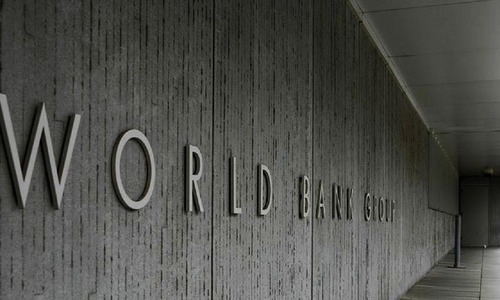
World Bank sees uptick in global growth, but warns of trade risks


 2
2


WASHINGTON: The World Bank says the global economy should see a modest rebound in growth this year.
But the 189-nation lending institution is cautioning that a number risks could upend its forecast, including the possibility of renewed trade hostilities between the world’s two biggest economies, the United States and China.
In an updated economic outlook released Wednesday, the World Bank forecast the global economy will grow 2.5 per cent this year, up only slightly from 2.4pc growth in 2019. That had been the weakest performance since the 2008 financial crisis and a significant slowdown from growth rates above 3pc in 2017 and 2018.
The bank’s revised outlook represents a downgrade from its last forecast in June when it had expected growth to be 0.2 percentage-points higher this year. The forecast also trimmed its expectation for global growth by 0.2 percentage points over the next two years to moderate rates of 2.6pc in 2021 and 2.7pc in 2022.
Downside risks persist. The recovery is fragile, said World Bank Vice President Ceyla Pazarbasioglu. Uncertainty has weighed on confidence, trade and investment which are all critical for growth.’ For the United States, the World Bank sees gross domestic product growth slowing from 2.3pc in 2019 to 1.8pc in 2020 and then slowing further to 1.7pc in both 2021 and 2022.
Those growth rates are significantly below the 3pc plus growth President Donald Trump has promised to deliver with his economic programme of tax cuts and deregulation.
For Europe, the World Bank has an even gloomier outlook. Last year’s minuscule 1.1pc growth is expected to be followed by further scant gains of 1pc this year and 1.3pc in both 2021 and 2022.
The new forecast projects China, the world’s second largest economy, will grow at steadily slower rates of 5.9pc this year, 5.8pc next year and 5.7pc in 2022. That would mark the slowest growth period for China since the early 1990s.
Economic growth in both China and the United States has been impacted by the uncertainty generated by the punitive tariffs both countries have imposed on each others goods.
Growth for all advanced economies is expected to slip to 1.4pc this year, down from 1.8pc last year, reflecting continued softness in manufacturing in many parts of the world that has caused businesses to pull back on their plans to expand and modernise production facilities.
Growth in emerging economies is expected to accelerate to 4.1pc this year, but the acceleration will not be broad based. A rebound is forecast for a group of larger economies including Argentina, Brazil and India which are expected to recover this year after a period of substantial weakness.
Published in Dawn, January 10th, 2020