0
0

 KARACHI, June 28: Perturbed by unannounced load-shedding and frequent power failures, Karachiites are now seeking alternative power gadgets such as uninterrupted power supply (UPS) and power generators, to cope with the situation.
With the entry of locally-made UPS, customers at electronic markets were reported to be confused while choosing between a generator and a UPS for their houses.
As there is no firm data available to indicate production and sales figures of UPS in the country, it is, therefore, difficult to analyze the quantum of current demand for UPS. However, the demand for generators can be ascertained from monthly import figures of the Federal Bureau of Statistics.
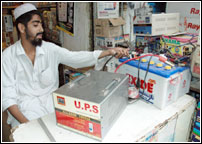
A general purpose UPS, capable of running two bulbs/tubelights and two fans, is available at Rs4,500-5,000 in the market with a guarantee of six months for transformer, but the problem is that the buyer has to arrange a new battery so that the UPS could last for three to four hours. Battery prices vary depending on ampere power. For three fans and three tubelights, the price of a UPS is Rs8,000, without battery. For running an air-conditioner, the price of UPS is Rs85,000 and the buyer has to arrange three batteries for running the AC for just one hour.
During a visit to the Arambagh area at Shahra-e-Liaquat, this reporter saw a few buyers of UPS. A shopkeeper, however, insisted that the frequent power breakdowns had pushed up the demand for UPS in the market.
Abdul Rafay of Al Rehman Electronics said that UPS had not attracted many buyers because with a battery the UPS became expensive and out of the reach of an average customer. “Those who can afford are buying UPS with battery even if the price is more than their expectations.”
He says people in large number do enquire about the UPS but only a few buy it. Acquiring a UPS means that a customer will get a relief of two to three hours in times of power failures.
The UPS is manufactured exclusively in Lahore. There is no manufacturing company of UPS in Karachi, a shopkeeper told Dawn.
On the other hand, the generator market has under gone a transformation in the last one or two years, thanks to the entry of cheap Chinese generators.
The market is now flooded with Chinese generators. Japanese generators are qualitatively superior but the price difference is too stark. There is a marked price difference between Chinese and Japanese brands. The quality conscious buyers still prefer Japanese generators.
A 500-watt Japanese generator is priced at Rs24,000 as compared to Rs4,000-4,500 for a Chinese generator. The price of a one-KVA generator of Chinese brand ranges between Rs6,000 and Rs8,000, as against Rs26,000 for a Japanese generator.
Similarly, a two-KVA Japanese generator can be purchased at Rs38,000, as against Rs12,000-20,000 for a Chinese generator, depending on make and quality.
“Everybody can now buy a generator. It was not like this a few years back,” Karachi Machinery and Generator Importer Group President Sikandar Shahzada said.
About the quality of Chinese generators, he admitted that Chinese generators lack quality as compared to Japanese generators, but the low price factor was luring the buyers. Chinese generators some times create problems but they are repairable, he added.
Mr Shahzada said Chinese generators were being imported in huge quantities. “The smuggling of generators has stopped in Karachi, but it is flourishing in Punjab and other parts of the country.”
However, a dealer at the generator market presented a dismal picture of Chinese generators, saying that they are virtually nuisance both for buyers and sellers because of their poor quality.
“Despite substandard quality, Chinese generators have captured 85-90 per cent market share just because of low price,” he said, adding that Chinese generators are not long lasting. “Power generator is much better option than UPS,” he adds.
The import of power generating machinery in May 2005 stood at $36 million as compared to $26 million in May 2004. In July-May 2004-05, the import surged by 35 per cent to $338 million from $250 million in the same period of 2003-04, FBS figures show.