0
0
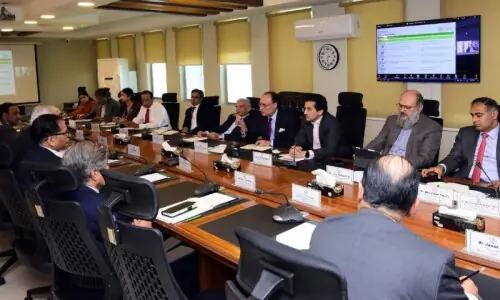
THE Election Commission of Pakistan (ECP) used Results Transmission System (RTS) developed by Nadra for the first time for the recent polls. Through the RTS, the presiding officers were supposed to forward their results to the returning officers. The combined results of various stations should have been sent to the ECP as verified and complete.
Unfortunately, because of the huge quantity of data and transmission load, the RTS collapsed. Therefore, the ECP was unable to receive polling results and was therefore in no position to issue complete, authentic polling results on time.
RTS is a centralised database server. In centralised databases, there are many disadvantages like a single-point of failure, a huge quantity of data transmission and storage, data handling load, etc.
I felt sad on this mishap because Pakistan is full of talent, yet our government relies on the conventional voting system. All over the world, distributed e-voting system is used. Distributed means we do not store data at one place. Instead, we have distributed servers and because of this, computational and storage load is divided among servers. Therefore, the system becomes efficient and reliable.
Blockchain is a hot topic nowadays, specifically for distributed servers. Blockchain is a public ledger which stores data publicly. It is peer-to-peer distribution network. It provides privacy to the user and credibility to the stored data through cryptographic schemes.
This technology has an impact on almost every industrial and public sector application such as finance, energy, and healthcare. I believe blockchain has the potential to conduct elections and make the voting process secure, transparent, trustable and immutable (meaning nobody can change once vote is cast by voter).
Although Pakistani researchers are working on this technology and have the capability to develop such systems, unfortunately in Pakistan technology is talked about in news, books and research articles. There is no practical use.
Nadra and the ECP should find a technical solution and develop an e-voting system by using blockchain.
Kashif Inayat
Research Assistant
Hongik University, South Korea
Published in Dawn, August 7th, 2018