Saudi Arabia to buy Russian S-400 defence systems, other arms


Saudi Arabia signed on Thursday preliminary agreements to buy S-400 air defence systems and receive “cutting edge technologies” from Russia during King Salman's landmark visit to Moscow, the Saudi military industries firm said.
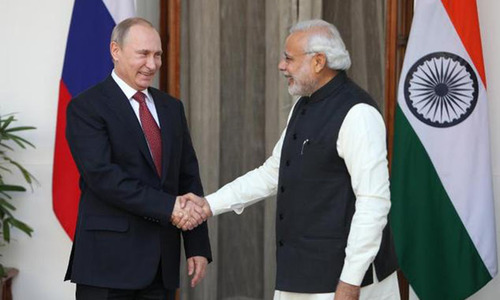
The agreement was announced as King Salman, who is on the first official trip to Russia by a Saudi monarch, and Russian President Vladimir Putin held talks at the Kremlin.
Under the agreements, Saudi Arabia is set to buy S-400 air defence systems, Kornet anti-tank guided missile systems and multiple rocket launchers. These agreements are “expected to play a pivotal role in the growth and development of the military and military systems industry in Saudi Arabia,” Saudi Arabian Military Industries (SAMI), the state's military industries firm said.
“The memorandum of understanding includes the transfer of technology for the local production” of the Kornet anti-tank guided missile systems, advanced multiple rocket launchers and automatic grenade launchers.
“In addition, the parties will cooperate in setting a plan to localise the manufacturing and sustainment of parts of the S-400 air defence system,” SAMI said.
The two countries also agreed on the production in Saudi Arabia of the Kalashnikov automatic rifle and its ammunition as well as educational and training programmes for Saudi nationals. “These agreements are expected to have tangible economic contributions and create hundreds of direct jobs,” the company said.
They “will also transfer cutting edge technologies that will act as a catalyst for localising 50 per cent of the Kingdom's military spending.”
Rosoboronexport, Russia's state-owned arms exporter, had no immediate comment on the agreements.
The first official trip to Russia by a Saudi monarch will also see the leaders of the world's largest energy exporters discuss an extension of an OPEC agreement to cap oil output.
“I'm sure your visit will boost the ties between our countries,” Putin said. “We aim to strengthen our relations in the interests of peace and security, in the interests of developing the world economy,” the Saudi king responded.
'Positive cooperation'
Citing Russia's energy minister Alexander Novak, the Financial Times reported that Russia and Saudi Arabia were expected to sign deals worth over $3 billion (2.5 billion euros), including a $1bn energy investment fund and a $1.1bn agreement for Russia's petrochemicals giant Sibur to build a plant in Saudi Arabia.
Russia and Saudi Arabia are heavily dependent on oil exports and the global plunge of the price of crude that began in 2014 lashed both their economies. OPEC members have joined with Russia and other countries in cutting crude output in a pact that has helped prop up prices.
Putin said on Wednesday it was possible to extend an OPEC deal to cap oil output “at least until the end of 2018”. The current agreement runs until March 2018.
“We strive to continue the positive cooperation between our countries to achieve stability on world oil markets which promotes the growth of the world's economy,” Salman said in Moscow.
The leaders held one-on-one talks, followed by broader discussions. Once they sign the expected deals, Putin will host a state dinner for Salman. “The political will of Moscow and Riyadh for deeper cooperation on the widest range of issues is clear,” Putin's spokesman Dmitry Peskov told journalists ahead of the meetings.
Awkward start
The 81-year-old Saudi monarch's three-day visit got off to an awkward start on Wednesday evening after landing at Moscow's Vnukovo-2 airport when the escalator he uses to descend from his plane malfunctioned.
The escalator stopped midway, forcing the king to walk down himself, to be met by Russian officials including deputy prime minister Dmitry Rogozin and a military brass band. His delegation of around 1,000 people occupied all the available hotel rooms in five-star hotels around the Kremlin, including one entire hotel, state RIA Novosti news agency reported.
Salman arrived in Moscow along with Saudi Energy Minister Khalid al-Falih, Foreign Minister Adel al-Jubeir and Minister of State Musaed al-Aiban.
The head of Saudi's state-owned oil giant Aramco Amin Nasser told Rossiya 24 state television ahead of the talks that the company would sign agreements with Russia's Gazprom, Gazprom Neft and Sibur energy companies as well as with an affiliate of Lukoil.
Discord over Syria, Yemen
The Kremlin said ahead of the visit that Salman and Putin would also discuss the Middle East, “especially focusing on conflict situations in the region.” While Russia and Saudi Arabia are partners on the oil market, they are at loggerheads on Syria, where Moscow supports President Bashar al-Assad and Riyadh backs the opposition.
They also diverge on Yemen, where a Saudi-led coalition has been bombing Huthi rebels since 2015, drawing criticism from Moscow. Putin visited Riyadh in 2007 and last met Salman in Turkey in 2015. Salman said he last visited Russia in 2006, before becoming king.